Google+
Showing posts with label Hindu Mythology. Show all posts

Sunday, February 3, 2013

Pralaya - The End of the Earth


Some say the world will end in Fire; Some say in Ice,
From what I've tasted of desire,
I hold with those who favor Fire.
But if it had to perish twice,
I think I know enough of hate,
To say that for destruction,
Ice is also great!

End of the World - How does the phrase sound to you?

For me it conjures up something abstract.. an inconclusive conclusion fashioned from the catastrophe-centric best-sellers churned out of Hollywood and the Doomsday predictions of a few ancient mythologies.

God decides to End our Days
Assuming that it happens within our lifetimes, how would the world end indeed? A lot of people believe, it would happen because of a Nuclear War.

A very plausible scenario a decade ago but currently the chances of that seem a little less. It may still come to pass as we have varying degrees of religious fanatics running around the globe with secret stashes of atomic-missiles obtained through illegitimate means.
 
A Nuclear Cloud obliterating Life

Others believe, the world would end because of a Meteor crash.

This again is a possibility as there are loads of meteors hurtling past Earth everyday in their journey around the Sun. From time to time, one or the other of these meteors keeps scaring the scientists with its proximity to Earth. It has happened in the past (when the Dinosaurs were wiped out 65 million years ago) so the chance of that happening again can not be ruled out!

Armageddon Arrives
Armageddon Arrives
Others, believe in Global Warming or Earthquakes triggering a Great Deluge that would submerge the entire landmass and drown everything in its colossal Tsunamis.

This again is a decent possibility since we have been observing the melting of Antarctic Ice sheets and frequent Earthquakes in the sea-bed. The Tsunamis that hit south-east Asia few years back reminded us of how fragile our relationship with nature is!


Drowning of the Earth

All these, I must confess, are possible and extremely PROBABLE events that may happen anytime in our future. 
Yet, as mentioned by Robert Frost in the beginning of this post, I believe its Ice that is destined to wipe out the entire civilizational progress of Humanity and that too in a not too distant future!! There is a reason why My preferred Modus Operandi (if you can call it that) of Destruction is ICE and in the current post, I'll share with you descriptions from ancient scriptures to support the argument.

End of the World in Hindu Mythology
Strictly speaking, Hindu Mythology does not believe in a SINGLE event of destruction of the World, or even a SINGLE event of creation for that matter.

  Time in Hinduism, is not Linear i.e. it doesn't start and end at specific points, rather, it is Cyclical and never-ending. This eternal cycle of Life and Death; Birth and Re-birth; Formation and Dissolution is called the Kaal-chakra or the Wheel of Time.

The Cyclical Destruction of the World as we know it, occurs in events singularly known as a Pralaya  that takes place at the end of a Chatur-Yuga. A cycle of Four Yugas is known as a Maha Yuga or a Chatur-Yuga and at the end of this cycle, our Earth experiences a cataclysmic event which has the capacity to wipe out all life from the face of the planet.


life of brahma
Ancient Puranas detail this concept further and describe different types of Pralayas:
  • A Pralaya at the end of a Chatur-Yuga (every 4.32 Million Solar Years), 
  • Manvantar Pralaya at the end of the rule of each of the Manus (every 307 Million Solar Years), 
  • Naimittik Pralaya at the end of the Day of Brahma (4.32 Billion Solar Years) and lastly,
  • Prakritik Maha Pralaya at the end of Brahma's Lifetime (311.4 Trillion Solar Years)!
Leaving the latter three for later, let us first see how the tiniest of these, the Pralaya looks.


Description of Pralaya

In various Puranas, the description of Pralaya that happens at the end of a Chatur-yuga is extremely applicable to what is referred to as the Great Deluge in Biblical and Koranic references.

In these as well as the Hindu legends of Manu, entire Earth was inundated by Water which swallowed up the land and gobbled up most living as well as non-living things surviving on it. In all the three traditions, ONE Man was chosen by God to continue the legacy of Human race.

In Hinduism, this man is Vaivasvat Manu and in Biblical references he is called Noah. We have learnt more about him already in a previous post {The Story of Manu - The First Man}.
The belief in a Great Deluge is not limited to the three above mentioned religions alone.. it was widely believed by a lot of ancient mythologies as well viz:

  • In Sumer and Babylonia Atrahasis, Ziusudra, Xisuthrus and Utnapishtim are the different heroes credited with the same feat as Manu. Each of these is credited hoarding with cattle, wild animals and birds on the boat to constitute “the seed of all living creatures” in the next Eon.
  • According to Tibetan legends, Tibet was almost totally inundated, until the god Gya drew off the waters through Bengal, and sent teachers to civilize the people, who repopulated the land.
  • In the Ifugaos of Philippines and the Kammu of Thailand, a brother and sister were the only survivors after the flood and they were responsible for populating the Earth with different races.
  • For the Batak of Sumatra, the giant snake on whose head Earth rests, Naga-Padoha (Hindu Shesh-Naag?), grew tired of its burden and shook it off into the sea. But the god Batara-Guru caused a mountain to fall into the water to preserve his daughter and the human race is descended from her.
  • In Egyptian mythology, Set sent forth the deluge to destroy the evil Sebau, the Sami, the Apap-dragon ( Hindu Vrtra) and the long-armed ones. There is another story, about Horus steering his ark across the cosmic ocean as six poles are capsized leaving only the seventh one as dry land, upon which he rested.

Egyptian god Horus in his ship


  • In the Greek myths, Zeus sends a flood to destroy all of humanity but Prometheus warns his son, Deucalion, about the coming deluge, and advises him to build an ark.
  • In Norse mythology, the flood occurred at the dawn of time before the world was formed. Ymir, the first giant, was killed by the god Odin and his brothers and his blood drowned almost the entire race of giants with the exception of the frost giant Bergelmir and his wife. They escaped in a ship and survived, becoming the progenitors of a new race of giants. 

The Frost giant Bergelmir

  • According to the Quechua Native Americans, a llama tells his human owner about an impending flood and saves him; for the Mayans, the gods used a flood to destroy the wooden people, an early imperfect version of humanity.
  •  Similar beliefs are echoed by the Shaur of Andes, the Caddo of Texas, and the Hopi.
  • The Michoacan of Mexico have the same story as Manu and the hero here is a guy called Tezpi. The Tarahumara and the Toltecs of Mexico also have their own versions of the flood myth.
  • The Nahua of central Mexico talk about a man known as Nata (“Our Father”) and his consort Nene who were protected by their God at the time of flood while the Mixtec  of northern Oaxaca, Mexico believed that the earth was once well populated, when mankind committed a magical fault for which they were punished by a great deluge. 

 A Native American survivor of the flood
 A Native American survivor of the flood


  • In New Guinea legends, Lohero and his brother were angry with their neighbors, so they put a human bone into a small stream. Soon a great flood came forth, and the people had to retreat to the highest peaks until the sea receded.  
  • In Africa, the Kwaya residing around Lake Victoria believed that the ocean was once enclosed in a small pot kept by a man and his wife which was by mistake shattered by their daughter-in-law, and the resulting flood drowned everything.
  • The Yoruba of southwest Nigeria talk about an adro-gynous god Olokun who in a fit of rage, destroyed nearly everybody in a great flood. 

Olkun, the Orisha who flooded Earth


  • For the Vogul after seven years of drought, the Great Man counseled the other giants to make boats from cut poplars, anchor them with ropes of willow roots 500 fathoms long, and provide them with seven days of food and with pots of melted butter to grease the ropes. Those who did not make all the preparations perished when the waters came. 
  • In North-central Siberia, Yenisey-Ostyak believe that during the seven day flood some people and animals were saved by climbing on floating logs and rafters. A strong north wind blew for seven days and scattered the people, which is why there are now different peoples speaking different languages.
  • According to Tuvinian tails of Mongolia, the giant frog (or turtle) which supported the earth moved, which caused the cosmic ocean to begin flooding the earth. An old man who had guessed something like this would happen built an iron-reinforced raft, boarded it with his family, and was saved.

There are hundreds more from around the world, from various tribes and cultures, and so this is just a handful. What could have caused these Geographically separate civilizations to form such a common belief?

The answer according to me, rests in Ice, or more specifically, the Ice-Age. It is MORE than likely that all the above myths refer to the same phenomenon, one which we scientifically KNOW to have taken place - that of the Ice Age.

There have been at least five major ice ages in the Earth's past. The earliest well established ice age, called the Huronian, formed around 2.4 to 2.1 Billion years ago and the latest one started about 2.58 million years ago when the spread of ice sheets in the Northern Hemisphere began!

Since then, the world has seen cycles of glaciation with ice sheets advancing and retreating on 40,000 and 100,000 year time scales called Glacial periods, and Glacial retreats called the Interglacials. We are currently in an interglacial, and the last glacial period ended about 10,000 years ago.

Extent of the previous Ice Age


The Arctic region had a temperate climate, quite conducive to the growth of plant and animal life before the Ice-Age set in. In the same post, I also mentioned the possibility that at least some of the Vedic seers and magi had lived in the Arctic area in close proximity to their Gods who dwell on Mount Meru.

But everything changed 20,000 years ago when extensive ice sheets covered large swaths of Northern and Southern Hemispheres. Consequently, whatever civilizations were existing before, were forced to migrate to warmer places or perish.


North Pole during the last Ice Age


But that was not all, the real trouble would have begun when ALL this Ice began to MELT!
During Ice-Age, water was taken from the oceans to form the ice, thus Global Sea-levels must have dropped, forming bridges between land-masses for animals to migrate. However, during Deglaciation, or Meltdown, the ice-water returned to the oceans, causing the SEA-LEVEL to rise by as much as 110-120 meters!!


Pre-glacial US coastline
Pre-glacial coastlines in Australia
Pre-glacial US coastline
Pre-glacial India and S-E Asia

And what can be the result of such a meltdown?? Of course we get what is theologically labeled as The Great Deluge!!

Throughout our history, the busiest cities have been located either on the banks of mighty rivers or near busy coastlines. All the melted ice lead to a RISE in sea-levels, inundating huge chunks of land and ALTERING the shape of the planetary landmass.

Consequently, there would have been wide-spread displacement of people and populations leading to probably the BIGGEST catastrophe in the History of Human civilization. No wonder then, that mythologies from such different parts of the World narrate the same story!!
The existing hubs of civilization were inundated and the tracts of land connecting different continents too got submerged altering the course of our history. A case in point is the Bering Bridge which was the landmass connecting Russia to America.


The Bering Strait replaced the bridge of land connecting Russia to America
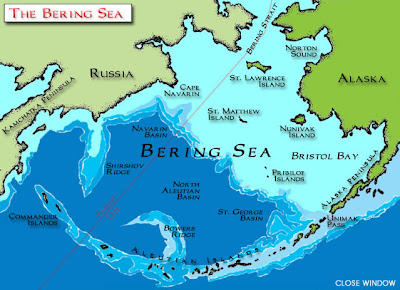


This small tract of land performed a vital function as numerous species of animals, as well as the ancient humans migrated to and populated the American continent through the same bridge!


The Migration route of Homo sapiens into America


If the inundation of such a tiny piece of land could have such immense effect, imagine the condition when major civilizational hubs on the planet would have undergone submersion under the super-massive TSUNAMIS!!

As such a catastrophe would lead to major uprooting of people and populations all over the world, it can very well explain the presence of the SAME LEGEND in widely differing Geographical locations! 


Water reclaiming Land during the recent Tsunami
The flood waters would wipe clear all evidence of civilization from the face of Earth leaving only a few stranded pockets at the highest altitudes of the Planet! One such place is Manali high in the Northern Himalayas where the Ark of Vaivasvat Manu is believed to have docked.

There are other explanations given by the scientific community for the Great floods, ranging from Meteor crashes to Volcanic eruptions.. However, it is the CYCLICAL nature of the Ice Ages along with their capacity to generate GLOBAL FLOODS that prompts me to co-relate them with the Pralaya myths from Hindu Mythology!

And as far as cyclicity goes, already, many scientists predict a coming of the next Ice Age as we may have reached the end of the current period of Interglacial interval. The predictions have created a lot of debate and not surprisingly, there have been movies based on the same theme.



Pralaya - The End of the Earth


As each grain of Time is destroyed, the next comes along and brings with it either Creation or Destruction. The eminent Austrian Physicist Fritjof Capra, in his monumental and path-breaking work called {The Tao of Physics}, calls it the Dance of Shiva.


Tandav - the Cosmic Dance of Shiva
Everything we amass in this life will all be taken away one day by the hands of Time. The same thought must have inspired Oppenheimer, Father of the Atomic Bomb to quote Lord Krishna, from the Bhagvad Gita - Time, I am, the Destroyer of All.

The sooner we realize the transient nature of all existence and start on the Path of Spirituality, the easier it would become to deal with that Final Moment in the End. I conclude this post with the same sentiment expressed in the words of a 6th Century Sanskrit Poet Bhartrhari:


A Hundred Years complete our span,
And Half of that is passed in Night,
Childhood and Old-age devour the Half,
Of what belongs to Light.
The rest is torn with parting pangs,
Of ceaseless toil the Slave,
What profit is our Human Life,
Unstable as a Wave.

Our Bloom of Youth decays,
Our Joys are brief as lightning flash,
And in Summer's cloudy days,
Our riches fly away and crash.

Faith in the One Supreme,
Alone will bear us over the Chasm,
Of Existence's Stormy Stream,
And Maya's elaborate Phantasm.

Tuesday, November 27, 2012

Maharana Pratap


Maharana Pratap, the eldest son of the founder of Udaipur Maharana Udai Singh was born to Sonagari Queen Jayawanti on Jyestha Sudi third day of Vikram Era 1597 (i.e. May 9, 1540) Sunday at 47 Ghati 13 Pal past sunrise. Born is Ardra Naksatra, his birth was considered not only auspicious but the astrologers also made the prediction that the child will bring shining glory to the name of the clan.

He was initiated into education and leasing worthy of a prince and, when adult, he mastered the skills in the use of arms and weapons including horse riding. But owing to mutual jealousy among the queens of Udai Singh, he was deprived of his father’s have and affection, and was forced live in a village below the ridge of Chittorgarh. His maternal grand father Akheraj Sonagar (pali) had died in the battle of Sumel Girari in 1600 Vikram Era. Thus, neither he received the from his father nor did he get maternal grand father’s care for long.

First Marriage of Pratap and Founding of Udaipur
At around age of 17 years Pratap was married to Ajabade, the daughter of Rao Ram Rakh Panwar. Amar Singh was born to her in the month of Chaitra Sudi 7, Thursday of Vikram Era 1613 (i.e. 16 March, 1559). At this time Maharana Udai Singh had gone to Ekaling Ji for Darshana (holy Vision of the lord) and from there he moved towards village Ahar in the cause of hunting. After consultations and discussions with his chieftains and advisers he started construction of a palace and establishment of a city towards the north of present day Udaipur the ruins of which exist to-day, known as Moti Mahal

Hero of the Age – Maharana Pratap
The Third Saka (Supreme Sacrifice) of Chittor and Pratap
When emperor Akabar evivaded Chittor in 1967, Maharana Udai Singh abandoned Chittorgarh following the advice of his chief cans and Generals. Though Pratap desired to stay back and protect the fort but the chief fans and Generals did not agree to expose the future king of Mewar to the jows of death and sent him to mountains alongwith his father on the night of 23 febuary 1568 the last Jauhar (a ritualistic self emulation by the women in order to protect their chastity and honour before their warrior husbands march for the final and last assault) was organized and in the morning of the following day the warriors threw open the Fort gates and wade the supreme sacrifice (the Saka, in popular lane). With the fort fell to the hands of Akabar. Akabar not only ordered the killing of innocent residents women and children but also offended sentiments of Hindus by destroying and desecrating the temples and idols in the fort.

This incident of Jauhar and Saka at Chittor made a deep impression on the heart of Pratap. He was full of hatred for Akabar who indulged in this merciless killing. The Supreme Sacrifice made by the women and the warriors for upholding the honour and respect of their nation family, clan and religion because the source of expiration for Pratap to resolve for a struggle ful life
Repression of the Vagadiya Chauhans
Pratap first demonstrated his bravery by attacking the Vagadiya Chauhans. In the battle at the banks of Som river Karansi the cousin of Rana Sanwaldas was killed. Being defeated the Vagadiya Chauhans Conceded a large part of Vagad lard to Mewar. This enhanced the fame of Pratap and the attention of the common masses and feudal heads started centering towards the browsing of Pratap.

Coronation of Pratap
Living for a while in the difficult mountain terrains at Kumbhaner alongwith his father, Pratap made his residence at Gogunda where Maharana Udai Singh died on 28 Feb.,1572. In accordance with the desire of Bhatiyani queen Dheer bai, Maharana Udai Singh had declared his son Jagamal as his heir apparent but despite strong desires of the queen and the Maharana, Jagamal could not realize his dreams. After the death of the Maharana Jagamal occupied the Royal Throne but he did not participate in the funeral rites the former ruler of Gwalior Ram Singh Tanwar enquired about Jagamal after which the noble heads came to know about Jagamal having been made the heir-apparent. At this point Man Singh Sonagare, the maternal uncle of Pratap raised objection and said to Rawat Sanga ( the predecenor of Devagarh nobles) – you Belong to the clan of Chunda therefore, this ought to have been decided after consultation with you. Then, Rawat Krishna das and Rawat Sanga said – “pratap is the eldest son, and worthy also, hence, he will be the Maharana.” After completing the last rites, the noble chieftains made Pratap to occupy the Royal Throne and spoke to Jagamal – “In your capacity as the younger brother, your seat is in front of the Royal Throne”. Thus, on 28 feb, 1572- the day of Holi Pratap’s coronation was performed at Gogunda Afterward, the coronation ceremony was celebrated at Kumbhalwer which was attended by Rao Chandra Sen (Jodhpur) the brother-in-low (Sister’s husband) of Pratap as Nell.

Making Kumbhalmer and Gogunda as centres, Pratap started ruling over Mewar. He conquered the CHHAPPAn area, defeating the rathors, then he ensured full protection of entire Godwad and the Arawali ranges. At that time, the territories lying to the North-east and South-east of Mewar had fallen to the hands of Akabar and almost all the kings of Rajasthan had accepted authority of Akabar, the only exception being Pratap who never bowed his head before the emperor. After Pratap’s coronation, Akabar kept sying over his activities for one year. Hoping that Pratap too will follow the path of other kings and will himself join the Royal service but this did not happen and Akabar decided to send emissaries to Pratap to prevail upon him

Akabar Sends three Emissaries to make Pratap accept his authority
First of all, at the orders of Akabar, Prince Man Singh Kachhawah came to Pratap lowing Gujarat in april 1573 and traveling via Eedar and Dungarpur, Pratap come to Udaipur from Gogunda and extended an affectionate wel-come to Man Singh near Udaipur. Though, Man Singh tried his best to prevail upon Pratap to come to the Royal court but Pratap did not agree. Tension developed between the two at the time of taking food and maan Singh left angrily and reported the mother to Akabar. On eruption of rebellion again in Gujarat, Akabar invaded Gujarat and suppressed the rebellion on 2 Sep. 1573 and from there ordered some army generals two under the leadership of King Bhagawan das (Amer) to go to the Rana.

Elderly bhagwan das , it was hoped, will succeed in prevailing upon Pratap to accept subjection Bhagwandas reached Eedar after first conguering the strong fort of Badanagar. The ruler of that place Narayan Das Rathore, who was Pratap’s father-in-low, accepted subjection under Akabar there after Bhagawan das went to Gogunda to meet Pratap. Although, Pratap welcomed Bhagawan das with due respects, he tactfully sefured the proposal to present him self in the court of Akabar. After two months itself, under orders from Akabar king Todarmal, while returning from Gujarat met Pratap, but had to return disappointed. This fully convinced Akabar to believe that Pratap can not be pressed down without using military might, he resolved to send Army on Pratap.

Pratap’s Reaction
Despite efforts having been made to prevail upon Pratap, he did not accept subjection of Akabar, rather remained firm on his earlier decision. What will be the consequences of all this? Pratap know this very well. Therefore, he quickened his campaign of organizing the soldiers. He stored food- items in Forts like Kumbhalmer and established many posts to protect Gogunda his main centre.

The Battle of Haldighati

Prince Mana Singh left Ajmer on 2 April, 1576 and reached Mandalgarh to launch attack on maharana Pratap. Staying there fore two months he organized the Royal Army and then moved his army towards Gogunda. On the way , he encamped at Mohi and Molela – the two villages. Onreceiving this information Pratap came to lohsing from Gogunda. This place is 9 miles away to the south-west of Haldighati From here to Haldighati the path is so narrow that not more than two men could walk together on this at a time.

It Pratap had preferred to stay here and wait for the arrival of the Royal Army, they would have had no other option but to move through this narrow path and would have been killed in the narrow valley. But Pratap and his soldiers were very eager and deprecate to fight in the open area. So, Pratap alongwith his soldiers reached khamnor though the inaccessible path. The battle was fought in the morning of 18 June, 1576 in the wide open area between Haldighati and village Khamanor. In Man Prakash, written in the praise of Man Singh it is stated – Pratap said to Madhav Singh – the younger brother of Man Singh Kachhawah, don’t feel happy in this battle field, I am soon going to end your happiness with alongwith king Man Singh in a moment. I say this under oath in the name of lord vishnu that you can not cherish the thought of Victory, so leery as I am alive.” And for the first time launched such a severe attack that the Mughal army ran miles away, but soon the scenario changed. Fighting from Pratap’s side many warriors in cluding Ramdas Medaliya, Tanwar Ram Shah of Gwalior alongwith his three sons, Jhala Beeda Jhala Mansingh, Man Singh Sonagara, Dodiya Bheem Shankar das Rathore, Rawat Naitsee, charam Jaisa and many others sacrificed their lives fighting fiercely. At last Pratap and his remaining soldiers had to abandon the battle field. Although the Royal army won, but the purpose, for which the bottle was fought- was not achieved, neither Pratap could be captioned nor did his attitude charge.


Post Battle Activities
The Royal army moved forward after the battle of Haldighati captured Gogunda the place of Pratap there they dug around a moat as they were afraid of the Mewar army. Pratap now made his stay in the strong fort of Kumbhalmer. After a short while Pratap reached Gogunda via village Kolyari, re-captured Gounda after forcing the Mughals to flee from there and placed Mandana Kumpawat there for its protection. He had good neighborly relations with the rulers to Sirohi, Jalore and Eedar. So to weaken the friendly ties the Royal army attacked them and brought Taj Khan of Jalore and Surtan of Sirohi under subjection – still, they continued supporting Pratap and they did not become averse to Pratap.
Back to Top

Attack by Akabar
In Oct., 1576 Akabar himself resolved to invade Mewar. He was confident of accomplishing the task which his generals could not do. So Akabar left Ajmer on 13 oct., 1576 with a huge army. King Bhagawan das and prince Man Singh were sent to Gogunda under the command of Kutubuddin Khan. When Pratap got this information, he left Gogunda and went into the mountains. The Royal army went searching for Pratap in the caves of mountains but he could not be traced. Staying at village Mohi, Akbar made several efforts to capture Pratap but he did not succeed. Army generals were placed in the areas of Mohi and Madariya, and the campaign to search Pratap was given impetus. But all efforts failed. About Fazal writes while attempting to hide the failures of army generals – “They went into the territory of the Rama, but finding no clue to trace him returned back. Akabar got angry with them and suspended them from royal duties, and re-instated them when the begged for pardon. Hararred as he left, aKabar finally left Udaipur on 27 Nov, 1576 and went to Mahawa via Banswara. Thus, staying in Mewar for about a month and a half Akabar put all his might and skills in actions to suppress Pratap, but he did not get success. Rawal Pratap Singh of Banswara and Rawal Aasakaran of Dungarpur accepted subjection lender Akabar but Pratap Continued to give thorny pricks to the heart of Akabar. Soon after Akabar left, Pratap not only re-captured the Royal posts, but also closed all important exit points of Mewar people under the Mughal areas stopped cultivating lands with the reruls that Royal army stanted failing grant hardships due to non-supply of rations and restrictions of movements. Akabar sent his huge army those and came himself as well, to suppress Pratap but failures did not part campany with him.

Pratap was annoyed with the rulers of Dungarpur and Banswara because they did not support and stand by him ceramal the son of Dungarpur ruler Aasakaran aligned with Pratap and persuaded Pratap to send his army on Aasakaran and promised to pay Pratap 4000 Memudi for this favour Pratap at that time, was in dire need of money and he saw in this offer an opportunity to suppress his opponent therefore Pratap immediately sent his army to invade Dungarpur. When the army besieged the fort, Parvati, the wife of Dungarpur Rawal Aaskaran infomed her brother Rao Chandrasen of Jodhpur about this envision. At this Rao Chandra sen came to Dungarpur with his prominent warriors and entered the fort through the back-gate of thefoot when sesamal informed Pratap of this development, Pratap ordered his army not to take any action against Rao Chandra sen and removed his army from Dungarpur. Rao Chandrasen called Aaskaram in and handed him over the fort when Akabar invaded Dungar, Chandrasen went to Banswara, then came to village Kotara and lived there, Pratap met him there.
Invasions by Shahabag Khan against Pratap
On 15 oct., 1577 army was again sent to attack Pratap under the command of Shahbag Khan and Mir Baksi, king Bhagwandas and prince Man singh were also with them. The army, this time, intended to occupy the strong fort of Kumbhalmer. Shahbag first captive Kelwara, situated at the ridges of Khumbhalmer and then laid siege of khumbhalmer. Facing shortage of food items Pratap left the fort in the night and assigned to task of Protecting the fort to his maternal uncle Bham Sonagae. The ammunition got destroyed by the fire from a big cannon that cracked. Bham and other Rajput worriers came out opening the Fort Gate and made the supreme sacrifice while fighting on 3 April, 1578. Kumbhalmer was captured but Pratap was not caught therefore, instead of dying stationed in the fort, Pratap thought it better to abandon the fort and continue with the struggle in the style of his fathers paticies.

Pratap left kumbhalmer and went to Ranapur and then stayed for quite long in village choolye under the state of Eedar. Bhamashah and Tarachard went to Rampura and took shelter. After shahabag khan left mewar, bhamashah returned from rampura and after plundering villages of malwa and mewar, offered good amount of wealth to Maharana Pratap. For this favour Bhamashah was made Prime Minister replacing Rana Mahan see. After returning from chooliya, Pratap spent his time in mountain terrains around Kamalnath and Awargarh. After about 8 months, Akabar again ordered Shahabag Khan to invade Mewar with the warning that if you will not bring Maharana under subjection, you will be beheaded. So, he left fatehpur sikari on 15 Dec. 1578 for Mewar. Despite the exhaustive efforts for three months, no where about of Pratap could be known Tarachand fell down from horse while fighting with shahabag Khan but Devara Saindas of Runija sawed his life.

Third attack by Shahabag Khan and Pratap leaves for Godawad
On 11 Nov., 1579 Shahabag Khan moved from sambhar to launch third attack on Pratap this time many Rajputs were killed fighting with shahabagkhan. Royal posts were established at many important places and strict vigil was enforced to moniter movements of Pratap, Pratap went to the mountains of Soondha in Godawad where Dewal Padihars were ruling. Thkur Raydhawal Dewal of loyana extended warn welcome to pratap and gave his daughter to Pratap in marriage. Pratap got dug a well (Bavadi) and stabled a garden at Soondha, Decorated Raydhawal with the title of Rana. When in May 1580 Shahabag Marched to Bengal, Pratap came back to Mewar and lived at village Dholan (sayara area).

Shahabag Khan had stabled authority over Jawar Chhappan and Vagad in addition to kumbhalmer and established Royal posts there. Pratap suspended action against the mughals for some time due to fall in military strength. He territories under his control and increasing the strength of his army. After three years he chalked out plans to attack the Royal posts making Dholan as his main centre of activities

The Battle of Dever and Victory of Pratap
Pratap launched an attack on the Royal Post at Dever a village situated in Dever valley of Arawali ranges north east of kumbhalmer. The post commander Sulteen Khan lead the Royal off the legs of the elephant with blows of swards and the elephant fell down. Then sultan khan fought riding a horse. Prince Amar Singh demonstrated great bravery in this battle the Amar Kavya states – He pierced his spear through Sulteen Khan and the house together. Other soldiers ran away and Pratap got victory. Pratap got the triumphing victory in this battle. James To & describes Dever as the marathon of Mewar. Marathon is a place in Greece where the Greeks foxed the inamains to flee away from the war

Demise of Pratap
In January 1597, while pulling the sting of bow to hunt a tiger he developed pain in his intenstine and fell sick. Seeing him grim faced, the Rawat of Salumber asked him for the reason, I am worried and doubtful at the prospects as to weather my son Amar Singh, who, I know, is prone to a comfortable life-style will be able to up hold the glory of Mewar and the tradition of my family and clan. It you nobles make a promise to protect the glory of the kingdom of Mewar, I may die in peace, All the chieftains of Mewar, present there at that time, when took the oath in the name of the throne of Bappa Rawal, then Pratap breathed his last on 19 January 1597 and thus came the end to a golden era of struggle for freedom.

Chetak - The Royal Horse
Chetak was the famous horse of Rana Pratap, whom Pratap rode during the gruesome Battle of Haldighati (June 21, 1576). Chetak died in this battle and since then has been immortalized in the ballads of Rajasthan. This famous warhorse was of Kathiawari breed. Folklore has it that Chetak's coat had a blue tinge. That is why Rana Pratap is sometime referred as the "Rider of the Blue Horse" in ballads.

No story of this famous battle can be complete without mentioning the exploits of Chetak in this battle. It was while mounted on Chetak that Pratap made that daring attempt on the life of Imperial Mughal Commander Man Singh. Again it was Chetak who carried away Pratap to safety from the lost battle even though being grievously wounded himself.

During the course of the battle When Pratap saw that the battle's tide was turning against him, he decided to settle the issue one way or other in a spectacular and quintessentially Rajput manner. Imperial commander Man Singh was directing the battle seated on an elephant. Pratap charged frontally at the Imperial army, hacked his way through the massed ranks of enemy combatants and reached in front of Man Singh's elephant. Once there, Chetak reared high in the air and planted his hooves on the forehead of Man Singh's elephant. Pratap threw his lance at Man Singh, who had the necessary quick reflexes to duck in time. The blow fell on the mahout (elephant driver) instead, who was killed instantly. In the general melee that followed, Chetak received a fatal wound on one of his legs. This was the turning point of the battle. Mewar's bold gamble to siege the battle in its favor had failed. As Man Singh was whisked away to safety, Pratap found himself surrounded by enemy soldiers.

This was the moment of decision for Pratap, whether to seek personal glory by embracing martyrdom on the battlefield, or to live and keep the flame of resistance burning. If he lived, Mewar stood another chance. In fact every rebel anywhere in India against the Mughal empire would have a rallying figure. But with him gone, the sun would set on Indian aspirations forever. Mewar own fate would be sealed.

Maharana was loath to leave a battle in between, but was prevailed upon by his faithful followers. By some accounts one of the Jhala sardar literally snatched the Royal Insignia from Maharana's person and wore them himself, thus making him a target for the Mughal Army.

As Mughal army fell upon the Jhala sardar mistaking him for Maharana, Maharana left the battlefield with some of his loyal followers. Chetak was exhausted and seriously wounded, but labored on carrying his master. About 2 miles from the site of the battle he came across a small stream. It was here while trying to leap across the stream Chetak collapsed.

Maharana erected a small and beautiful monument for his beloved companion at the place where Chetak fell. This cenotaph still exists near the village of Jharol in in Rajsamand District. Chetak lives on in poetic traditions as the epitome of loyalty.


Bhama Shah - The Loyal Lieutenant of Rana

Bhama Shah ––– The Saviour Minister
Bhama Shah, the son of Bharmal –– Kiledar of Ranthambhore, came of the Oswal family of Chitor and was born on the 25th June, 1547 A.D. By dint of merit and ability, he won the favour of his young master and rose by degrees to higher position and ranks. He under the leadership of Pratap, fought gallantly at the fierce and famous battles of Haldighati (1576 A.D.) and made several desperate attacks upon the divisions of the Mughal army at Nadol, Diver, Ranakpur, etc., being impressed with his valourous actions and rare ability of civil and military acumen, Pratap entrusted the management of Finances and the State forces to him. He well stood to the task. He not only consolidated Pratap’s authority in Mewar but also overran nearly the whole of Malwa. In this exploit he exacted tribute amounting to 25 lakhs of rupees and 20 thousand Asharfis and presented the entire collection to the Rana at the village of Chulia. Besides this huge amount he was providing countless concealed hordes of silver, gold and jewels, of which he maintained confidential notes with him, time and again, to lessen the financial stringency of the State, occasioned by frequent wars and aiding in Pratap’s scheme of the consolidating programmes of his new capital –– Chawand. For all this Bhama is remembered with esteem as a brave and benevolent ‘Saviour’ Minister of the State.

After Bhama Shah’s death on the 16th January, 1600, his son and grandson also served the State as ministers in three successive reigns of Pratap, Amar and Karan Singh, with efficiency and honesty. The loyalty, fidelity and rare status enjoyed by Bhama Shah and his successors was duly recognized by the State by allowing the main head of the progeny of Bhama to be honoured by Tika mark on the occasions of the community dinners of the Oswals. This practice continued to our own days, in one form or the other. By virtue of his conspicuous ability, and successful military operations, he earned the name of an unrivalled minister of Mewar.

RANI LAKSHMI BAI


RANI LAKSHMI BAI


JHANSI KI RANI was the great heroine of the First War of Indian Freedom. She became a widow at the tender age of 18 and lived only till 22 yet she has inspired many and is still a living legend. She was the embodiment of patriotism, self-respect and heroism. Her life is a thrilling story of womanliness, courage, adventure, deathless patriotism and martyrdom. In her tender body there was a lions spirit.


At birth she was named Manu. The young Manu, unfortunately she lost her mother when she was only four. The entire duty of bringing up the daughter fell on her father. Along with formal education she acquired the skill in sword fighting, horse riding and shooting. Manu later became the wife of Gangadhar Rao, Maharaj of Jhansi, in 1842. From then on she was known as Maharani Laksmi Bai of Jhansi.


In 1851 Maharani Lakshmi Bai bore a son but her fate was cruel and she lost her child within three months. The Maharaja passed away on the 21st November 1853. Although prior to this the Maharaja and Maharani adopted a boy the British government claimed they did not recognise the right of the adopted boy. Thus they tried to buy off the Rani however she stated: "No, impossible! I shall not surrender my Jhansi!"It did not take her long to realise how difficult it was for the small state of Jhansi to oppose the British when even the Peshwas and Kings of Delhi had bowed down to the British Demands. The Rani’s battle now was against the British who had cunningly taken her kingdom from her.


After the British took over her government her daily routine changed. Every morning from 4am to 8am were set apart for bathing, worship, meditation and prayer. From 8am to 11am she would go out for a horse ride, practise shooting, and practise swordmanship and shooting with the reins held on her teeth. Thereafter she would bathe again, feed the hungry, give alms to the poor and then have food; then rested for a while. After that she would chant the Ramanyan. She would then exercise lightly in the evening. Later she would go through some religious books and hear religious sermons. Then she worshipped her chosen deity and had supper. All things were done methodically, according to her strict timetable. Such a dedicated and devoted women!


All these disciplined and training patterns came in use during the Indian Mutiny in 1857. Many lives were lost and innocence people killed. Although Bharat did not gain independence the Rani did win back Jhansi and created the state to its former glory having a full treasury and army of women matching the army of men. However Sir Hugh Rose attacked Jhansi on 17th March 1858. The next day’s battle was the Rani’s last. Her death was heroic, her army had declined as they were out numbered by the opposition. The British Army had encircled her and her men. There was no escape blood was flowing, darkness was approaching. The British army was pursuing her. After a great struggle the Rani died muttering quotes from the Bhagvad Gita.


When she went to War and took up arms she was the very embodiment of the War Goddess Kali. She was beautiful and frail. But her radiance made men diffident. She was young in years, but her decisions were mature. Such an confident and dominant women! A lesson is to be learnt for us all from her experiences! The words of the British General Sir Hugh Rose who fought against the Maharani several times and was defeated time and time again stated: "Of the mutineers the bravest and the greatest commander was the Rani".

Chatrapati Shivaji Maharaj


Chatrapati Shivaji - The chastiser of the Mughals

Chatrapati Shivaji Maharaj


Shivaji Bhosle, also known as Chhatrapati Shivaji Raje Bhosle(Born:February 19, 1627, Died: March 4, 1680) was the founder of Maratha empire in western India in 1674.


He raised a strong army and navy, constructed and repaired forts, used guerilla warfare tactics, developed a strong intelligence network, gave equal treatment to the people from all religions and castes based on merit, and functioned like a seasoned Statesman and General. He appointed ministers with specific functions such as Internal security, Foreign affairs, Finance, Law and Justice, Religious matters, Defense etc. He introduced systems in revenue collection and warned the officials against harassment of subjects. He thought ahead of times and was a true visionary. In his private life, his moral virtues were exceptionally high. His thoughts and deeds were inspired by the teachings of his mother Jijabai, teacher Dadaji Konddev, great saints like Dnyaneshwar & Tukaram and the valiancy and ideals of the Lords Rama and Krishna


The Marathas - Samurais from Western India
The Marathas are a proud and hardy race who are a sub-set of the wider Hindu Community. They are first mentioned in Indian history as the stout fighters in the army of the Chalukya King Pulikeshin who resisted the Southward march of Emperor Harsha in the 7th century C.E


The Maratha dynasties of the ancient (pre-Muslim) period are the Chalukyas (500 C.E. to 750C.E.), the Rastrakutas (750 C.E. to 978 C.E. and the Yadavas or Jadhavs (1175 C.E. to 1318 C.E.).

The Marathas were the first who crossed Malik Kafur's path, when he invaded the deccan in 1314 C.E. They were then led by the last scion of the Yadava dynasty - Ramdev Rai Yadava who ruled from Devagiri (today's Daulatabad). In their first clash with the Muslims; the Marathas lost to the invaders and accepted the status of being vassals and mercenaries of their Muslim overlords.


The Marathas before Shivaji were Mercenaries and revenue Collectors for the Muslim Rulers
In keeping with the feudal tradition, the Maratha Sardars (Generals), before Shivaji kept shifting their loyalties from one Muslim ruler to another. And there were many Muslim rulers like the Adilshahis at Bijapur, the Nizamshahis at Ahmednagar (Berar), the Qutubshahis at Golkonda (Hyderabad), etc.


Shahji Bhosale, who was Shivaji's father typified this practice of shifting loyalties from one Muslim overlord to another. He was from time-to-time in the service of the Mughals, the Adilshahis and the Nizamshahis. The thought of establishing an independent Maratha-Hindu kingdom, does seem to have crossed his mind, but he never really got about to doing it successfully. The germ of this idea however seems to have got rubbed into Shivaji - his son by Jijabai.


Shivaji Maharaj - the Visionary Saint-SoldierShivaji was born in the year 1627 at the Fort of Shivneri in Maharashtra in Western India. Shivaji's mother, Jijabai was a direct descendant of the erstwhile Yadav royal family of Devagiri. She seems to have nursed deep within her mind the idea of recovering independence from Muslim rule which her Yadav forebears had lost in the year 1318. Shivaji grew up with these ideas embedded into him. His childhood stories are those of playing games in which he and his friends attacked and captured forts held by the enemy.
The Oath of Independence - at Raireshwar


When Shivaji was seventeen, he decided to transform what were till then simply games to a reality. He and his friends encouraged by Jijabai and his Guru Dadoji Kondeo; decided to take a formal oath to free the country from the shackles of Muslim tyranny. This was done in the year 1645 in a dark cavern housing a small temple to the Hindu God Shiva (locally called Raireshwar).


Here Shivaji and his select band of teenaged Maratha friends slit their thumbs and poured the blood oozing from it on the Shiva-linga (Phallus representing the Lord Shiva). By this act they declared a blood-feud against Mughal tyranny. This was the beginning of a long and arduous Maratha-Mughal struggle that went on for the next century and a half to culminate in the defeat of the Mughals and their replacement by the Marathas as the dominant power in India


Shivaji's encounter with Afzal Khan

When Shivaji started his military career by capturing the fortress of Torana, it sent shockwaves in the Adilshshi court at Bijapur. Here was a local Hindu chieftain, daring to challenge the might of a Muslim ruler. The retribution was swift and Adil Shah sent in his most fearsome general named Afzal Khan to bring back Shivaji dead or alive to Bijapur. Afzal Khan who was reputed to be more than six feet tall and of a real massive built, set on his mission and in order to lure Shivaji down into the plains, he destroyed the Hindu temples at Tuljapur, Pandharpur and Shikhar Shenganapur.

Afzal Goes Up to Pratapgad


This ploy failed to work and Shivaji stuck to his Hill fastness in the Sahyadris. Shivaji even sent a letter to Afzal Khan praising the legendary strength of Afzal Khan's powerful arms and his reputed fearlessness. Shivaji addressed him as his uncle and said that he was afraid to come down to meet Afzal Khan. Shivaji asked him to come up into the hills to meet him and on condition that Afzal Khan came with not more than few select soldiers. The proud Khan felt that the Dekkhan-Ka-Chuha (Rat of the Deccan as the Muslims scornfully addressed Shivaji) had really chickened out.


Afzal Meets his Nemesis in Shivaji


Khan-Saheb agreed to go up the hills at Pratapgad to meet his nemesis. When the meeting took place, Afzal Khan embraced Shivaji and with his diminutive enemy (Shivaji was less than five feet in height) in his grip, Afzal suddenly pulled out his dagger and tried to stab Shivaji. When Afzal's dagger could not plunge into Shivaji Maharaj due to the protective armour which Shivaji was wearing, Afzal tried to throttle him. But the wily Maratha was more than prepared for this as he had come down not only with full armour that was hidden by his thick satin robes, but he also had with him the 'Wagh Nakh' - a sharp weapon resembling tiger claws that could be hidden in the grip of one's fist. In addition, he had the Bichhwa - curved dagger hidden in the pocket of his waistcoat.

Jiwa Mahalaya

On sensing that the Khan meant to throttle him, Shivaji pierced the tiger claws deep into Khan's belly and pulled out his intestines. After which Shivaji repeatedly stabbed him with the bichhwa. The Khan bellowed "Daga" "Daga" and yelled for Syed Banda, his bodyguard to come to his rescue. When Syed Banda, also a burly Muslim was about to strike Shivaji with his sword, Shivaji's bodyguard Jiva Mahalya struck off Banda's upraised arm in the air itself.

Santaji Kawji

After this commotion, the bleeding Khan tried to make good his escape and rushed into his palanquin. As the palanquin bearers set off with the fleeing Khan, Santaji Kawji, another of Shivaji's select warriors cut-off the feet of the bearers and Khans' palanquin, with its load of Khansaab fell to the ground. Santaji Kawji, then finished off the task of sending Khan to his final resting place. Khan's army which was waiting in the valley was ruthlessly massacred by the Marathas who were hiding behind every crevice and bush in the densely wooded jungles around the Pratapgad fort. At the place where this encounter took place on 10th November 1659 between Shivaji Maharaj and the Khan, there stands today a Kabar (grave) erected by Shivaji for the departed Khan's soul to rest in peace.

Bijapur Stymied

The result of this dramatic encounter was that the Bijapur ruler panicked and after that never posed a serious threat to the growing Maratha power. The next Muslim power which Shivaji turned to was that of the Mughals. Here was the real challenge for Shivaji. The Bijapur rulers were a provincial power, while the Mughals were an power of imperial dimensions whose writ ran almost all over Northern India.

The Siege of Panhalgad

Despite this defeat, Bijapur's Adil Shah made one last attempt to check Shivaji by sending another general named Siddhi Jouhar against him. Siddhi besiged Panhalgad where Shivaji was camping. The seige went on for some months, from summer till the monsoons. But Shivaji Maharaj slipped out of Panhalgad and reached safely at Vishalgad.

The Brave Deed of Baji Prabhu Deshpande

It is during this escape that Baji Prabhu Deshpande held the pursuing enemy troops at a narrow pass called Ghod Khind. Baji Prabhu immortalized himself by laying down his life but ensured that his Master reached safely at Vishalgad. This narrow pass is today known as Pawan Khind i.e. a Holy Pass. Made holy by Baji Prabhu's memorably brave deed.

Encounter with Shaista Khan - Aurangzeb's Uncle

The next Khan to come down 'literally' before Shivaji was Shaista Khan. On hearing Shivaji's depredations, Aurangzeb was furious and wanted to desperately crush this infidel upstart. He sent his uncle maternal Shaista Khan with a large and powerful army to checkmate Shivaji.

But even this time the wily Maratha proved that brain was stronger than the brawn.

Shaista Khan came into Maharashtra and started devstating towns, villages fields, temples, forts and everything that came in his path.

Shaista Establishes his Harem in Shivaji's Devghar (Prayer Room)

To provoke Shivaji, Shaista Khan established his camp in Shivaji's home in Pune called Lal-Mahal. And to top it up, he put up his Harem in Shivaji's Devghar (prayer room).
Shaista is Lucky - He Only Loses His Fingers

Shivaji bided his time for many months and one on fine day (night), he with a select band of Maratha Samurais, sneaked into Pune and into the Lal-Mahal. He tracked down the sleeping Khan to his bed. The Khan sensing that his time was up tried jumping out of the window. At that point Shivaji cut off the Khan's fingers with which he was holding on to the window sill.

On the Khan's wife's pleading before Shivaji to spare her husband's life as she considered Shivaji to be her brother. And so killing her husband would mean making her a widow, Shivaji spared the Khan's life. This was a mistake for which Shivaji was to pay dearly later. Shivaji made good his escape from the Khan's lair, but not before the treacherous Khan ordered his troops to give chase and try to capture the fleeing Shivaji.

Shaista's Retreat from Maharashtra
The Khan however, decided that enough was enough and returned to Delhi - without his fingers. This happened in April 1663

The failure of his uncle peeved Aurang to no end and he now sent another general to subjugate Shivaji. This was Mirza Raja Jai Singh, Aurangzeb's Hindu general who was also the scion of the house of the Suryavanshi Kachhawaha's who we saw earlier had ingratiated themselves to the Mughal rulers by giving away their daughters in marriage to the Mughal Padishah. (The Moghuls incidentally never returned the favour by giving, or even offerring, their daughters to the Rajputs!). This Mirza Raja Jaisingh who came with a powerful force was smarter than Shaista Khan sent earlier by Aurangzeb. Mirzaji laid siege to Purandar alongwith a systematic loot and destruction of rural Maharashtra.

The Brave Deed of Murar Baji
When Raja Jai Singh and his general Diler Khan laid siege to the Fort of Purandar. Murar Baji was the Maratha Fort Commandant at Purandar. To break the morale of the Maratha troops, Diler Khan launched a viscious attack on the fort and laid waste the surrounding countryside. The Mughals succeeded in forcing their way into the outer defenses of Purandar.

But the Marathas were not easily intimidated, they withdrew to the inner fort (bali-killa) and kept on their attack on the besieging Mughals. One day, Murar Baji decided to rain hell on the enemy and the Marathas stormed out of the fort and fell upon the Mughals who were occupying the outer fort. In face of the Maratha attack, the Mughals broke ranks and fled to their main camp in the plains below, where Diler Khan was camping.

Seeing the ferocity of the Maratha attack, Diler Khan, decided to tempt Murar Baji with an offer of making him a general in the Mughal army if he betrayed Shivaji. When news of this offer reached Murar Baji, in the midst of the battle, his rage knew no bounds, and in a rash act he pushed into the ranks of the Mughal troops, hacking right, left and center towards Diler Khan and shouted at him that he would reply Diler's offer by cutting off his head and taking it to Shivaji Maharaj.

Murar Baji had left his own troops behind and was now surrounded by Mughal troops on all sides, but he could only see Diler, whose head he wanted. This act was brave but rash and cost Murar Baji his life. Their leader dead, the Marathas withdrew into the fort. The news of this battle and the passing away of Murar Baji and the long drawn siege along with the destruction of the countryside forced Shivaji to reach out for a compromise with Jai Singh in the interests of the sufferring population of Maharashtra.

The Treaty of Purandar
The treaty of Purandar signed between Mirza Raja Jai Singh and Shivaji Maharaj had among many conditions, one condition that Shivaji accompany Mirzaji to Agra. Shivaji decided to go to Agra in 1666.

Shivaji's Visit to Aurangzeb at Agra

At Agra, when Shivaji presented himself at the Moghul court, Aurangzeb deliberately insulted him by making him stand behind a lesser noble whom Shivaji has once defeated in battle. This was a calculated humiliation that Aurang had arranged for Shivaji. As a result Shivaji left the court in a huff. This gave Aurangzeb an excuse to declare Shivaji of having committed the offence of insulting the Mughal court.

Imprisonment of Shivaji

Aurangzeb detained Shivaji in Mirza Raja Jai Singh's house where Shivaji had put up. Shivaji seems to have read Aurangzeb's mind of having him put to death. Aurag had made plans to shift Shivaji into the proper Mughal dungeons.

Shivaji's Escape from Aurang's Clutches

Shivaji struck upon an idea and said that he wanted to make peace with God by sending fruit and sweetmeats to Brahmins and holy men. To this Aurangzeb consented. One fine day Shivaji and his son Sambhaji hid himself in two of the sizable baskets in which fruits and sweetmeats had been packed everyday and made good their escape from Aurnag's custody. In doing this Shivaji must have had in mind what had happened to his general Netaji Palkar who after being captured by the Mughals had been forced to embrace Islam and change his name to Quli Mohammed Khan. Netaji was forced to serve as a Mughal soldier in Afghanistan, till he too made good his escape and returned to Shivaji to reconvert to Hinduism and join the forces of Swaraja once again. Others were not so lucky, they were made to convert to Islam and some others were simly tortured to death - as was to happen later with Shivaji's son Shambhu Raje or Sambhaji, ater Shivaji's death.

Coronation of Shivaji as Chattrapati

After returning to the deccan, Shivaji again raised an army and recaptured all the forts that he had been made to surrender to the Mughals as per the treaty of Purandar. In this phase we see the exploits of his brave general Tanaji Malusare who perished while recapturing the invincible fort of Kondana from Uday Bhan - the renegade Rajput who was the Mughal commandant of the fort. After all the forts had been recaptured, Shivaji was pursuaded by Gaga Bhatt (a brahmin from Benaras) and his mother the ageing Jijabai to formally crown himself as the king of the Marathas. The coronation took place at Raigad on the 6th of June 1674.


Shivaji Maharaj's Seal. Shivaji Maharaj was the first Hindu King to ascend a throne after a long time. During the Dark Days of Muslim Tyranny, Shivaji Maharaj was one of the very few (along with the Ranas of Mewad), to issue his own coinage. Shivaji's coinage was in Sanskrit. The coins were in two main denominations, the Shivrai made of copper was a lower denomination coin and the Hon was a gold coin of a higher denomination. To erase the memory of Shivaji Maharaj, Aurangzeb issued an order after the passing away of Shivaji Maharaj that all Hons were to be imponded and melted. That Aurang did not succeed in erazing Shivaji Maharaj's illustruous personality from our memory is another matter

A "Nazarana" - The Daughter-in-law of the Muslim Subahdar of Kalyan

During the days after the coronation, many Maratha generals presented Nazaranas (tribute in kind) to the newly anointed King of Maharashtra. It was then a practice of the Muslims to abduct any fair maiden and to force her into the harem as a concubine. (A harem is a term for the living quarters of abducted women, nominally treated as wives.) On one such occasion, following the "illustrious" example set by the Muslim aggressors, a Maratha Sardar also (general) abducted a daughter-in-law of the Muslim Subahadar of Kalyan, near Mumbai (Kalyan was then under Mughal occupation).

This Sardar presented this "Nazarana" to Shivaji Maharaj, expecting to be patted on the back for such a "fair" tribute. Shivaji Maharaj's reaction at this occasion, gives us an insight into the mind of the person who lived 300 years before us. Shivaji not only chided the general, but warned him and all the other Maratha generals that such a heinous offence would henceforth attract a penalty of the offender's hands being chopped off. The dazed general was asked by Shivaji to return with full honours, the daughter-in-law of the Muslim Subahadar of Kalyan.

The Maratha ballads (Povadas) that describe this event say that on hearing Shivaji's dialogue in Marathi the teenaged girl is said to have exclaimed "Ya Allah, yeh aadmi nahin farishta hai. Ees farishtey pe kamyaabi bahal karna." ("O Lord, this is not an ordinary man but an angel. Bestow success on this angel.") The Maratha balladeers, while narrating this event say that "Asseech amuchi aai asatee,sundar roopavati; amhi hee sundar zhalo asato - vadaley Chattrapati" ("If my mother had been as beautiful, I too would have been as beautiful - exclaimed Chattrapati"). These dialogues might as well be a later romanticization of what actually happened. But it proves a point - Shivaji Maharaj had risen above the attitudes of religious bigotry, and beastly behaviour that had come to typify the Indian ruling class under Muslim rule.

Karnataka and Tamil Nadu Campaigns of Shivaji
After this Shivaji launched his campaign in Karnatak, which took him up to Thanjavur in Tamil Nadu. The period from 1674 up his passing away in 1680 was a relatively peaceful period, as the Mughal made no more attempts to molest the Marathas. Only after the passing away of Shivaji Maharaj did Aurang again dared to venture into Maharashtra, and then too he did not entrust the task to any general. He came himself in 1682 and stayed on in the deccan till his death in 1707.

The Marathas After Shivaji Maharaj - Sambhaji
After the passing away of their illustrious leader, the marathas fell into relative disarray. Shivaji's eldest son Sambhaji did not prove adequate to the responsibility of preserving the flame of independence to which his father had given the initial spark. Sambhaji was extremely fearless and brave. Maratha chronicles (Bakhars) refer to him as in fact more assertive and independent than his father. But in addition to all this Sambhaji also had vices like wine and women. In his eventful life, Shivaji Maharaj did not seem to have had enough time to groom his successor. Sambhaji's temper had a short fuse. During Shivaji's life-time itself, he had once quarreled with his father and had gone over to join the Mughals as one of their Mansabdars. Subsequently, he realized his folly and came back to his father and repented. But this act of his deeply hurt his father nad also displayed his chimerical nature for which he was to pay later with a painful death.

Sambhaji's Assassination

Sambhaji did not falter in battling the Mughals, as well as the Portuguese. In those days Aurnagzeb had come over to the Deccan. After subjugating the Bijapur and Golkonda kingdoms, he turned his attention on the Marathas. He carried on a ceaseless campaign against the Marathas. Sambhaji performed many daring acts in this guerrilla campaign especially in the Konkan region. But in spite of his bravery, his short temper and his vices went against him. One night, when he was passing thru Sangmeshwar with a small band of bodygaurds, he was waylaid by the Mughals and was brought in chains before Aurangzeb.

On being presented to Aurabgzeb, Sambhaji was asked to surrender all his forts, accept Islam and enter the service of the Mughal Emperor. To this affront, Sambhaji scronfully replied that he could consider this if Aurangzeb gave him his daughter in marriage and proclaimed him as the successor to the Mughal throne! On hearing this Aurang flew into a rage and decided to torture Sambhaji to death. Sambhaji's eyes were gouged, his tongue was cut off, followed by his arms and legs. Sambhaji died an inhuman death, but till the agonizing end he never recanted his faith.

Rajaram, Tarabai and Shahu
After Sambhaji's assassination, his step-brother Rajaram became the king. He was not especially brave and is said to have been physically weak. During his time Aurangzeb besieged and captured Raigad. Instead of fighting the enemy, Rajaram fled from Raigad when the fort was about to be besieged. Raigad fell into the hands of the Mughals in 1689 when a renegade Maratha called Suryaji Pisal betrayed the defences of the fort to the besieging Mughals. During the capture of Raigad, Sambhaji' wife Yesubai and his son Shahu were taken captive by the Mughals. Rajaram's life as Chattrapati was spent mostly in fleeing from the Mughal armies. Nevertheless during his times, the generals like Santaji Ghorpade and Dhanaji Jadhav carried out a whirlwind guerrilla campaign to harras the Mughal army and never let Aurangzeb rest in one place. Thus in spite of his presence in the Deccan for more than 25 years from 1680 to 1707, Aurang could not subsume the flame of independence lit by Shivaji Maharaj

Aurang's Death in 1707
When Aurang died in 1707, his son Azamshah who was with him at his deathbed, proclaimed himself the Mughal Emperor and prepared to battle his elder brother Muaazam, who was then in Kabul. To ensure that the Marathas came over to his side, Azamshah released Shahu who was till then held as a prisoner by the Mughals. Shahu had been a prisoner for 18 years from 1689 up to 1707. When Shahu staked his claim to the throne, Tarabi was ruling. A battle between the two was inevitable. This battle fought at Khed went in favour of Shahu and he became the Chattrapati. He was incidentally the last de facto Chattrapati of the Marathas.


The Spread of the Maratha Empire.
The Marathas rose to the status of Imperial Rulers of India. Their rise from freedom fighters for swarajya to the rulers of Marathi Daulat (Empire) took place from 1720 to 1761 and lasted till 1803 when they were supplanted by the British.

The Peshwas - Baji Rao, Balaji Baji Rao, Madhav Rao

As we saw above, after Shahu, the de facto executive power passed into the hands of the hereditary Prime Ministers the Peshwas. Balaji Viawanath Bhatt was succeeded by his son Baji Rao the first. Baji Rao was a very able and ambitious soldier and he was the one who consolidated Maratha power in North India.

history and the fissiparous tendencies he let loose ultimately let to the downfall of the Maratha empire.

His first mistake was to go back on the agreement between his grandfather Balaji Viswanath Bhatt and Kanhoji Angre according to which the Peshwa was to have no direct control over the Maratha Navy. He attacked the his own navy and weakened one arm of the Maratha might.

During his rule, North India was invaded by Ahmed Shah Abdali first in 1756. Balaji Baji Rao then sent his brother Raghunath Rao along with Malharrao Holkar to defeat Abdali. Raghunath rao not only defeated Abdali but chased him up to the Khyber pass till Attock in Paktoonistan. .

This success of Raghunath Rao aroused the jealousy of Balaji Baji Rao's wife Gopikabai, who started conspiring against Raghunath Rao to undermine his influence. This led to corresponding jealousy from Anandibai who was Ragunath Rao's wife. The unfortunate fallout of this court intrigue ws to end in the disastrous 3rd battle of Panipat in 1761.Let us see the event that led to this catastrophe at Panipat.

The Persian Invasion of 1740 by Nadir Shah

Some 80 years after Shivaji when the Mughal Empire had been weakened by repeated Maratha attacks, the Afghan raider Ahmed Shah Durrani (Abdali) invaded North India. As the Mughals were past their prime and were now living at the mercy of the Marathas, they did not dare oppose Ahmed Shah. The task of challenging him was left to the Marathas. The Marathas who then were on their ascendancy in North India had since the first Persian-Afghan invasion by Nadir Shah, the king of Persia in 1740, established themselves as a dominant power in Northern India. The 20 years from 1740 to 1760 saw a see-saw battle between the Afghans and the Marathas for the domination of North India.

With the defeat of Mohammed Shah, the Moghul Emperor in 1740 by Nadir Shah (in whose army Ahmed Shah Abdali was a general), the Mughal power steadily declined and its place was usurped by the Rohillas who were led by an ambitious and ruthless chieftain named Najib Khan. Najib's ambition was to supplant the Moghal Emperor and crown himself as the ruler of India by capturing Delhi.

The Marathas Liberate Punjab

But the growing power of the Marathas in their northward expansion, stood between Najib and his ambition. To overcome the Marathas, in 1755, Najib invited Ahmed Shah Abdali from Afghanistan to help him in defeating the Marathas and crown himself the ruler of India. In this, he was thwarted by the Marathas who decisively defeated the Rohillas and Afghans near Delhi in 1756. The defeat was so decisive that Najib Khan surrendered to the Marathas and became their prisoner. The Maratha forces were led by Shrimant Raghunath Rao and Malhar Rao Holkar.

After defeating the Afghan-Rohilla forces, the Marathas pursued the Afghans into the Punjab and beyond up to the Khyber pass. The last frontier of the Marathas was at Attock in today's NWFP (or Paktoonistan) on the Afghan border. (This campaign of the Marathas led by Shrimant Raghunath Rao is called as Raghu's Bharari - i.e. whirlwind campaign.

Thus after nearly 800 after the last Punjabi King Tirlochan Pal Shahi had been defeated by Mahmud of Ghazni in 1020 C.E. did that part of India come under Indian rule in 1756 due to the liberation of Punjab by the Marathas.
Meanwhile with machinations and trickery, Najib Khan won over Malhar Rao Holkar and secured his release. On his release Najib started to undermine the Marathas once again and treacherously killed Dattaji Shinde (eldest brother of Mahadji Shinde). Najib continued to battle the Shindes in 1757-58 and with his newly found confidence again invited Ahmed Shah Abdali to invade India.

PANIPAT - A Result of Court Intrigues at Pune

The court intrigues at Shaniwarwada in Pune between Gopikabai (Peshwa Balaji Baji Rao's wife) and Anandibai (Raghunath Rao's wife) led to the sidetracking of Raghunath Rao in favour of the Peshwas cousin, Sadashiv Rao Bhau (along with Viswas Rao the Peshwa's son and successor) as the Supreme commander of the Maratha forces that were to give battle to Abdali a second time. It was unfortunate for the Marathas, that due to rivalries, a successful commander like Raghunath Rao was bypassed in favour of another general.

The 3rd Battle of Panipat

When Abdali launched his second invasion in 1759 the Marathas who after their successes in 1756 had been hibernating in Maharashtra and Central India again woke up and in alliance with the Jat King Suraj Mal of Bharatpur formed an alliance. This alliance led by Shrimant Sadshiv Rao Bhau and Shrimant Vishwas Rao (the Peshwa Shrimant Balaji Baji Rao's son) won spectacular victories and captured Delhi and Kunjapura (where the Afghan treasury and armoury was located). Here the alliance developed cracks due to the Maratha insistence on not allowing the Jats to loot Delhi. This ultimately split the alliance and Suraj Mal withdrew from the alliance. The Marathas consequently marched upto Panipat, but instead of continuing their attacks to completely defeat the partly defeated Abdali and Najib Khan, they stayed put at Panipat, blocking the way of the Afghans back to Afghanistan. Seeing their way back to their homeland blocked, the Afghans now became restless. They in turn, decided to block the way of the Marathas back into the Deccan.

Stand-off for one year

This stand-off continued for one whole year from the 14th of January 1760 up to the 14th of January 1761. This led to the fall in the morale of the stranded Marathas and ultimatley led to their defeat at Panipat. The Marathi term "Sankrant Kosalali" meaing "Sankranth has befallen us" comes from this event. During this stand-off the Afghans cut-off all supplies to the huge Maratha army. The Afghans with Najib Khan meanwhile also recaptured Delhi and Kunjpura. On the decisive day of 14th January 1761 (Makar Sankranti), the Marathas decided to break-through the Afghan blockade and re-enter Deccan. The disastrous battle saw about one hundred thousand Maratha troops being slaughtered in a matter of eight hours. But the Afghans too suffered heavy losses and decided enough was enough and went back to Afghanistan never to return to India.

The defeat of the Marathas and the withdrawal of the Afghans created a power vacuum in North India in the period 1761-1790. It was this vacuum that was filled up by the rising British power. But more of this later.

Wednesday, October 31, 2012

The Story of Manu - The First Man


Early man, tell me if you can,
When did you come to Earth,
Opened your eyes, And took your first steps,
What era was that, Unknown, Unnamed,
When the rising sun, Kissed your forehead,
When you were ignited, And you were born..


In these verses, Kalpana Singh Chitnis beautifully conveys the enigma that the First Human-Beings are. WHO indeed was the first man? HOW did he appear? WHERE did he come from? WHAT gave birth to him and WHEN was he born?

Peering out the window, looking at Versova beach, I can still see people mulling around even at this late hour.. after all it's Mumbai, the city that never sleeps. There is a sea of Humanity wherever you turn to and sometimes it feels as if the city is literally bursting at its seams!

I started wondering how so many people came to be and my thoughts turned towards the legend of the First Man on this planet. Hindu Scriptures call this Man - Manu and make him the Indian counterpart of western Adam, the First Human-being created by God.

The Brahma Puraan declares :

"To continue with Creation, Brahma gave form to a Man and a Woman. The man was Swayambhu Manu and the Woman was named Shatrupa. Humans are descended from Manu, that is the reason they are known as Manavs."

Indeed MANU is the root-word for both the Sanskrit 'Manushya' and the English 'Man' that derives origin from the Germanic Mannus  which stems from the same root as Manu.


The First Man - Manu


After creating the Devas, Asurs, Pitras etc. Lord Brahma was completely exhausted and decided to take a break. He sat ruminating about the direction his work had taken till now, when suddenly, from his body, emerged a creature who looked a lot like him.

This was the First Man, Swayambhu Manu (Born-on-his-Own) who was born with the Kaya of his father Brahma (Ka-Brahma, ya-form). Interestingly, the same incident is noted in Bible as - 'Man was created in the Image of His Maker!'


Son and Father - Adam and God - Manu and Brahma


Alongwith Manu, there appears the feminine principle in the form of Shatrupa, the counterpart to Biblical Eve. Norse Mythology uses the terms Ask and Embla for Manu and Shatrupa, while the Zoroastrians called them Mashya and Mashyana.

However, there are certain fundamental differences between the Western and Hindu concepts of the Creation of Man.

  • While in the former, God deliberately created Adam, in the Latter, Manu emerged ON HIS OWN from the body of Lord Brahma.
  • In the Western concept, woman was created from the rib of Man(u) but in Hindu tradition, both emerged on their own from the body of Brahma thus, there is an Equality of Sexes.
  • Again, unlike the Biblical and Islamic accounts, there is no mention of the First Couple being thrown out of the Garden-of-Eden and NO concept of the ORIGINAL SIN.
  • Neither is there a mention of the DEVIL disguised as a serpent who asked Eve to partake of the forbidden fruit which she passes on to Adam resulting in their expulsion.

Instead, Lord Brahma, quite willingly, asks Manu and Shatrupa to establish their dominion on the Planet Earth. Here, the Biblical record matches with the Puranic story wherein Manu/Adam is made the Lord of all beings on Earth.


Manu and Shatrupa asked to establish their dominion on Earth
Manu and Shatrupa


In Western Theology, the belief that Adam and Eve were created fully grown, has led to the depiction of the first human couple WITHOUT navels and is propounded in the Omphalos theory.

The idea is that they did not develop in a womb, therefore could not have been connected to an Umbilical Cord like other Humans. This again matches with the Hindu conception of Manu and Shatrupa emerging full-grown from the body of Brahma without any BIOLOGICAL parents.

Interestingly, Hindu scriptures do not stop at one Manu but mention MORE than ten different Manus! To clear the confusion, I should mention that Manu is NOT the name of a person but a TITLE, and refers to different people in different spans of Time just like Indra!!


So How many Manus are there?


To understand this, we shall first have to go through the basic calculation of time for Lord Brahma.

Just like our own division of time, each day of Brahma (known as a Kalpa) is divided into 14 Manvantars (~ our 12 Hours) and each Manvantar is composed of 72 Chatur Yugas ( ~ our 60 Minutes).  

How many Manus are there?


As you can observe from the chart above, the Chatur-yuga and Manvantar periods run into huge time spans. For the smooth functioning of such long intervals of time, each of these has a different set of Gods and Guardians.

For example, the post of Indra passes to the most deserving of the Devas every Manvantar and alongwith him, the groups of Devas, Saptarishis etc. also change posts and so does the Manu.

Thus, there are a total of 14 Manus in EACH day of Brahma and it is in deference to Manu that the division of time is called a Manvantar!

Right now, we are nearing the Noon of the 1st year of the 51st day of our Brahma's life. This implies there have already been a total of {14x360x50 = 252000 Manus for previous Years + 7 for this day} = 252007 Manus till now!

Mercifully, our scriptures do not give us the details of the previous years of Brahma's life and only talk about the CURRENT day known as the Varah Kalpa :o)


The Current Day of Brahma


At the end of the 50th Year of Brahma, there was the usual flooding and destruction. Brahma rested for the night and at the break of the First Dawn of his 51st Year, started the process once again .

Shrimad Bhagvatam gives the names of all the past, present and future Manus for the current day of Brahma.


Fourteen Manus and corresponding Indras


Now, our Swayambhu Manu and Shatrupa were all set to take their place in the scheme of things and populate the Earth with their progeny. But, when they tried to locate their future home, the planet Earth was not to be found anywhere!

This is what had happened - While Brahma was busy with the creative process, a demon called Hiranyaksh (the Golden-Eyed), had abducted the Earth-goddess Bhumi from her central position in Bhu-loka and imprisoned her in the Lower planetary system of Rasaatal. Consequently, Manu and Shatrupa did not have a planet of their own anymore.

I used to be quite confused as a kid as to what ocean could be so huge that an entire planet can drown and get submerged in it! Shrimad Bhagavatam clarifies that this ISN'T an earthly water-body we are talking about, but the Cosmic Ocean known as Garbhodak that forms the base of our Universe.


Earth trapped at the bottom of the Garbhodak Ocean


Brahma was dismayed and started praying to Lord Vishnu for help. The benevolent Lord then adopted the form of a huge boar (Varaha) to perform the dual task of releasing Bhumi-devi from imprisonment and vanquishing the demon Hiranyaksh.

One may wonder why Lord Vishnu took this particular form at that time. The reason for it is pretty simple and is related to  what I call the 'Boon of Conditional Immortality'. What I am referring to is the practice where an Asura would perform great penance directed towards Brahma in order to obtain Immortality and Brahma would grant him the boon BUT with an inherent condition.

An Asura praying to Brahma for Immortality

An Asura praying to Brahma for Immortality 


The Minotaur Mahish, who had conquered the Three Worlds, had to be killed by a Female warrior because he had the Boon of Conditional Immortality against Males of any species. Hence Devi Durga had to be created from the combined energy of all Gods.

Similarly, Hiranyaksh asked for a boon of invincibility against ALL known species of Men, Animals, Birds and Divine Beings (male as well as female), but FORGOT to enumerate the Wild-Boar or Varah. Hence, Lord Vishnu had to incarnate in this particular form to put an end to the demon's life.


 Varah Avatar of Lord Vishnu
 Varah Avatar of Lord Vishnu


The gigantic Varah entered the cosmic waters and began to search for the captive planet. He found the submerged Earth and raised it on His tusks up to the top of the Garbhodak Ocean, after which He proceeded to kill the evil demon Hiranyaksh.

Since this Kalpa started with the appearance of Lord Vishnu, it is known as the Varah Kalpa and because of the First Man - Manu, the First Manvantar is known as the  Swayambhu Manvantar.


Lord Varah heralding the present 51st Day of Brahma
Lord Varah heralding the present 51st Day of Brahma

Thus Varah-avatar was the FIRST Avatar of Lord Vishnu in the present day of Brahma and this incident took place 6 Manvantars = 1.8 Billion Solar Years ago!! 

After the Earth was restored to its proper position, Manu and Shatrupa took charge of its affairs. They had two sons Priyavrat and Uttanpad and two daughters Devahuti and Akuti. The two sons were married to daughters of the rishis while the two daughters of Manu were married to the Manas-Putras

The sons of Priyavrat were the ones who established dominion over the Mortal Realm. Priyavrat and his wife Kamya had 2 daughters and 10 sons, 7 of whom became the rulers of the Seven Mortal Realms.
I am sharing with you the names of the seven sons of Agnidhra who established their kingdoms in these planets.


7 rulers of 7 Mortal Dvipas
Saval
Pushkardvipa
Bhavya
Shakadvipa
Dyutimat Kraunchdvipa
Vapushmat Shalmalidvipa
Jyotishmat Kushadvipa
Medhatithi Plakshdvipa
Agnidhra
Jambudvipa


Emperor Agnidhra became the monarch of our own planet Earth (Jambudvipa) and when the time was opportune, he divided his kingdom into 9 different continents for his 9 sons.

Manu's other son, Uttanpad also begot extremely virtuous sons and three of them viz, Uttam, Raivat and Tamas became the Manus for 3rd, 4th and the 5th Manvantar respectively. The fourth son Dhruva, because of his undying devotion to Lord Vishnu, became the guardian of the ONLY Spiritual Abode in this Material Universe, the Dhruva Loka.

Let us know a little more about the Manvantars that have already come to pass in the Present Day of Brahma.


PAST Manvantars of the VARAH KALPA

(2). Swarochish Manvantar - Swarochi was the Manu for the second Manvantar and the son of fire-god Agni. He had sons named Dyumana, Sushen and Rochisman.

During that Manvantar, Indra’s post was occuppied by Rochan and instead of the present Adityas, Tushitas were the gods.

These Tushitas are better detailed in Buddhist Cosmology where they are described as superior Devas dwelling in the Tushita Heaven led by their ruler Santushita. This is where all Bodhisattvas destined to reach full enlightenment in their next life dwell before descending to Earth.


Tushita gods bidding Buddha adieu on his descent from Heaven


Another noteworthy detail mentioned for this Manvantar, is the story of a virtuous king Surath, who had worshiped Goddess Durga and obtained the boon of having an unbroken empire on earth. Consequently, this king would be born as the son of Sun-god Surya and would become the eighth Manu!


Ma Bhagvati blesses King Surath to attain Manu-hood


(3). Uttam Manvantar - The third Manu Uttam was the younger son of Priyavrat and hence the grandson of Swayambhu Manu.

In this Manvantar, seven sons of Vasishth were the Saptarishis. Indra’s name was Satyajit and Satya, Vedshrut and Bhadra were the main courtiers.


(4). Tamas Manvantar - Tamas, the fourth Manu was the younger brother of Uttam.

Trishikh/Shibi was Indra then, and Satyak, Hari, Veer etc. were his main courtiers. There were four categories of demigods namely Supar, Hari, Satya and Sudhi, each of them with 27 members each.

During this Manvantar, Lord Vishnu had saved the King of elephants Gajendra from the jaws of a cursed Gandharva who had turned into a Makar. By slaying the crocodile with His Sudarshan Chakra, Lord Vishnu liberated him from his curse and also saved the King of the Jungle.


Gajendra praying to Lord Vishnu for rescue


(5). Raiwat Manvantar - Raiwat was the fifth Manu and the brother of Uttam and Tamas, the previous two Manus.

Vibhu was the name of Indra and there were four categories of demigods namely Amitabh, Bhootrath, Vaikunth and Sumedha with 14 deities each.

Lord Vishnu had then appeared in the incarnation of Vaikunth, the son of RIshi Shubh and his wife Vikuntha.

(6). Chakshush Manvantar - The sixth Manu was Chakshush and during his Manvantar,  Mantradruma was the Indra.

Apya, Prasoot, Bhavya, Prithuk and Lekh were the categories of gods each with 8 demigods. During this Manvantar, Lord had appeared in the partial incarnation as Ajit, the son of Vanraj and his wife Sambhuti.

In His complete incarnation, Lord Vishnu supported mount Mandrachal on his back as the Kurma when the Samudra-Manthan took place. Thus, the Cosmic Churning of the Ocean occurred  in the 6th Manvantar when the leader of the Gods was MANTRADRUMA and that of the Demons was Maharaj BALI, the grandson of Prahlad Maharaj.

This was the time when Devas obtained the Nectar of Immortality - Amrit from the ocean alongwith riches like the wish-fulfilling Kamdhenu cow; Parijaat tree; Airavat, the white elephant and Uchhaishrava, the flying horse.


Kurma Avatar of Lord Vishnu
Ajit expansion of the Lord on top of Mandar Parvat


Ajit expansion of the Lord on top of Mandar Parvat


At the end of this Manvantar, when the Great Deluge was to occur, another one of Lord's incarnations took place and for a very specific purpose.

Lord Surya's son Satyavrat ruled the Dravid-desha in that period. When it was time for him to retire to the forest, he handed over the kingdom to his eldest son Ikshvaku (who gave rise to the Solar Dynasty). He then went to the foothills of Mount Malaya and started to perform meditation.

After a long time, Brahma appeared to him and granted him a boon. Satuyavrat knew the time was nigh for the end of the Chatur-Yuga, hence he asked the boon that he be allowed to carry on the role of Manu in the NEXT Manvantar and Brahma readily granted this boon.

One mornin, Satyavrat was performing ablutions in a pond and immersed his hands in the water so that he might offer some water to his ancestors. When he raised his cupped hands, he was amazed to find a tiny minnow (shafari) in his hands and that too, a talking one!


Satyavrat finds a tiny talking fish in his hands


Satyavrat finds a tiny talking fish in his hands


The tiny fish requested for shelter and Satyavrat obliged the creature. But, during the night, the fish grew too large for the small pot it was in, so in the morning, the King had to transfer it to a small pond and then move it to a still bigger one.


King gets the fish moved from one pond to another
King gets the fish moved from one pond to another


However, the tiny fish continued to grow over the next day while Satyavrat took the fish from one pond to another and finally to the ocean, but soon it grew as large as the ocean itself!

It was then, that the significance of what had happened struck the King, and he realized that the fish was none other that the Supreme Lord Vishnu Himself and immediately bowed down to pay his respects.


Satyavrat realizes the magical creature is Lord Vishnu Himself!

The Lord, pleased with his humility, told him that he was to be the Manu for the next Manvantar. The responsibility of saving all species of life for their continuation in the next eon also lay with him. The Lord told him that exactly seven days after that day, Pralaya or the Great Deluge will come and everything will be swallowed by the mighty ocean waves.

Lord Vishnu told Satyavrat that the demigods themselves would construct a ship and he was to take with him the Saptarishis and a pair each of all species of living beings worth saving, and wait at the same spot for the Lord to come there.


All species of Life collected for the next Yuga

All species of Life collected for the next Yuga


The appointed day came, and clouds completely filled the sky. The torrential rains caused by Seven classes of clouds, known as Samvarta, Bhimananda, Drona, Chanda, Valahaka, Vidyutapataka and Kona began and entire land mass was flooded.

However, as instructed by Vishnu, Manu, along with his consort Shradha, the Saptarishis, chosen animals and plants was safe aboard the ship being buffeted by waves as large as mountains. As promised, at the predicted time, Lord Matsya appeared. His body had a golden effulgence and now He had a horn on His head.


Matsya Avatar of Lord Vishnu


The boat was tied by means of Nag-raj Vasuki, to the horn on the head of Matsya and thus, the virtuous devotees of Lord were saved to take life ahead to the next Eon. During the period of Deluge, Vaivasvat Manu asked Lord Vishnu several questions and this conversation is recorded in the form of the Matsya Puraan.


Matsya Avatar saving Manu and Life for the Present Manvantar

Matsya Avatar saving Manu and Life for the Present Manvantar


At last the rain stopped, the water took some more time to subside, and the land peeped out from under its watery prison. As promised, Satyavrat Vaivasvat Manu and his associates had been saved, and began the task of settling in the new world.


The PRESENT Manvantar


(7). Vaivasvat Manvantar - As mentioned above, in the present era, the seventh Manu, Shardhdev or Vaivasvat is the son of Surya. The Mahabharat declares:

"Manu was imbued with great wisdom and became the progenitor of a line. And in Manu's race have been born all human beings, who have, therefore, been called Manavs."

This implies that the Earth was repopulated by the progeny of Manu and all the Human-beings existing today are descendants of Manu.

Comparing with the western mythologies, Vaivasvat Manu is the counterpart of Noah, whom the Hebrew Bible, declares to be the tenth and last of the ante-diluvian Patriarchs.

The Qur'an contains 43 references to Noah and declares that he received a revelation to build an Ark, after his people refused to believe in his message and hear the warning.


Noah's Ark from a Biblical description

The Ark's occupants from a Koranic depiction

the Ark's occupants from a Koranic depiction


There are so many myths in different World Mythologies regarding the DELUGE that it certainly seems to have been a historical phenomenon of Global proportions!

In Greek Mythology, Deucalion is forewarned of the flood and he builds an ark and staffs it with creatures. Similar legends exist in Norse Mythology, African legends and the foundational myths of the Quiché and Mayas, and the story of Utnapishtim in the Mesopotamian Epic of Gilgamesh.

It is MORE than likely that all the above myths refer to the same phenomenon, one which we scientifically KNOW to have taken place - that of the Ice Age!!


The Ark carrying Manu/Noah/Utnapishtim/Deucalion and other survivors would have been guided by the global currents generated by the melting waters. The Quran claims that this Ark rested atop Mount Judi. However, Hindu records identify the site with Manali in the Himalays, which was obviously the highest land available on the planet.

In fact, on my visit to Himachal Pradesh, I discovered that the ONLY temple to Manu in the entire World is located at Manali, and the name of the place itself commemorates Manu's landing!!


Temple of Manu at Manali


The last glacial period ended about 10,000 years ago and this would have been the time-period of our current Manu. Manu and his wife Shradha  are believed to have ushered in the New Age through their 10 sons- Ikshvaku, Drisht, Sharyati, Narishyanta, Nabhag, Disht, Karush, Prishadhra, Vasumana and Sudyumna/Ila.

As mentioned earlier, the eldest one IKSHVAKU gave rise to the illustrious Suryavansh in which was born Lord Rama, while from ILA, came the Chandravansh, in which Lord Krishna took birth.

Genetically speaking, our Manu would probably have been brown-skinned in order to cover all color variations from fair to the dark! Also, medically, the Blood-groups for Manu and Shradha would probably have been A-ve  for Manu and B+ve for Shradha in order to to cover all the groups from the ABO series!! Would be interesting to find some archaeological evidence for this hypothesis.


All different races of Mankind are derived from Manu and Shradha
All different races of Mankind are derived from Manu and Shradha


In Theosophy, Vaivasvat Manu is one of the most important beings at the highest levels of Initiation of the 'Masters of Ancient Wisdom', along with Sanat Kumar, Gautam Buddha and others. These beings act as the 'ROOT' for the Human race in the New Eon.

Coming to the divinities, our present Indra is known as Purandar and his courtiers are the Adityas, Vasus, Rudras, Vishvadevas, Marudgana, and the Ashwini Kumars. Kashyapa, Atri, Vashishtha, Vishvamitra, Gautam, Yamdagni and Bhardwaj are the Saptarishis.

During this Manvantar, Lord Vishnu has incarnated as Vaman, the son of Kashyap and Aditi.

Vaman Avatar of Lord Vishnu


It is interesting to note, that while the Indra had changed from one Manvantar to the other, the ruler of the Asurs was STILL Maharaj Bali.

Maharaj Bali was a benevolent king but he was ambitious and urged by his rakshas subjects, attacked and wrested control of the Heavens from Indra. The Devas were thus rendered homeless and to help them regain control of their planet, Lord Vishnu incarnated as the dwarf Vaman.

The Lord thus took back the THREE WORLDS from Bali and sent him to rule the Underworld.  Bali Maharaj right now resides in the lower planetary system of Sutal.

However, there's more to this story and we shall see what happens to Bali Maharaj ahead. Till now, we have discussed the Six Eons which have passed and the one that is going on. You would be surprised to know, that the Puranic descriptions do not stop at this!

The SEVEN Manvantars of the FUTURE are equally well detailed in the Bhagavaatm complete with the list of the Indras, Manus, Saptarishis, other gods, their sons and the incarnations of Lord Vishnu!!


The FUTURE Manvantars of Varah Kalpa


(8). Savarni Manvantar - King Surath, whom we encountered in the Second Manvantar, would be born as the son of Surya and Chhaya and because of Goddess Durga's blessings, would become the eighth Manu - Savarni.

We saw in the previous Manvantar that Lord Vaman had wrested control of the Three-Worlds from Bali Maharaj. However, because of his goodness of heart and spiritual nature, the Lord blessed him to become the Indra in the next Manvanatar!

Hence, Vairochan Bali, the pious Asura who was the King of Demons for two Manvantars, would become the King of Gods in the next Manvantar!!


Bali arrives in Amravati to claim his right from Purandar


This shows that even if you are born a demon, with the Lord in your heart, you can even obtain the highest position in the Swarga-Loka, that of Indra himself!

However, it seems our present Indra would not be too willing to let go of his throne (quite similar to our modern politicians eh!) and Bali will need help from the next incarnation of Lord Vishnu  -  Sarvabhaum, (the son of Devguhya and Saraswati) to obtain the title of Indra.

In this incarnation, Lord Vishnu would snatch the kingdom of Swarga-loka from Purandar and give the crown to King Bali. Sutap, Amitabh and Mukhya will be the categories of demigods with 20 deities each and Galav, Diptiman, Parashuram, Ashwatthama, Kripacharya, Rishyashring and Vyas would be the Saptarishis.


(9). Ninth Manvantar - Daksha-savarni, the son of Varun, the Lord of the Ocean would be the ninth Manu.

Adbhut would be the Indra and during that Manvantar, Para, Marichgarva and Sudharma will be the three categories of gods with 12 deities each.


(10). Tenth Manvantar - Upashloka’s son Brahma-savarni would be the tenth Manu. He would be very pious in nature and have sons like Bhurishen etc. Shambhu would be the Indra, with Suvasana, Viruddh etc. as his main courtiers.

Lord Vishnu would appear in the incarnation of Vishwasen as the son of Vishwasrij and his wife Vishuchi and would be a friend of Indra. Sudhama and Vishuddh will be the two categories of gods with 100 deities each.


(11). Eleventh Manvantar - In the eleventh hour of Brahma's Kalpa, Dharma-savarni would be the eleventh Manu and would have ten sons. Vaidhrit would be the Indra with Vihangam, Kamagam, etc. as main courtiers.


(12). Twelfth Manvantar - Rudra-savarni would be the twelfth Manu whose sons would be led by Devavan.

The demigods would be called Haritas, Indra would be Ritadhama, and the seven sages would be led by Tapomurti. The incarnation of Lord Vishnu in this manvantara is Svadhama, born to Satyasaha and Sunrita.


(13) Thirteenth Manvantar - In the period of the thirteenth Manu, the Manvantar would be led by Deva-savarni.

Among his sons the famous one would be Chitrasena, the demigods would be called Sukarmas, Indra would be Divaspati, and Nirmoka would lead the Sapta-rishis. Lord Vishnu's manvantar-avatar is Yogeshvar, who would be born of Devahotra and Brihati.


(14) FINAL Manvantar - In the final period of this Kalpa, the Manu would be Indra-savarni and among his sons would be Uru and Gambhira.

The demigods would be known as Pavitras, Indra's name would be Shuchi, and among the sages would be Agni and Bahu. The incarnation for this manvantar would be Brihadbhanu, born of Shatrayana from the womb of Vitana.


Exhausting as it has been, I have shared with you a summary of all 14 Manvantars of the Present Kalpa of Brahma. We have read about the Avataras, Indras, Sapta-rishis, Devatas, and of course the various Manus of the  Present Kalpa of Brahma.

If you have noted Lord Vishnu's incarnations, you would have observed one startling fact - The ten incarnations or Dashavatar are not in the order generally mentioned. For example, the 1st incarnation Matsya, took place just BEFORE the onset of present Manvantar while the 3rd one, that of Varah, occurred LONG AGO at the beginning of the Kalpa!!

The artifical order of the Ten Incarnations actually represents the development of Life on this planet and gives support to the Organic Evolution Theory as propunded by Charles Darwin.

What is more amazing to me is that since EACH Manvantar is ~307 Million Years long, all these predictions cover a period of 4.32 Billion Years between them! Nostradamus and his elk could not even make proper predictions for the 2nd Millenium and here we have predictions lasting the entire lifespan of our Earth!!

Yet, even with the mind-boggling numbers, this period is just ONE DAY in the Life of Brahma; One day of Brahma is just 1/720th of his YEAR; One Year of Brahma is just 1/100th of his LIFETIME; and the lifetime of One Brahma and his Universe is just a SINGLE BREATH of Lord Maha-Vishnu.


 Lifetime of Our Universe is just a single Breath of Shri Maha Vishnu!
Lifetime of Our Universe is just a single Breath of Shri Maha Vishnu!


We keep fighting over petty issues all our life yet, this life, is not even a fraction of a second of Lord Maha-Vishnu's Breath. What is important, is to understand the ephemeral nature of all existence and strive to get out of this Material Creation.

Even with mankind descending from such an illustrious ancestor and making remarkable progress with each decade, we have somewhere lost our purpose of Life. We owe it to our ancestor Manu, to try and follow the path of the most ancient Dharma - Sanatan Dharma.

To conclude, I'll leave you with some verses inspired by the Shatapatha Brahmana's account of events that transpired at the Twilight of the Present Manavantar.


One morning Manu went to the river,
To offer oblations along the sands,
But when he took a palmful of water,
He found a fish between his hands!

"Save me O King and I'll save Thee!"
"Save me?" asked Manu, "How can that be?"
"A great flood will destroy all you know;
But I can save you and help you go."

Manu asked, "What must I do?"
Save me from the monsters it said,
"Its the Jungle Law - Fish eat Fish,
So keep me safe and let me grow."

"When I grow too big in size,
Dig a pond and keep me in;
When I get too big for that,
Take me down to sea for a swim."

When the fish reached the Ocean,
It told the King, "The flood is coming;
I know the time when it is due.
So listen to me and start planning."

When Deluge comes I'll send a ship,
This shall happen in Seven days,
Keep all species and Saptarishis with you,
And I will save you from drowning waves."

The flood came, but Manu was safe,
They tied the ship to Matsya's horn,
For an endless night, the waters poured,
Till there appeared the rainbow of Morn.

Matsya said: "Now you're saved.
Mind the water going down,
Come out slowly, as the level drops,
And let free your ship's entire town".

Manu did all that he was told,
And became the Lord of present Manvantar,
The flood destroyed every living thing,
But the pious were saved from going under.

This is the way Kaalchakra works,
For each Morn there is a Twilight,
Only the ones with faith in the Lord,
Can look out the tunnel and see the Light.