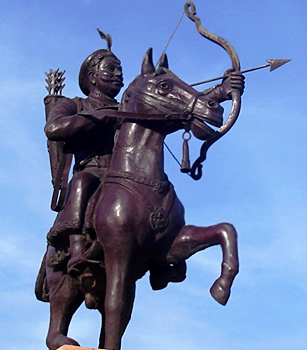
Chauhan Saab is my personal blog and in it i am trying to showcase the great chauhan history. Also i am trying to show the listing of all the famous chauhan personalities. Its my request to all the visitors please do post your comments and do like the posts.
Showing posts with label Famous Chauhans. Show all posts
Tuesday, January 15, 2013
Sunday, December 9, 2012
Conquest of Prithviraj Chauhan
Conquest of Prithviraj Chauhan can be characterised as aggressive and
implementation of shrewd tactics occasionally. Prithviraj Chauhan was a
king of the Chauhan dynasty, who controlled the kingdom of Delhi and Ajmer in northern India during the second half of the twelfth century. He belonged to the Agnikula clan of Rajputs. Delhi had witnessed Prithviraj Chauhan as the last Hindu King. He ruled to a large extent current Rajasthan and Haryana, and unified the Rajputs against Muslim invasions.
Battle against Bhimdev Solanki of Gujarat
Prithviraj Chauhan had killed many of Bhimdev`s generals before getting into a war with him. Bhimdev was a ruler of the Solanki dynasty in Gujarat. A general had betrayed Prithviraj and had joined Bhimdev in this battle. He had given all the inside information to Bhimdev and had poisoned Prithviraj Chauhan`s army. Bhimdev was sending his army men accordingly. All his plans failed and on the final day of the battle, Bhimdev himself clashed with Prithviraj Chauhan and was crushed to defeat.
Battle against Mahoba
Some Chauhan dynasty soldiers from Delhi decided to stop at the Mahoba royal gardens as they were injured. The Mahoba soldiers told the Delhi soldiers that they had insulted the Mohaba king Parmar by stepping into his garden and were attacked. Prithviraj Chauhan came to know about this and declared war on Mahoba. The Mahoban army was divided into three different sections during this battle. One part was led by the Prince of Mahoba, whilst the other two were led by the brothers Alha and Udal. Prithviraj Chauhan defeated the section controlled by Udal and Prince of Mahoba. Udal had injured Pundir a friend and general of Prithviraj Chauhan in combat. Udal was then killed by Prithviraj who was injured badly. Prithviraj and his friend Sanjham Rai, who was also injured, fell down a nearby hill and were left to be eaten by crows. Sanjham Rai, in order to save his friend allowed the crows to feed on him and not on Prithviraj and died a slow death. Alha`s section was still in battle with Prithviraj`s army. He was stopped from killing Prithviraj Chauhan by his guru. When Chand Bardai, had arrived Prithviraj became unconscious. He recovered later and was grieved at his friend`s death.
Prithviraj Chauhan continued his conquests winning one territory after another.
One of Prithviraj`s small battles was in opposition to King Raichand. King Raichand and some of the other neighbouring kings took advantage of Prithviraj`s injury. They attacked at that time knowing his inability to fight .The generals and close friends of Prithviraj Chauhan guarded the king of Delhi. Some villagers also came in handy to get rid of King Raichand and he was finally killed.
Prithviraj Chauhan took over the Kukada kingdom. He continued expanding his area of control by extending his region in all four directions. His army continued a rather bloody victory march for over four years. They won the battle against King of Dariyagargh. Soon after this conquest he had to witness the destruction of a major portion of his state. This was Muhammad Ghori`s first attack on Prithviraj`s province.

First Battle of Tarain 1191
In 1191, Shahabuddin Ghori invaded India through the Khyber Pass and reached Punjab. He captured a fortress, either at Sirhind or Bathinda on the north-western frontier of Prithviraj Chauhan`s kingdom. Prithviraj`s army led by his vassal prince Govinda-Raja of Delhi rushed to defend the frontier. The two armies met at the town of Tarain, near Thanesar in present-day Haryana. Shahabuddin Ghori`s army had been divided into three flanks. The Hindu Rajput army had elephant cavalry whereas Shahabuddin Ghori`s army had no elephants. Shahabuddin Ghori`s horse cavalry was unable to hold its own against Prithviraj`s elephant cavalry, resulting in the defeat of Shahabuddin Ghori`s left and right flanks. Two regiments of the Muslim army with Shahabuddin Ghori attacked the center with a body of soldiers; where Shahabuddin Ghori met Govinda Raja in personal combat. Ghori`s army was exhausted and withdrew back and Shahabuddin Ghori himself was captured by the Rajputs.
Second Battle of Tarain, 1192
In 1192, Shahabuddin Ghori re-assembled his army and returned to challenge Prithviraj at the Second Battle of Tarain. He had sent his envoy to Prithviraj Chauhan to demand his surrender but Prithviraj Chauhan refused. He assembled a large army with the help of his fellow Rajput rulers to combat Ghori`s army. Shahabuddin Ghori issued delivered an ultimatum to him that he convert to Islam or be defeated. Either of the side could reach on an agreement. Shahabuddin Ghori divided his troops into five parts and attacked the Rajput armies in the early morning hours but retreated as the Rajput elephant group advanced. Khande Rao general of Prithviraj was killed. By the end of the day, Shahabuddin Ghori himself led a heavily-armoured force to the center of the Rajput line, which collapsed into confusion. Prithviraj abandoned the battlefield and attempted to escape but was captured. The Rajput Army also fled, thereby conceding victory to Shahabuddin Ghori.Shahabuddin Ghori took the captured Prithviraj back with him to Ghazni, where he was executed in 1192.
Although Prithviraj Chauhan could not conquer many territories like the other Indian rulers, yet he proved himself as an able soldier in the first battle of Tarain. Conquests of Prithviraj Chauhan proved him to be a great soldier but lacking political insight of a diplomatic administrator. With his victory at Tarain, Muslim rule ushered in North India and decline of Hindu supremacy begun.
Battle against Bhimdev Solanki of Gujarat
Prithviraj Chauhan had killed many of Bhimdev`s generals before getting into a war with him. Bhimdev was a ruler of the Solanki dynasty in Gujarat. A general had betrayed Prithviraj and had joined Bhimdev in this battle. He had given all the inside information to Bhimdev and had poisoned Prithviraj Chauhan`s army. Bhimdev was sending his army men accordingly. All his plans failed and on the final day of the battle, Bhimdev himself clashed with Prithviraj Chauhan and was crushed to defeat.
Battle against Mahoba
Some Chauhan dynasty soldiers from Delhi decided to stop at the Mahoba royal gardens as they were injured. The Mahoba soldiers told the Delhi soldiers that they had insulted the Mohaba king Parmar by stepping into his garden and were attacked. Prithviraj Chauhan came to know about this and declared war on Mahoba. The Mahoban army was divided into three different sections during this battle. One part was led by the Prince of Mahoba, whilst the other two were led by the brothers Alha and Udal. Prithviraj Chauhan defeated the section controlled by Udal and Prince of Mahoba. Udal had injured Pundir a friend and general of Prithviraj Chauhan in combat. Udal was then killed by Prithviraj who was injured badly. Prithviraj and his friend Sanjham Rai, who was also injured, fell down a nearby hill and were left to be eaten by crows. Sanjham Rai, in order to save his friend allowed the crows to feed on him and not on Prithviraj and died a slow death. Alha`s section was still in battle with Prithviraj`s army. He was stopped from killing Prithviraj Chauhan by his guru. When Chand Bardai, had arrived Prithviraj became unconscious. He recovered later and was grieved at his friend`s death.
Prithviraj Chauhan continued his conquests winning one territory after another.
One of Prithviraj`s small battles was in opposition to King Raichand. King Raichand and some of the other neighbouring kings took advantage of Prithviraj`s injury. They attacked at that time knowing his inability to fight .The generals and close friends of Prithviraj Chauhan guarded the king of Delhi. Some villagers also came in handy to get rid of King Raichand and he was finally killed.
Prithviraj Chauhan took over the Kukada kingdom. He continued expanding his area of control by extending his region in all four directions. His army continued a rather bloody victory march for over four years. They won the battle against King of Dariyagargh. Soon after this conquest he had to witness the destruction of a major portion of his state. This was Muhammad Ghori`s first attack on Prithviraj`s province.

First Battle of Tarain 1191
In 1191, Shahabuddin Ghori invaded India through the Khyber Pass and reached Punjab. He captured a fortress, either at Sirhind or Bathinda on the north-western frontier of Prithviraj Chauhan`s kingdom. Prithviraj`s army led by his vassal prince Govinda-Raja of Delhi rushed to defend the frontier. The two armies met at the town of Tarain, near Thanesar in present-day Haryana. Shahabuddin Ghori`s army had been divided into three flanks. The Hindu Rajput army had elephant cavalry whereas Shahabuddin Ghori`s army had no elephants. Shahabuddin Ghori`s horse cavalry was unable to hold its own against Prithviraj`s elephant cavalry, resulting in the defeat of Shahabuddin Ghori`s left and right flanks. Two regiments of the Muslim army with Shahabuddin Ghori attacked the center with a body of soldiers; where Shahabuddin Ghori met Govinda Raja in personal combat. Ghori`s army was exhausted and withdrew back and Shahabuddin Ghori himself was captured by the Rajputs.
Second Battle of Tarain, 1192
In 1192, Shahabuddin Ghori re-assembled his army and returned to challenge Prithviraj at the Second Battle of Tarain. He had sent his envoy to Prithviraj Chauhan to demand his surrender but Prithviraj Chauhan refused. He assembled a large army with the help of his fellow Rajput rulers to combat Ghori`s army. Shahabuddin Ghori issued delivered an ultimatum to him that he convert to Islam or be defeated. Either of the side could reach on an agreement. Shahabuddin Ghori divided his troops into five parts and attacked the Rajput armies in the early morning hours but retreated as the Rajput elephant group advanced. Khande Rao general of Prithviraj was killed. By the end of the day, Shahabuddin Ghori himself led a heavily-armoured force to the center of the Rajput line, which collapsed into confusion. Prithviraj abandoned the battlefield and attempted to escape but was captured. The Rajput Army also fled, thereby conceding victory to Shahabuddin Ghori.Shahabuddin Ghori took the captured Prithviraj back with him to Ghazni, where he was executed in 1192.
Although Prithviraj Chauhan could not conquer many territories like the other Indian rulers, yet he proved himself as an able soldier in the first battle of Tarain. Conquests of Prithviraj Chauhan proved him to be a great soldier but lacking political insight of a diplomatic administrator. With his victory at Tarain, Muslim rule ushered in North India and decline of Hindu supremacy begun.
Labels:
Famous Chauhans,
History,
Prithviraj Chauhan
Wednesday, November 28, 2012
Rajput Surnames
Chauhans Chauhans originated as feudatories of the Pratiharas and rose to power in the wake of the decline of that power. Their state was initially centered around Sambhar in present-day Rajasthan. In the 11th century, they founded the city of Ajmer which became their capital. In the 12th century, their the then King Prithviraj Chauhan acquired Delhi from his maternal grand father,the then Tomar King Anangpal II Tomar (see above under Tomars or Tanwars). Their most famous ruler was Prithviraj Chauhan, who won the First Battle of Tarain against an invading Muslim army but lost the Second Battle of Tarain the following year. This loss heralded a prolonged period of Muslim rule over northern India.
Sisodia
The Sisodias suryavanshi Rajputs were also known as the Ranas of Mewar,
old Ranas states are to be found in many parts of India, and Nepal. The
earliest history of the clan calims that they had moved from Lahore that
was also known as 'Lohkot' or 'Lavasthali' to Shiv Desh, or Chitor in
V.S 191. In V.S 193 their ancestor Maharaja Kanak sen whose 21 had ruled
over Lahore. Later he also defeated the Kushan Satrap Rudradama who
ruled over Gujarat had moved to Gujarat on a punitive expedition against
Dihraj Dev Parmar the ruler of Idar (Gujarat). There he established his
capital Vallabhi. They trace their descent from Bappa Rawal, purported
scion of the Guhilot or Guhila or Gehlot or Gahlot clan, who established
himself as ruler of Mewar in 734 AD, ruling from the fortress of
Chittor (or Chittorgarh). According to legend and clan history, Bappa
grew up as a cowherd in the town of Kailashpuri (now Eklingji) but spent
much of his time studying the Vedas in the hermitage of the sage Harita
Rishi. He learned to respect Lord Eklingji, and later Harita Rishi gave
him the title of the Diwan of Eklingji, one that has become a legacy
for the succeeding maharanas. When he was 15 Bappa came to know that he
was the nephew of the ruler of Chittor who had been ousted by the ruler
of Malwa. He left Kailashpuri, went to the fortress city of Chittor and
snatched his kingdom back from the prince of Malwa, Man Singh Mori. In
the 9th century bad luck fell upon the Gehlots who were driven away by
the Pratiharas who in turn made way for the Rashtrakutas and Paramaras
Bhati Bhati Rajputs are a chandravansh Rajput clan from the Jaiselmer region of western Rajasthan. The Maharajas of Jaisalmer trace their lineage back to Jaitsimha, a ruler of the Bhati Rajput clan. The major opponents of the Bhati Rajputs were the powerful Rathor clans of Jodhpur and Bikaner. They used to fight battles for the possession of forts, waterholes or cattle. Jaisalmer was positioned strategically and was a halting point along a traditional trade route traversed by the camel caravans of Indian and Asian merchants. The route linked India to Central Asia, Egypt, Arabia, Persia, Africa and the West.Bhati Rajputs were proficient horse riders,marksman and warriors. Their reign spread to the Punjab,Sindh and beyond, to Afghanistan. The City of Ghazni was named after a brave Bhatti warrior. In Lahore, a monument exists to this day, which is called the Bhati Gate, named so probably because it opens in the direction of the "Sandal Bar", an area ruled by Rai Sandal Khan Bhati Rajput.They earned too much by imposing the taxes levies on the passing Carvans.they were known as a great shooter with Gun.
Jadeja Jadeja(Gujarati: જાડેજા Hindi: जाडेजा) is the name of a major clan of (Yadav) [1] Yaduvanshi[citation needed][1] or Chandravanshi Rajputs. The Chandravanshi[2], claiming descent from Chandra, the Hindu Moon-god, in English known as the Lunar Dynasty. They ruled huge parts of Kathiawar peninsula and Kutch as kings and princes for several centuries.
Vaghela Vaghela is a Kshatriya name. (Hindi: क्षत्रिय, kṣatriya from Sanskrit: क्षत्र, kṣatra) It is one of the four varnas (Social Orders) in Hinduism. It constitutes the military and noble order of the traditional Vedic-Hindu social system as outlined by the Vedas and the Laws of Manu. Lord Rama, Lord Krishna, Lord Buddha and Lord Mahavira all belonged to this social order. Initially in ancient Vedic society, this positions was achieved on the merits of a person's aptitude (guna), conduct (karma), and nature (swabhava). Over the years it became hereditary
The Vaghelas were an Indian dynasty of Gujarat. The Vaghelas were based in the town of Dholka, and were feudatories of the Solanki dynasty, who ruled Gujarat from the 10th to the 13th centuries. The Solanki went into decline in the thirteenth century, and by 1243 the Vaghelas were firmly in control of Gujarat. They restored stability to Gujarat for the latter half of the 13th century, and the Vaghela kings and officials were dedicated patrons of the arts and temple-building. They established a a rather shortlived (76 years) but powerful dynasty. The two rulers of this dynasty, Virdhaval and Vishaldev, were responsible for consolidating the stabilizing the prosperity of Gujarat after the fall of the Solankis. Virdhaval was the first Vaghela king, and two of his Jain minister brothers, who were also his two distinguished Dewans (chief ministers), Vastupal and Tejpal, built the exquisite Dilwara Temples on Mount Abu in Rajasthan, and temples at the Girnar and Shetrunjay hills. His successor Vishaldev built temples at Dabhoi and founded Vishalnagar. Karandev was the last Vaghela king and also the last Hindu ruler of Gujarat, who died in the 1304 conquest of Gujarat by Ala-ud-din Khilji, Sultan of Delhi. With his defeat Gujarat not only became part of the Muslim empire but the Rajput hold over Gujarat lost for ever.
Rathore Rathore(राठौड़) The Rathore or Rathor or Rathod is a Rajput tribe of India. Rathors in India are a Suryavansh Rajput clan from the Marwar region of western Rajasthan, inhabiting Idar state of Gujarat and also the Chhapra and Muzaffarpur districts of Bihar in very small numbers. In India, their native languages are Hindi and its dialects (such as Rajasthani, Marwari and other languages of Rajasthan, Gujarati and Kutchi in Gujarat, as well as Punjabi in the Punjab a dialect of Punjabi called Rathi spoken in Ratia and Tohana in present day Haryana.Rathore are the people from the west Rajasthan. Rathore's have many gotras, most of these gotras are from the name of the great warriors of the past and gotras are being used by their family members. Some of these gotras are: Jodha, Bidawat, Banirot, Champawat, mertiya and so forth. Rathore's were said to be the worshipers of sun. To understand the huge clan of Rathore's we will have understand their areas they occupy. Rathore's of Jodhpur were supreme in present districts such as - Jodhpur, Pali, Ajmer, Nagaur, Barmer, Sirohi. Rathore,s of Bikaner were occupant of the area that included districts Bikaner, Churu, Ganganagar, Hanumangarh. Dynasties belonging to this clan ruled a number of kingdoms and princely states in Rajasthan and neighbouring states before India's independence in 1947. The largest and oldest among these was Jodhpur, in Marwar and Bikaner. Also the Idar State in Gujrat. The Maharaja of Jodhpur, is regarded as the head of the extended Rathore clan of Hindu Rajputs. Even in the modern times the clout of this clan in the democratic world is such that a large number of MLAs and MPs have been elected from among them.
Katoch The Katoch clan is considered to be one of the oldest surviving clan in the world. They first find mention in the mythological Hindu epic The Mahabharta and the second mentions in the recorded history of Alexander the Great's war records. One of the Indian kings who fought Alexander on the river Beas was a Katoch king Parmanand Chandra famously known as Porus. In past centuries, they ruled several princely states in the region. The originator of the clan was Rajanaka Bhumi Chand. Their famous Maharaja Sansar Chand-II was a great ruler. The ruler Rajanaka Bhumi Chand Katoch founded the Jwalaji Temple (now in Himachal Pradesh).
Nirwan The Nirwan (also spelled as Chauhan) Their state was initially centered around khetri, khandela, alsisar malsisar,srimadhopur, alwar, jhunjhunu, sikar, churu, According to legend and clan history, the Nirwan are with Maharana Pratap against Akbar in Haldighati Battle. Nirwan's have many gotras, most of these gotras are Baloji, Pithoraji, Kaluji.Nirwan gotra is also found in yadavs [2] and jats.
Kachwaha The Kachwaha (also spelled as Kachavāhā,Kacchavahas, Kachhawa, Kuchhwaha & Kushwah including Kacchapghata, Kakutstha, and Kurma) are a Suryavanshi Rajput clan who ruled a number of kingdoms and princely states in India such as Alwar, Maihar, Talcher, while the largest and oldest state was Amber (city) later known as Jaipur. The Pachrang flag of the former Jaipur state. Prior to the adoption of the Pachrang (five coloured) flag by Raja Man Singh I of Amber, the original flag of the Kachwahas was known as the 'Jharshahi' (tree-marked) flagJaipur(Jainagara), an extension of the old kingdom of Amber, was founded by Maharaja Sawai Jai Singh II in 1727.The Maharaja of Jaipur is regarded as the head of the extended Kachwaha clan. Overall, sub-clans of the Kachwaha number around 71. Prominent sub-clans of the Kachhawa clan include: Rajawat, Shekhawat, Sheobramhpota, Naruka, Nathawat, Khangarot and Kumbhani. The Kachhawas belong to the Suryavanshi lineage, which claims descent from the Surya and Sun Dynasty of the ancient Kshatriyas. Specifically, they claim descent from Kusha[1] younger of the twin sons of Rama, hero of the Ramayana, to whom patrilineal descent from Surya is in turn ascribed. Indeed, the name Kachawaha is held by many[2] to be a patronymic derived from the name "Kusha". Prominent Sub-clans are Shekhawat, Naruka, Rajawat, Nathawat, Kalyanot, Jamwal, Minhas, Manhas, Baghel, Jasrotia, Nindar.
Solankis Solankis were descended from the Chalukyas of Karnataka who ruled much of peninsular India between the 6th and 12th centuries. In the 10th century, a local branch of the clan established control over Gujarat and ruled a state centered around the town of Patan. They went into decline in the 13th century and were displaced by the Vaghela.
Paramaras Paramara were near-neighbours of the Solankis. They originated as feudatories of the Rashtrakutas and rose to power in the 10th century. They ruled Malwa and the area at the border between present-day Gujarat and Rajasthan. Bhoja, the celebrated king of Malwa, belonged to this dynasty. In the 12th century, the Paramaras declined in power due to conflict with the Solankis and succumbed to attack from the Delhi sultanate in 1305.
Chandelas In the early 10th century, the Chandelas ruled the fortress-city of Kalinjar. A dynastic struggle (c.912-914 CE) among the Pratiharas provided them with the opportunity to extend their domain. They captured the strategic fortress of Gwalior (c.950) under the leadership of Dhanga (ruled 950-1008).
Tomars or Tanwars Tomar or Tuvars, or Tanwars, are Chandravanshi Rajputs, and descended from Mahabharat's great hero, Arjun, through his son Abhimanyu, and grandson, Parikshat. Chakravarti Samrat (King) Yudhishtra, founded Indraprastha, present day Delhi. Tomars (King Anangpal Tomar) conquered and re-established the Delhi Kingdom in CE 792 and founded the city of 'Dhillika,' (modern Delhi). Besides Delhi, Tomar's rule covered western U.P. and most of present day Haryana and Punjab. Tomar's rule lasted until CE 1162 when last Tomar King Anangpal II appointed Prithviraj Chauhan, his grandson (his daughter's son), and King of Ajmer- as 'catetaker,' since his own sons were very young at that time. According to the accounts kept by Tomar/ Tanwar 'Jagas,' King Anangpal Tomar appointed Prithviraj Chauhan as caretaker only when he went on a religious pilgrimage. It is also said by Tanwar 'Jagas' that when King Anangpal returned, Prithviraj refused to hand over the kingdom to him. It is worth mentioning that 'Jagas' are a caste in Rajasthen who are hereditary keepers of genealogical records of Rajputs, and present 'Jagas' of Tomar/Tanwar Rajputs reside near Jaipur, Rajasthan.
Dhanetiya In A.D.685 Chakravarti Manik Rae Chauhan who we consider as the founder of the great chauhan recovered Ajmer and Sambhar in Rajputana. Prithviraj chauhan , the descendant of Manik rae chauhan emperor of Northern India. He has many progeny, he established many dynasties throughout rajwaras father of the various tribes such as Dhanetiya,Bhaduria etc.these all are the descendant of Manik Rae Chauhan.These are all emerged from Agni that’s why known as Agnivanshi or Agnikulas. Mostly having the Vatsa gotras.Dhanetiya's setteled at shahabhad in kota laterly they came under hada's of koth or kota
Bhati Bhati Rajputs are a chandravansh Rajput clan from the Jaiselmer region of western Rajasthan. The Maharajas of Jaisalmer trace their lineage back to Jaitsimha, a ruler of the Bhati Rajput clan. The major opponents of the Bhati Rajputs were the powerful Rathor clans of Jodhpur and Bikaner. They used to fight battles for the possession of forts, waterholes or cattle. Jaisalmer was positioned strategically and was a halting point along a traditional trade route traversed by the camel caravans of Indian and Asian merchants. The route linked India to Central Asia, Egypt, Arabia, Persia, Africa and the West.Bhati Rajputs were proficient horse riders,marksman and warriors. Their reign spread to the Punjab,Sindh and beyond, to Afghanistan. The City of Ghazni was named after a brave Bhatti warrior. In Lahore, a monument exists to this day, which is called the Bhati Gate, named so probably because it opens in the direction of the "Sandal Bar", an area ruled by Rai Sandal Khan Bhati Rajput.They earned too much by imposing the taxes levies on the passing Carvans.they were known as a great shooter with Gun.
Jadeja Jadeja(Gujarati: જાડેજા Hindi: जाडेजा) is the name of a major clan of (Yadav) [1] Yaduvanshi[citation needed][1] or Chandravanshi Rajputs. The Chandravanshi[2], claiming descent from Chandra, the Hindu Moon-god, in English known as the Lunar Dynasty. They ruled huge parts of Kathiawar peninsula and Kutch as kings and princes for several centuries.
Vaghela Vaghela is a Kshatriya name. (Hindi: क्षत्रिय, kṣatriya from Sanskrit: क्षत्र, kṣatra) It is one of the four varnas (Social Orders) in Hinduism. It constitutes the military and noble order of the traditional Vedic-Hindu social system as outlined by the Vedas and the Laws of Manu. Lord Rama, Lord Krishna, Lord Buddha and Lord Mahavira all belonged to this social order. Initially in ancient Vedic society, this positions was achieved on the merits of a person's aptitude (guna), conduct (karma), and nature (swabhava). Over the years it became hereditary
The Vaghelas were an Indian dynasty of Gujarat. The Vaghelas were based in the town of Dholka, and were feudatories of the Solanki dynasty, who ruled Gujarat from the 10th to the 13th centuries. The Solanki went into decline in the thirteenth century, and by 1243 the Vaghelas were firmly in control of Gujarat. They restored stability to Gujarat for the latter half of the 13th century, and the Vaghela kings and officials were dedicated patrons of the arts and temple-building. They established a a rather shortlived (76 years) but powerful dynasty. The two rulers of this dynasty, Virdhaval and Vishaldev, were responsible for consolidating the stabilizing the prosperity of Gujarat after the fall of the Solankis. Virdhaval was the first Vaghela king, and two of his Jain minister brothers, who were also his two distinguished Dewans (chief ministers), Vastupal and Tejpal, built the exquisite Dilwara Temples on Mount Abu in Rajasthan, and temples at the Girnar and Shetrunjay hills. His successor Vishaldev built temples at Dabhoi and founded Vishalnagar. Karandev was the last Vaghela king and also the last Hindu ruler of Gujarat, who died in the 1304 conquest of Gujarat by Ala-ud-din Khilji, Sultan of Delhi. With his defeat Gujarat not only became part of the Muslim empire but the Rajput hold over Gujarat lost for ever.
Rathore Rathore(राठौड़) The Rathore or Rathor or Rathod is a Rajput tribe of India. Rathors in India are a Suryavansh Rajput clan from the Marwar region of western Rajasthan, inhabiting Idar state of Gujarat and also the Chhapra and Muzaffarpur districts of Bihar in very small numbers. In India, their native languages are Hindi and its dialects (such as Rajasthani, Marwari and other languages of Rajasthan, Gujarati and Kutchi in Gujarat, as well as Punjabi in the Punjab a dialect of Punjabi called Rathi spoken in Ratia and Tohana in present day Haryana.Rathore are the people from the west Rajasthan. Rathore's have many gotras, most of these gotras are from the name of the great warriors of the past and gotras are being used by their family members. Some of these gotras are: Jodha, Bidawat, Banirot, Champawat, mertiya and so forth. Rathore's were said to be the worshipers of sun. To understand the huge clan of Rathore's we will have understand their areas they occupy. Rathore's of Jodhpur were supreme in present districts such as - Jodhpur, Pali, Ajmer, Nagaur, Barmer, Sirohi. Rathore,s of Bikaner were occupant of the area that included districts Bikaner, Churu, Ganganagar, Hanumangarh. Dynasties belonging to this clan ruled a number of kingdoms and princely states in Rajasthan and neighbouring states before India's independence in 1947. The largest and oldest among these was Jodhpur, in Marwar and Bikaner. Also the Idar State in Gujrat. The Maharaja of Jodhpur, is regarded as the head of the extended Rathore clan of Hindu Rajputs. Even in the modern times the clout of this clan in the democratic world is such that a large number of MLAs and MPs have been elected from among them.
Katoch The Katoch clan is considered to be one of the oldest surviving clan in the world. They first find mention in the mythological Hindu epic The Mahabharta and the second mentions in the recorded history of Alexander the Great's war records. One of the Indian kings who fought Alexander on the river Beas was a Katoch king Parmanand Chandra famously known as Porus. In past centuries, they ruled several princely states in the region. The originator of the clan was Rajanaka Bhumi Chand. Their famous Maharaja Sansar Chand-II was a great ruler. The ruler Rajanaka Bhumi Chand Katoch founded the Jwalaji Temple (now in Himachal Pradesh).
Nirwan The Nirwan (also spelled as Chauhan) Their state was initially centered around khetri, khandela, alsisar malsisar,srimadhopur, alwar, jhunjhunu, sikar, churu, According to legend and clan history, the Nirwan are with Maharana Pratap against Akbar in Haldighati Battle. Nirwan's have many gotras, most of these gotras are Baloji, Pithoraji, Kaluji.Nirwan gotra is also found in yadavs [2] and jats.
Kachwaha The Kachwaha (also spelled as Kachavāhā,Kacchavahas, Kachhawa, Kuchhwaha & Kushwah including Kacchapghata, Kakutstha, and Kurma) are a Suryavanshi Rajput clan who ruled a number of kingdoms and princely states in India such as Alwar, Maihar, Talcher, while the largest and oldest state was Amber (city) later known as Jaipur. The Pachrang flag of the former Jaipur state. Prior to the adoption of the Pachrang (five coloured) flag by Raja Man Singh I of Amber, the original flag of the Kachwahas was known as the 'Jharshahi' (tree-marked) flagJaipur(Jainagara), an extension of the old kingdom of Amber, was founded by Maharaja Sawai Jai Singh II in 1727.The Maharaja of Jaipur is regarded as the head of the extended Kachwaha clan. Overall, sub-clans of the Kachwaha number around 71. Prominent sub-clans of the Kachhawa clan include: Rajawat, Shekhawat, Sheobramhpota, Naruka, Nathawat, Khangarot and Kumbhani. The Kachhawas belong to the Suryavanshi lineage, which claims descent from the Surya and Sun Dynasty of the ancient Kshatriyas. Specifically, they claim descent from Kusha[1] younger of the twin sons of Rama, hero of the Ramayana, to whom patrilineal descent from Surya is in turn ascribed. Indeed, the name Kachawaha is held by many[2] to be a patronymic derived from the name "Kusha". Prominent Sub-clans are Shekhawat, Naruka, Rajawat, Nathawat, Kalyanot, Jamwal, Minhas, Manhas, Baghel, Jasrotia, Nindar.
Solankis Solankis were descended from the Chalukyas of Karnataka who ruled much of peninsular India between the 6th and 12th centuries. In the 10th century, a local branch of the clan established control over Gujarat and ruled a state centered around the town of Patan. They went into decline in the 13th century and were displaced by the Vaghela.
Paramaras Paramara were near-neighbours of the Solankis. They originated as feudatories of the Rashtrakutas and rose to power in the 10th century. They ruled Malwa and the area at the border between present-day Gujarat and Rajasthan. Bhoja, the celebrated king of Malwa, belonged to this dynasty. In the 12th century, the Paramaras declined in power due to conflict with the Solankis and succumbed to attack from the Delhi sultanate in 1305.
Chandelas In the early 10th century, the Chandelas ruled the fortress-city of Kalinjar. A dynastic struggle (c.912-914 CE) among the Pratiharas provided them with the opportunity to extend their domain. They captured the strategic fortress of Gwalior (c.950) under the leadership of Dhanga (ruled 950-1008).
Tomars or Tanwars Tomar or Tuvars, or Tanwars, are Chandravanshi Rajputs, and descended from Mahabharat's great hero, Arjun, through his son Abhimanyu, and grandson, Parikshat. Chakravarti Samrat (King) Yudhishtra, founded Indraprastha, present day Delhi. Tomars (King Anangpal Tomar) conquered and re-established the Delhi Kingdom in CE 792 and founded the city of 'Dhillika,' (modern Delhi). Besides Delhi, Tomar's rule covered western U.P. and most of present day Haryana and Punjab. Tomar's rule lasted until CE 1162 when last Tomar King Anangpal II appointed Prithviraj Chauhan, his grandson (his daughter's son), and King of Ajmer- as 'catetaker,' since his own sons were very young at that time. According to the accounts kept by Tomar/ Tanwar 'Jagas,' King Anangpal Tomar appointed Prithviraj Chauhan as caretaker only when he went on a religious pilgrimage. It is also said by Tanwar 'Jagas' that when King Anangpal returned, Prithviraj refused to hand over the kingdom to him. It is worth mentioning that 'Jagas' are a caste in Rajasthen who are hereditary keepers of genealogical records of Rajputs, and present 'Jagas' of Tomar/Tanwar Rajputs reside near Jaipur, Rajasthan.
Dhanetiya In A.D.685 Chakravarti Manik Rae Chauhan who we consider as the founder of the great chauhan recovered Ajmer and Sambhar in Rajputana. Prithviraj chauhan , the descendant of Manik rae chauhan emperor of Northern India. He has many progeny, he established many dynasties throughout rajwaras father of the various tribes such as Dhanetiya,Bhaduria etc.these all are the descendant of Manik Rae Chauhan.These are all emerged from Agni that’s why known as Agnivanshi or Agnikulas. Mostly having the Vatsa gotras.Dhanetiya's setteled at shahabhad in kota laterly they came under hada's of koth or kota
Thursday, October 4, 2012
Sonal Chauhan fined by Mumbai Customs
Sonal Chauhan is the latest actress to have come under the scanner of the Mumbai Customs. The Jannat
babe, who was returning from Macau after attending an awards function,
tried to pass through the green channel but was stopped for questioning
by the Mumbai Customs.
Sonal was intercepted for carrying high-end branded bags and not declaring her purchases. The actress had picked up the bags from Hong Kong international airport and thought she could get away without having to pay any duty. However, that was not to be and finally Sonal had to end up paying Rs.85,000 as a fine for evading duty after which she was allowed to go.
Tuesday, October 2, 2012
Sonal Chauhan to debut as singer
The gentle 'Jannat' beauty is soon going to show her another side of talent.
In her forthcoming psychological thriller '3-G', Sonal Chauhan is said to be debuting as a singer courtesy the co-star
Neil Nitin Mukesh.
In fact, buzz is that Neil has turned composer for this film by churning out eight tunes! The actor already debuted as singer in 'Aa Dekhen Zara' and with '3-G', he seemed to have pushed himself to prove his musical personality
Sources have it that it was Neil who encouraged Sonal to render her voice for one of the song in '3-G', after he heard her singing. Pretty much impressed with her hidden singing talent, Neil even said to have a song ready that will suitable for her voice.
Hmmm, such a helpful co-star, we say.
In fact, buzz is that Neil has turned composer for this film by churning out eight tunes! The actor already debuted as singer in 'Aa Dekhen Zara' and with '3-G', he seemed to have pushed himself to prove his musical personality
Sources have it that it was Neil who encouraged Sonal to render her voice for one of the song in '3-G', after he heard her singing. Pretty much impressed with her hidden singing talent, Neil even said to have a song ready that will suitable for her voice.
Hmmm, such a helpful co-star, we say.
Sunday, September 23, 2012
Getting married is a comforting feeling: Mohit Chauhan
One of the perks of marriage is that you have someone to share your
thoughts with and someone to come back home to, says singer Mohit Chauhan who had a hush hush marriage with journalist Prarthana Gehlot in
a quiet corner in Himachal Pradesh.
"I didn't take the plunge for a long time. Now I am glad I did. I now
have someone to share my thoughts and my creative ideas with. Most
importantly, I now have someone to come back home to in Mumbai," he said
adding that he is planning a "receiption for friends".
Mohit tied the knot with Prarthana June 29 at a hotel in Barog, near Kasauli hills in Solan district, Himachal Pradesh. Born to Krishana Rana and B.K. Rana, the singer belongs to Nahan in Sirmaur district.
Now he is looking forward to new phase in his life as well as his new album.
"My wife is part of the album. The whole idea of doing a non-film album is to make it a personal statement," he said.
Excerpts from the interview:
Q: Why so secretive about your marriage?
A: (Laughs in embarrassment) I am here in my hometown in Himachal still going through the post wedding rituals. My wedding was a very private affair for close family only. I will now have a reception for friends in Mumbai or Delhi. As soon as I am back in Mumbai, I will take a call on the reception.
Q: Tell me about your wife.
A: Her name is Prarthana. So I've no choice but to be deeply religious in life (laughs). It an love-cum-arranged marriage. Prarthana and I have known each for some years. She was my friend, and then we thought we should take our friendship to another level.
Q: So you married your best friend?
A: Ha ha. Not quite. She was a friend. I liked spending time with her...The vibration between the two of us is wonderful. With Prarthana I felt she was not just a friend but also someone who contributed substantially to my singing.
Q: Do you feel more complete after marriage?
A: Getting married is definitely a very comforting feeling. I didn't
take the plunge for a long time. Now I am glad I did. I now have someone
to share my thoughts and my creative ideas with. Most importantly I now
have someone to come back home to in Mumbai.
Q: Is Prarthana interested in music?
A: She is interested in music. But she isn't a singer. She is a writer and journalist. But she loves music. And she is contributing in terms of ideas and lyrics to my songs in my new album which would be out soon.
Q: So did you go through all the rituals like a good boy?
A: (laughs) Traditionally our Himachal weddings take a week. My marriage took two days. I return to Mumbai in some time. I've been getting calls asking where I am. I need to get back to work.
Q: Tell me about your new album?
A: This would be my third solo album. There will be one song in the English language. I've also dedicated one song tomy roots in Himachal. I've composed all the tunes. My wife is part of the album. The whole idea of doing a non-film album is to make it a personal statement. A private album has to be about the artiste. It gives the musician complete freedom to say what I want to.
Q: Is Prarthana interested in music?
A: She is interested in music. But she isn't a singer. She is a writer and journalist. But she loves music. And she is contributing in terms of ideas and lyrics to my songs in my new album which would be out soon.
Q: So did you go through all the rituals like a good boy?
A: (laughs) Traditionally our Himachal weddings take a week. My marriage took two days. I return to Mumbai in some time. I've been getting calls asking where I am. I need to get back to work.
Q: Tell me about your new album?
A: This would be my third solo album. There will be one song in the English language. I've also dedicated one song tomy roots in Himachal. I've composed all the tunes. My wife is part of the album. The whole idea of doing a non-film album is to make it a personal statement. A private album has to be about the artiste. It gives the musician complete freedom to say what I want to.
Q: Have you had anything comparable to "Rockstar" coming your way?
A: That was a once in a lifetime opportunity. I am thankful to god I got it. No, I haven't got a similar offer. Yes, I am working with A.R. Rahman again. But for an opportunity like "Rockstar", I'll have to wait a while.a while.
Friday, August 24, 2012
Prithviraj Chauhan
Prithviraj Chauhan was born in Ajaymeru (Ajmer) in 1166 A.D. He was the son of Someshwar Chauhan and Karpuri Devi(she was a Kalachuri (Chedi) princess, daughter of Achalaraja of Tripuri).
He fought with Muhammad Ghori.Muhammad Ghori attacked India many times. First time he was defeated in Gujarat by Rajputs. Mularaja-II was not even a teen yet and his mother organized the defences of Pattan. Battle was fought at Kayadara near Mount Abu, in 1178 A.D. and Ghori was resoundingly defeated. After this defeat he never entered India through Gujarat. In first battle of tarain in 1191 Prithviraj Chauhan's cavalry charged and routed the Ghurid cavalry and captured Ghori. Ghori begged for his life. Prithviraj allowed him to go despite his generals asking him not to do so..
Prithviraj Chauhan lived at Taragarh fort which was also known as Ajaymeru after which the town of Ajmer got its name.
Following year Ghori attacked again. Prithviraj advanced with his army and sent a letter to Ghori. In this letter Ghori was asked to return as he had been defeated the previous year and was spared his life. Ghori replied that he was in India on the orders of his brother, Ghiasuddin, and that he could only retreat after he got a word from his brother. This letter was sent in the evening and after sending the letter Ghori moved his camp back a few kilometers to feign retreat. On receiving this letter and seeing Muhammad move his camp back Prithviraj assumed that Ghori was not interested in fighting. Ghori also knew that rajputs did not fight in the night and only started fighting after sun had come up. (This is an ancient Kshatriya practice e.g Mahabharata was also fought mostly in day time). Ghori treacherously attacked in the early morning hours when Prithviraj and his army were sleeping and was able to win this war
The founder of the Gahadwala line was Govindchandra Gahadwala. He was an astute ruler and ruled from Kannauj. Most of North India, including the university town of Nalanda was a part of his kingdom. He stoutly defended his kingdom from further Muslims incursions. He instituted a tax for this purpose which was called Turushka Danda (i.e. tax to fight the Turushkas or Turks). His grandson was Jaichandra Gahadwala (Rathod) who played a tragic role in Indian History.
The Story of Prithviraj Chauhan and Muhammad Ghori
In Jaichand's days, a rival Rajput clan had established itself in Delhi (Pithoragarh). The ruler there was Prithviraj Chauhan. Pritiviraj was a romantic, chivalrous and an extremely fearless person. After ceaseless military campaigns, Pritiviraj extended his original kingdom of Sambhar (Shakambara) to Rajasthan, Gujarat, and Eastern Punjab. He ruled from his twin capitals at Delhi and Ajmer. His fast rise caught the envy of the then powerful ruler Jaichandra Gahadwala and there was a lot of ill-feeling between the two.
Prithiviraj's Love for Sanyogita - Jaichandra's Daughter
The story of Prithviraj's bold exploits spread far and wide in the country and he was the center of much discussion in the circle of the nobility. Sanyogita, the daughter of Jaichandra Gahadwala fell secretly in love with Prithiviraj and she started a secret poetic correspondence with him. Her father the haughty Jaichandra got wind of this and he decided to teach his daughter and her upstart lover a lesson. So he arranged a Swayamwara (a ceremony where a bride can select her husband from the assembled princes. She had the right to garland any prince and she became his queen. This is an ancient Hindu custom among Royalty). Jaichandra invited all the big and small princes of the country to Kannauj for the royal Swayamwara. But he deliberately ignored Prithiviraj.
To add insult to injury, he even made a statue of Prithiviraj and kept him as a dwarpala (doorman).
The Elopement of Sanyogita with Prithviraj
Prithviraj got to know of this and he confided his plans to his lover.
On the said day, Sanyogita walked down the aisle where the royals had assembled and bypassed all of them only to reach the door and garland the statue of Pritiviraj as a doorman. The assemblage was stunned at this brash act of hers. But what stunned them and her father Jaichandra was the next thing that happened.
Prithiviraj who was hiding behind the statue, also in the garb of a doorman, whisked Sanyogita away and put her up on his steed to make a fast gateway to his capital at Delhi
Chauhan-Rathod Warfare Leads to Weakening of both Rajput Kingdoms
Jaichandra and his army gave earnest chase and in the resultant string of battles between the two kingdoms fought between 1189 and 1190, both of them sufferred heavily. While this drama was being enacted, another ruler also named Mahmud who was from Ghori in Afghanistan had grown powerful and had captured Ghazni and subsequently attacked the Ghaznavid Governor of Punjab and defeated him. The kingdom of Mahmud Ghori now stretched up to the domains of Prithiviraj Chauhan. A clash was inevitable
The 1st Battle of Tarain 1191 C.E. - Victory of Prithiviraj Chouhan
Mahmud Ghori threw the gauntlet by laying siege to the fortress of Bhatinda in East Punjab which was on the frontier of Prithiviraj's domains. Prithviraj's appeal for help from his father-in-law was scornfully rejected by the haughty Jaichandra. But undaunted Prithviraj marched on to Bhatinda and met his enemy at a place called Tarain (also called Taraori) near the ancient town of Thanesar. In face of the persistent Rajput attacks, the battle was won as the Muslim army broke ranks and fled leaving their general Mahmud Ghori as a prisoner in Pritiviraj's hands.
Mahmud Ghori was brought in chains to Pithoragarh - Prithviraj's capital and he begged his victor for mercy and release. Prithviraj's ministers advised against pardoning the aggressor. But the chivalrous and valiant Prithviraj thought otherwise and respectfully released the vanquished Ghori.
The 2nd Battle of Tarain 1192 C.E. - Defeat of Prithiviraj Chauhan
The very next year Prithiviraj's gesture was repaid by Ghori who re-attacked Prithiviraj with a stronger army and willfully defeated him by attacking the Rajput army before daybreak. (The Hindus incidentally followed a hoary practice of battling only from sunrise up to sunset. Before Sunrise and after Sunset there was to be no fighting- as per a time honored battle code)The defeated Prithiviraj was pursued up to his capital and in chains he was taken as a captive to Ghor in Afghanistan.
The Blinding of Prithviraj
The story of Prithiviraj does not end here. As a prisoner in Ghor he was presented before Mahmud, where he looked Ghori straight into the eye
Ghori ordered him to lower his eyes, whereupon a defiant Prithiviraj scornfully told him how he had treated Ghori as a prisoner and said that the eyelids of a Rajputs eyes are lowered only in death.On hearing this, Ghori flew into a rage and ordered that Prithviraj's eyes be burnt with red hot iron rods
This heinous deed being done, Prithiviraj was regularly brought to the court to be taunted by Ghori and his courtiers. In those days Prithiviraj was joined by his former biographer Chand Bardai, who had composed a ballad-biography on Pritiviraj in the name of Prithviraj Raso (Songs of Prithviraj). Chand Bardai told Prithiviraj, that he should avenge Ghori's betrayal and daily insults.
The Blind Prithviraj avenges the Injustice done to him
The two got an opportunity when Ghori announced a game of Archery. On the advice of Chand Bardai, Prithviraj, who was then at court said he would also like to participate. On hearing his suggestion, the courtiers guffawed at him and he was taunted by Ghori as to how he could participate when he could not see. Whereupon, Prithiviraj told Mahmud Ghori to order him to shoot, and he would reach his target.
Ghori became suspicious and asked Prithviraj why he wanted Ghori himself to order and not anyone else. On behlaf of Prithiviraj, Chand Bardai told Ghori that he as a king would not accept orders from anyone other than a king. His ego satisfied, Mahmud Ghori agreed.
On the said day, Ghori sitting in his royal enclosure had Prithiviraj brought to the ground and had him unchained for the event. On Ghori's ordering Prithviraj to shoot, we are told Prithiviraj turned in the direction from where he heard Ghori speak and struck Ghori dead with his arrow. This event is described by Chand Bardai in the couplet, "Dus kadam aggey, bees kadam daey, baitha hai Sultan. Ab mat chuko Chauhan, chala do apna baan." (Ten feet ahead of you and twenty feet to your right, is seated the Sultan, do not now miss him Chauhan, release your arrow).
Thus ended the story of the brave but unrealistic Prithviraj Chauhan - the last Hindu ruler of Delhi. Delhi was to remain under Muslim rule for the next 700 years till 1857 and under British rule till 1947. Those few Hindus who came close to liberating Delhi during the seven centuries of Muslim rule were Rana Sanga in 1527, Raja (Hemu) Vikramaditya in around 1565 (2nd battle of Panipat), and Shrimant Vishwas Rao who was the Peshwa's son and was co-commander of the Maratha forces in the 3rd battle of Panipat in 1761. Metaphorically speaking, the next Hindu ruler to actually preside over Delhi was to be Dr. Rajendra Prasad, the first President of Independent India (and Jawarharlal Nehru - who was the President's first Minister).
He fought with Muhammad Ghori.Muhammad Ghori attacked India many times. First time he was defeated in Gujarat by Rajputs. Mularaja-II was not even a teen yet and his mother organized the defences of Pattan. Battle was fought at Kayadara near Mount Abu, in 1178 A.D. and Ghori was resoundingly defeated. After this defeat he never entered India through Gujarat. In first battle of tarain in 1191 Prithviraj Chauhan's cavalry charged and routed the Ghurid cavalry and captured Ghori. Ghori begged for his life. Prithviraj allowed him to go despite his generals asking him not to do so..
Prithviraj Chauhan lived at Taragarh fort which was also known as Ajaymeru after which the town of Ajmer got its name.
Following year Ghori attacked again. Prithviraj advanced with his army and sent a letter to Ghori. In this letter Ghori was asked to return as he had been defeated the previous year and was spared his life. Ghori replied that he was in India on the orders of his brother, Ghiasuddin, and that he could only retreat after he got a word from his brother. This letter was sent in the evening and after sending the letter Ghori moved his camp back a few kilometers to feign retreat. On receiving this letter and seeing Muhammad move his camp back Prithviraj assumed that Ghori was not interested in fighting. Ghori also knew that rajputs did not fight in the night and only started fighting after sun had come up. (This is an ancient Kshatriya practice e.g Mahabharata was also fought mostly in day time). Ghori treacherously attacked in the early morning hours when Prithviraj and his army were sleeping and was able to win this war
The founder of the Gahadwala line was Govindchandra Gahadwala. He was an astute ruler and ruled from Kannauj. Most of North India, including the university town of Nalanda was a part of his kingdom. He stoutly defended his kingdom from further Muslims incursions. He instituted a tax for this purpose which was called Turushka Danda (i.e. tax to fight the Turushkas or Turks). His grandson was Jaichandra Gahadwala (Rathod) who played a tragic role in Indian History.
The Story of Prithviraj Chauhan and Muhammad Ghori
In Jaichand's days, a rival Rajput clan had established itself in Delhi (Pithoragarh). The ruler there was Prithviraj Chauhan. Pritiviraj was a romantic, chivalrous and an extremely fearless person. After ceaseless military campaigns, Pritiviraj extended his original kingdom of Sambhar (Shakambara) to Rajasthan, Gujarat, and Eastern Punjab. He ruled from his twin capitals at Delhi and Ajmer. His fast rise caught the envy of the then powerful ruler Jaichandra Gahadwala and there was a lot of ill-feeling between the two.
Prithiviraj's Love for Sanyogita - Jaichandra's Daughter
The story of Prithviraj's bold exploits spread far and wide in the country and he was the center of much discussion in the circle of the nobility. Sanyogita, the daughter of Jaichandra Gahadwala fell secretly in love with Prithiviraj and she started a secret poetic correspondence with him. Her father the haughty Jaichandra got wind of this and he decided to teach his daughter and her upstart lover a lesson. So he arranged a Swayamwara (a ceremony where a bride can select her husband from the assembled princes. She had the right to garland any prince and she became his queen. This is an ancient Hindu custom among Royalty). Jaichandra invited all the big and small princes of the country to Kannauj for the royal Swayamwara. But he deliberately ignored Prithiviraj.
To add insult to injury, he even made a statue of Prithiviraj and kept him as a dwarpala (doorman).
The Elopement of Sanyogita with Prithviraj
Prithviraj got to know of this and he confided his plans to his lover.
On the said day, Sanyogita walked down the aisle where the royals had assembled and bypassed all of them only to reach the door and garland the statue of Pritiviraj as a doorman. The assemblage was stunned at this brash act of hers. But what stunned them and her father Jaichandra was the next thing that happened.
Prithiviraj who was hiding behind the statue, also in the garb of a doorman, whisked Sanyogita away and put her up on his steed to make a fast gateway to his capital at Delhi
Chauhan-Rathod Warfare Leads to Weakening of both Rajput Kingdoms
Jaichandra and his army gave earnest chase and in the resultant string of battles between the two kingdoms fought between 1189 and 1190, both of them sufferred heavily. While this drama was being enacted, another ruler also named Mahmud who was from Ghori in Afghanistan had grown powerful and had captured Ghazni and subsequently attacked the Ghaznavid Governor of Punjab and defeated him. The kingdom of Mahmud Ghori now stretched up to the domains of Prithiviraj Chauhan. A clash was inevitable
The 1st Battle of Tarain 1191 C.E. - Victory of Prithiviraj Chouhan
Mahmud Ghori threw the gauntlet by laying siege to the fortress of Bhatinda in East Punjab which was on the frontier of Prithiviraj's domains. Prithviraj's appeal for help from his father-in-law was scornfully rejected by the haughty Jaichandra. But undaunted Prithviraj marched on to Bhatinda and met his enemy at a place called Tarain (also called Taraori) near the ancient town of Thanesar. In face of the persistent Rajput attacks, the battle was won as the Muslim army broke ranks and fled leaving their general Mahmud Ghori as a prisoner in Pritiviraj's hands.
Mahmud Ghori was brought in chains to Pithoragarh - Prithviraj's capital and he begged his victor for mercy and release. Prithviraj's ministers advised against pardoning the aggressor. But the chivalrous and valiant Prithviraj thought otherwise and respectfully released the vanquished Ghori.
The 2nd Battle of Tarain 1192 C.E. - Defeat of Prithiviraj Chauhan
The very next year Prithiviraj's gesture was repaid by Ghori who re-attacked Prithiviraj with a stronger army and willfully defeated him by attacking the Rajput army before daybreak. (The Hindus incidentally followed a hoary practice of battling only from sunrise up to sunset. Before Sunrise and after Sunset there was to be no fighting- as per a time honored battle code)The defeated Prithiviraj was pursued up to his capital and in chains he was taken as a captive to Ghor in Afghanistan.
The Blinding of Prithviraj
The story of Prithiviraj does not end here. As a prisoner in Ghor he was presented before Mahmud, where he looked Ghori straight into the eye
Ghori ordered him to lower his eyes, whereupon a defiant Prithiviraj scornfully told him how he had treated Ghori as a prisoner and said that the eyelids of a Rajputs eyes are lowered only in death.On hearing this, Ghori flew into a rage and ordered that Prithviraj's eyes be burnt with red hot iron rods
This heinous deed being done, Prithiviraj was regularly brought to the court to be taunted by Ghori and his courtiers. In those days Prithiviraj was joined by his former biographer Chand Bardai, who had composed a ballad-biography on Pritiviraj in the name of Prithviraj Raso (Songs of Prithviraj). Chand Bardai told Prithiviraj, that he should avenge Ghori's betrayal and daily insults.
The Blind Prithviraj avenges the Injustice done to him
The two got an opportunity when Ghori announced a game of Archery. On the advice of Chand Bardai, Prithviraj, who was then at court said he would also like to participate. On hearing his suggestion, the courtiers guffawed at him and he was taunted by Ghori as to how he could participate when he could not see. Whereupon, Prithiviraj told Mahmud Ghori to order him to shoot, and he would reach his target.
Ghori became suspicious and asked Prithviraj why he wanted Ghori himself to order and not anyone else. On behlaf of Prithiviraj, Chand Bardai told Ghori that he as a king would not accept orders from anyone other than a king. His ego satisfied, Mahmud Ghori agreed.
On the said day, Ghori sitting in his royal enclosure had Prithiviraj brought to the ground and had him unchained for the event. On Ghori's ordering Prithviraj to shoot, we are told Prithiviraj turned in the direction from where he heard Ghori speak and struck Ghori dead with his arrow. This event is described by Chand Bardai in the couplet, "Dus kadam aggey, bees kadam daey, baitha hai Sultan. Ab mat chuko Chauhan, chala do apna baan." (Ten feet ahead of you and twenty feet to your right, is seated the Sultan, do not now miss him Chauhan, release your arrow).
Thus ended the story of the brave but unrealistic Prithviraj Chauhan - the last Hindu ruler of Delhi. Delhi was to remain under Muslim rule for the next 700 years till 1857 and under British rule till 1947. Those few Hindus who came close to liberating Delhi during the seven centuries of Muslim rule were Rana Sanga in 1527, Raja (Hemu) Vikramaditya in around 1565 (2nd battle of Panipat), and Shrimant Vishwas Rao who was the Peshwa's son and was co-commander of the Maratha forces in the 3rd battle of Panipat in 1761. Metaphorically speaking, the next Hindu ruler to actually preside over Delhi was to be Dr. Rajendra Prasad, the first President of Independent India (and Jawarharlal Nehru - who was the President's first Minister).
Subscribe to:
Posts (Atom)