Google+
Showing posts with label History. Show all posts

Sunday, December 9, 2012

Conquest of Prithviraj Chauhan


Prithviraj Chauhan

Conquest of Prithviraj Chauhan can be characterised as aggressive and implementation of shrewd tactics occasionally. Prithviraj Chauhan was a king of the Chauhan dynasty, who controlled the kingdom of Delhi and Ajmer in northern India during the second half of the twelfth century. He belonged to the Agnikula clan of Rajputs. Delhi had witnessed Prithviraj Chauhan as the last Hindu King. He ruled to a large extent current Rajasthan and Haryana, and unified the Rajputs against Muslim invasions.

Battle against Bhimdev Solanki of Gujarat
Prithviraj Chauhan had killed many of Bhimdev`s generals before getting into a war with him. Bhimdev was a ruler of the Solanki dynasty in Gujarat. A general had betrayed Prithviraj and had joined Bhimdev in this battle. He had given all the inside information to Bhimdev and had poisoned Prithviraj Chauhan`s army. Bhimdev was sending his army men accordingly. All his plans failed and on the final day of the battle, Bhimdev himself clashed with Prithviraj Chauhan and was crushed to defeat.

Battle against Mahoba
Some Chauhan dynasty soldiers from Delhi decided to stop at the Mahoba royal gardens as they were injured. The Mahoba soldiers told the Delhi soldiers that they had insulted the Mohaba king Parmar by stepping into his garden and were attacked. Prithviraj Chauhan came to know about this and declared war on Mahoba. The Mahoban army was divided into three different sections during this battle. One part was led by the Prince of Mahoba, whilst the other two were led by the brothers Alha and Udal. Prithviraj Chauhan defeated the section controlled by Udal and Prince of Mahoba. Udal had injured Pundir a friend and general of Prithviraj Chauhan in combat. Udal was then killed by Prithviraj who was injured badly. Prithviraj and his friend Sanjham Rai, who was also injured, fell down a nearby hill and were left to be eaten by crows. Sanjham Rai, in order to save his friend allowed the crows to feed on him and not on Prithviraj and died a slow death. Alha`s section was still in battle with Prithviraj`s army. He was stopped from killing Prithviraj Chauhan by his guru. When Chand Bardai, had arrived Prithviraj became unconscious. He recovered later and was grieved at his friend`s death.

Prithviraj Chauhan continued his conquests winning one territory after another.

One of Prithviraj`s small battles was in opposition to King Raichand. King Raichand and some of the other neighbouring kings took advantage of Prithviraj`s injury. They attacked at that time knowing his inability to fight .The generals and close friends of Prithviraj Chauhan guarded the king of Delhi. Some villagers also came in handy to get rid of King Raichand and he was finally killed.

Prithviraj Chauhan took over the Kukada kingdom. He continued expanding his area of control by extending his region in all four directions. His army continued a rather bloody victory march for over four years. They won the battle against King of Dariyagargh. Soon after this conquest he had to witness the destruction of a major portion of his state. This was Muhammad Ghori`s first attack on Prithviraj`s province.
Shahabuddin Ghori
First Battle of Tarain 1191
In 1191, Shahabuddin Ghori invaded India through the Khyber Pass and reached Punjab. He captured a fortress, either at Sirhind or Bathinda on the north-western frontier of Prithviraj Chauhan`s kingdom. Prithviraj`s army led by his vassal prince Govinda-Raja of Delhi rushed to defend the frontier. The two armies met at the town of Tarain, near Thanesar in present-day Haryana. Shahabuddin Ghori`s army had been divided into three flanks. The Hindu Rajput army had elephant cavalry whereas Shahabuddin Ghori`s army had no elephants. Shahabuddin Ghori`s horse cavalry was unable to hold its own against Prithviraj`s elephant cavalry, resulting in the defeat of Shahabuddin Ghori`s left and right flanks. Two regiments of the Muslim army with Shahabuddin Ghori attacked the center with a body of soldiers; where Shahabuddin Ghori met Govinda Raja in personal combat. Ghori`s army was exhausted and withdrew back and Shahabuddin Ghori himself was captured by the Rajputs.

Second Battle of Tarain, 1192
In 1192, Shahabuddin Ghori re-assembled his army and returned to challenge Prithviraj at the Second Battle of Tarain. He had sent his envoy to Prithviraj Chauhan to demand his surrender but Prithviraj Chauhan refused. He assembled a large army with the help of his fellow Rajput rulers to combat Ghori`s army. Shahabuddin Ghori issued delivered an ultimatum to him that he convert to Islam or be defeated. Either of the side could reach on an agreement. Shahabuddin Ghori divided his troops into five parts and attacked the Rajput armies in the early morning hours but retreated as the Rajput elephant group advanced. Khande Rao general of Prithviraj was killed. By the end of the day, Shahabuddin Ghori himself led a heavily-armoured force to the center of the Rajput line, which collapsed into confusion. Prithviraj abandoned the battlefield and attempted to escape but was captured. The Rajput Army also fled, thereby conceding victory to Shahabuddin Ghori.Shahabuddin Ghori took the captured Prithviraj back with him to Ghazni, where he was executed in 1192.

Although Prithviraj Chauhan could not conquer many territories like the other Indian rulers, yet he proved himself as an able soldier in the first battle of Tarain. Conquests of Prithviraj Chauhan proved him to be a great soldier but lacking political insight of a diplomatic administrator. With his victory at Tarain, Muslim rule ushered in North India and decline of Hindu supremacy begun.

Wednesday, November 28, 2012

The heart touching story of Rani Padmini-The Queen of Chittor


The heart touching story of Rani Padmini-The Queen of Chittor
In 12th and 13th centuries, Rawal Ratan Singh was the King of Chittor. Rani Padmini, the wife of King Rawal Ratan Singh and Queen of Chittor and often a mythological figure for her womanhood and sacrifice.

During those days, the Sultanate of Delhi- the kingdom set up by the invaders was nevertheless growing in power. That time Allah-ud-din Khilji was the Sultan and who made repeated attack on Mewar on one reason and the other.

At the same time Chittor was under the Rule of Rawal Ratan Singh, a brave and noble warrior King. As well a patron of the arts. In his court were many talented people one of whom was a musician named Raghav Chetan. But unknown to everyone, he was also a sorcerer. He used his evil talent to run down his competitor but unluckily was caught red-handed. On hearing this King was angry and he punished Raghav Chetan to send away from his kingdom after blackening his face and making him ride on donkey.

Due to this, Raghav Chetan became an uncompromising enemy of the King. Raghav Chetan made his way towards Delhi with the aim of trying to incite the Sultan of Delhi Allah-ud-din Khilji to attack chittor.

When Raghav Chetan come near to Delhi, was settled down in one of the forests nearby Delhi which the Sultan used frequently for hunting deers. One day he saw the hunt party entering the forest, he started playing a melodious tone on his flute. Hunt party get surprised, and they found Raghav Chetan was playing a flute . Raghav Chetan was then brought before sultan, and the Sultan asked him to come to his court at Delhi.The cunning Raghav-Chetan asked the king as to why he wants to have a ordinary musician like himself when there were many other beautiful objects to be had. The Sultan wondering what Raghav Chetan meant, Sultan asked him to clarify. Then he told about Rani Padmini's beauty, Allah-ud-din's lust was aroused and immediately on returning to his capital he gave orders to his army to march on Chittor.

But he get disappointed, due to the fort to be heavily defended. Hopefull to have a look at the legendary beauty of Padimini, he send word to King Ratan Singh that he looked upon padmini as his sister and wanted to meet her. On hearing this, the unsuspecting Ratansen asked Padmini to see the 'brother'. But Padmini was more wordly-wise and she refused to meet the lustful Sultan personally.

Rani Padmini then convinced by her husband, She agreed to allow Allah-ud -din to see her only in a mirror.On the word being sent to Allah-ud-din that Padmini would see him, he came to the fort with his selected and best warriors who secretly made a careful examination of the fort's defences on their way to the Palace. On seeing Padmini, in a mirror, the lustful Sultan decided that he should secure Padmini for himself. While returing to his camp, Sultan was accompanied for some way by King Ratan Singh. Taking this opportunity, Sultan skillfully kidnapped Ratan Singh and took him as a prisoner into his camp and demanded that Padmini come and surrender herself before Sultan, if she wanted her husband king Ratan Singh alive again.

The Rajput generals decided to beat the Sultan at his own game and sent back a word that Padmini would be given to Sultan the next morning. On the following day at the crack of dawn, one hundred and fifity palaquins (covered cases in which royal ladies were carried in medieveal times) left the fort and made their way towards Sultan's camps. The palanquins stopped before the tent where king Ratan singh was being held prisoner. Seeing that the palanquins had come from Chittor, and thinking that they had brought along with them his queen, king Ratan Singh was mortified. But get surprised, because his queen is not there in the palanquins but her women servant and fully armed soldiers, who quickly freed Ratan Singh and galloped away towards Chittor on horses grabbed from Sultan's stables.

On hearing that, the lustful Sultan was furious and ordered his army to attack on Chittor. But hard as they tried the Sultans army could not break into the fort. Sultan decided to lay seige to the fort. The seige was the prolonged effort to gain the fort. Finally King Ratnasingh gave orders that the Rajputs would open the gates and fight to finish with the besieging troops. On hearing of this decision, Padmini decided that with their men-folk going into the unequal struggle with the Sultan's army in which they were sure to perish, the women of Chittor had either to commit suicides or face dishonour at the hands of the victorious enemy.


The choice was in favour of suicide through Jauhar. A huge pyre was lit and followed by their queen, all the women of Chittor jumped into the flames and deceived the lustful enemy waiting outside. With their womenfolk dead, the men of Chittor had nothing to live for. Their charged out of the fort and fought on furiously with the vastly Powerful array of the Sultan, till all of them perished. After this phyrrhic victory the Sultan's troops entered the fort only to be confronted with ashes and burnt bones of the women whose honour they were going to violate to satisfy their lust.

These women who committed Jauhar had to perish but their memory has been kept alive till today by bards and songs which glorify their act which was right in those days and circumstances. Thus a halo of honour is given to their supreme sacrifice.

Tuesday, November 27, 2012

Maharana Pratap


Maharana Pratap, the eldest son of the founder of Udaipur Maharana Udai Singh was born to Sonagari Queen Jayawanti on Jyestha Sudi third day of Vikram Era 1597 (i.e. May 9, 1540) Sunday at 47 Ghati 13 Pal past sunrise. Born is Ardra Naksatra, his birth was considered not only auspicious but the astrologers also made the prediction that the child will bring shining glory to the name of the clan.

He was initiated into education and leasing worthy of a prince and, when adult, he mastered the skills in the use of arms and weapons including horse riding. But owing to mutual jealousy among the queens of Udai Singh, he was deprived of his father’s have and affection, and was forced live in a village below the ridge of Chittorgarh. His maternal grand father Akheraj Sonagar (pali) had died in the battle of Sumel Girari in 1600 Vikram Era. Thus, neither he received the from his father nor did he get maternal grand father’s care for long.

First Marriage of Pratap and Founding of Udaipur
At around age of 17 years Pratap was married to Ajabade, the daughter of Rao Ram Rakh Panwar. Amar Singh was born to her in the month of Chaitra Sudi 7, Thursday of Vikram Era 1613 (i.e. 16 March, 1559). At this time Maharana Udai Singh had gone to Ekaling Ji for Darshana (holy Vision of the lord) and from there he moved towards village Ahar in the cause of hunting. After consultations and discussions with his chieftains and advisers he started construction of a palace and establishment of a city towards the north of present day Udaipur the ruins of which exist to-day, known as Moti Mahal

Hero of the Age – Maharana Pratap
The Third Saka (Supreme Sacrifice) of Chittor and Pratap
When emperor Akabar evivaded Chittor in 1967, Maharana Udai Singh abandoned Chittorgarh following the advice of his chief cans and Generals. Though Pratap desired to stay back and protect the fort but the chief fans and Generals did not agree to expose the future king of Mewar to the jows of death and sent him to mountains alongwith his father on the night of 23 febuary 1568 the last Jauhar (a ritualistic self emulation by the women in order to protect their chastity and honour before their warrior husbands march for the final and last assault) was organized and in the morning of the following day the warriors threw open the Fort gates and wade the supreme sacrifice (the Saka, in popular lane). With the fort fell to the hands of Akabar. Akabar not only ordered the killing of innocent residents women and children but also offended sentiments of Hindus by destroying and desecrating the temples and idols in the fort.

This incident of Jauhar and Saka at Chittor made a deep impression on the heart of Pratap. He was full of hatred for Akabar who indulged in this merciless killing. The Supreme Sacrifice made by the women and the warriors for upholding the honour and respect of their nation family, clan and religion because the source of expiration for Pratap to resolve for a struggle ful life
Repression of the Vagadiya Chauhans
Pratap first demonstrated his bravery by attacking the Vagadiya Chauhans. In the battle at the banks of Som river Karansi the cousin of Rana Sanwaldas was killed. Being defeated the Vagadiya Chauhans Conceded a large part of Vagad lard to Mewar. This enhanced the fame of Pratap and the attention of the common masses and feudal heads started centering towards the browsing of Pratap.

Coronation of Pratap
Living for a while in the difficult mountain terrains at Kumbhaner alongwith his father, Pratap made his residence at Gogunda where Maharana Udai Singh died on 28 Feb.,1572. In accordance with the desire of Bhatiyani queen Dheer bai, Maharana Udai Singh had declared his son Jagamal as his heir apparent but despite strong desires of the queen and the Maharana, Jagamal could not realize his dreams. After the death of the Maharana Jagamal occupied the Royal Throne but he did not participate in the funeral rites the former ruler of Gwalior Ram Singh Tanwar enquired about Jagamal after which the noble heads came to know about Jagamal having been made the heir-apparent. At this point Man Singh Sonagare, the maternal uncle of Pratap raised objection and said to Rawat Sanga ( the predecenor of Devagarh nobles) – you Belong to the clan of Chunda therefore, this ought to have been decided after consultation with you. Then, Rawat Krishna das and Rawat Sanga said – “pratap is the eldest son, and worthy also, hence, he will be the Maharana.” After completing the last rites, the noble chieftains made Pratap to occupy the Royal Throne and spoke to Jagamal – “In your capacity as the younger brother, your seat is in front of the Royal Throne”. Thus, on 28 feb, 1572- the day of Holi Pratap’s coronation was performed at Gogunda Afterward, the coronation ceremony was celebrated at Kumbhalwer which was attended by Rao Chandra Sen (Jodhpur) the brother-in-low (Sister’s husband) of Pratap as Nell.

Making Kumbhalmer and Gogunda as centres, Pratap started ruling over Mewar. He conquered the CHHAPPAn area, defeating the rathors, then he ensured full protection of entire Godwad and the Arawali ranges. At that time, the territories lying to the North-east and South-east of Mewar had fallen to the hands of Akabar and almost all the kings of Rajasthan had accepted authority of Akabar, the only exception being Pratap who never bowed his head before the emperor. After Pratap’s coronation, Akabar kept sying over his activities for one year. Hoping that Pratap too will follow the path of other kings and will himself join the Royal service but this did not happen and Akabar decided to send emissaries to Pratap to prevail upon him

Akabar Sends three Emissaries to make Pratap accept his authority
First of all, at the orders of Akabar, Prince Man Singh Kachhawah came to Pratap lowing Gujarat in april 1573 and traveling via Eedar and Dungarpur, Pratap come to Udaipur from Gogunda and extended an affectionate wel-come to Man Singh near Udaipur. Though, Man Singh tried his best to prevail upon Pratap to come to the Royal court but Pratap did not agree. Tension developed between the two at the time of taking food and maan Singh left angrily and reported the mother to Akabar. On eruption of rebellion again in Gujarat, Akabar invaded Gujarat and suppressed the rebellion on 2 Sep. 1573 and from there ordered some army generals two under the leadership of King Bhagawan das (Amer) to go to the Rana.

Elderly bhagwan das , it was hoped, will succeed in prevailing upon Pratap to accept subjection Bhagwandas reached Eedar after first conguering the strong fort of Badanagar. The ruler of that place Narayan Das Rathore, who was Pratap’s father-in-low, accepted subjection under Akabar there after Bhagawan das went to Gogunda to meet Pratap. Although, Pratap welcomed Bhagawan das with due respects, he tactfully sefured the proposal to present him self in the court of Akabar. After two months itself, under orders from Akabar king Todarmal, while returning from Gujarat met Pratap, but had to return disappointed. This fully convinced Akabar to believe that Pratap can not be pressed down without using military might, he resolved to send Army on Pratap.

Pratap’s Reaction
Despite efforts having been made to prevail upon Pratap, he did not accept subjection of Akabar, rather remained firm on his earlier decision. What will be the consequences of all this? Pratap know this very well. Therefore, he quickened his campaign of organizing the soldiers. He stored food- items in Forts like Kumbhalmer and established many posts to protect Gogunda his main centre.

The Battle of Haldighati

Prince Mana Singh left Ajmer on 2 April, 1576 and reached Mandalgarh to launch attack on maharana Pratap. Staying there fore two months he organized the Royal Army and then moved his army towards Gogunda. On the way , he encamped at Mohi and Molela – the two villages. Onreceiving this information Pratap came to lohsing from Gogunda. This place is 9 miles away to the south-west of Haldighati From here to Haldighati the path is so narrow that not more than two men could walk together on this at a time.

It Pratap had preferred to stay here and wait for the arrival of the Royal Army, they would have had no other option but to move through this narrow path and would have been killed in the narrow valley. But Pratap and his soldiers were very eager and deprecate to fight in the open area. So, Pratap alongwith his soldiers reached khamnor though the inaccessible path. The battle was fought in the morning of 18 June, 1576 in the wide open area between Haldighati and village Khamanor. In Man Prakash, written in the praise of Man Singh it is stated – Pratap said to Madhav Singh – the younger brother of Man Singh Kachhawah, don’t feel happy in this battle field, I am soon going to end your happiness with alongwith king Man Singh in a moment. I say this under oath in the name of lord vishnu that you can not cherish the thought of Victory, so leery as I am alive.” And for the first time launched such a severe attack that the Mughal army ran miles away, but soon the scenario changed. Fighting from Pratap’s side many warriors in cluding Ramdas Medaliya, Tanwar Ram Shah of Gwalior alongwith his three sons, Jhala Beeda Jhala Mansingh, Man Singh Sonagara, Dodiya Bheem Shankar das Rathore, Rawat Naitsee, charam Jaisa and many others sacrificed their lives fighting fiercely. At last Pratap and his remaining soldiers had to abandon the battle field. Although the Royal army won, but the purpose, for which the bottle was fought- was not achieved, neither Pratap could be captioned nor did his attitude charge.


Post Battle Activities
The Royal army moved forward after the battle of Haldighati captured Gogunda the place of Pratap there they dug around a moat as they were afraid of the Mewar army. Pratap now made his stay in the strong fort of Kumbhalmer. After a short while Pratap reached Gogunda via village Kolyari, re-captured Gounda after forcing the Mughals to flee from there and placed Mandana Kumpawat there for its protection. He had good neighborly relations with the rulers to Sirohi, Jalore and Eedar. So to weaken the friendly ties the Royal army attacked them and brought Taj Khan of Jalore and Surtan of Sirohi under subjection – still, they continued supporting Pratap and they did not become averse to Pratap.
Back to Top

Attack by Akabar
In Oct., 1576 Akabar himself resolved to invade Mewar. He was confident of accomplishing the task which his generals could not do. So Akabar left Ajmer on 13 oct., 1576 with a huge army. King Bhagawan das and prince Man Singh were sent to Gogunda under the command of Kutubuddin Khan. When Pratap got this information, he left Gogunda and went into the mountains. The Royal army went searching for Pratap in the caves of mountains but he could not be traced. Staying at village Mohi, Akbar made several efforts to capture Pratap but he did not succeed. Army generals were placed in the areas of Mohi and Madariya, and the campaign to search Pratap was given impetus. But all efforts failed. About Fazal writes while attempting to hide the failures of army generals – “They went into the territory of the Rama, but finding no clue to trace him returned back. Akabar got angry with them and suspended them from royal duties, and re-instated them when the begged for pardon. Hararred as he left, aKabar finally left Udaipur on 27 Nov, 1576 and went to Mahawa via Banswara. Thus, staying in Mewar for about a month and a half Akabar put all his might and skills in actions to suppress Pratap, but he did not get success. Rawal Pratap Singh of Banswara and Rawal Aasakaran of Dungarpur accepted subjection lender Akabar but Pratap Continued to give thorny pricks to the heart of Akabar. Soon after Akabar left, Pratap not only re-captured the Royal posts, but also closed all important exit points of Mewar people under the Mughal areas stopped cultivating lands with the reruls that Royal army stanted failing grant hardships due to non-supply of rations and restrictions of movements. Akabar sent his huge army those and came himself as well, to suppress Pratap but failures did not part campany with him.

Pratap was annoyed with the rulers of Dungarpur and Banswara because they did not support and stand by him ceramal the son of Dungarpur ruler Aasakaran aligned with Pratap and persuaded Pratap to send his army on Aasakaran and promised to pay Pratap 4000 Memudi for this favour Pratap at that time, was in dire need of money and he saw in this offer an opportunity to suppress his opponent therefore Pratap immediately sent his army to invade Dungarpur. When the army besieged the fort, Parvati, the wife of Dungarpur Rawal Aaskaran infomed her brother Rao Chandrasen of Jodhpur about this envision. At this Rao Chandra sen came to Dungarpur with his prominent warriors and entered the fort through the back-gate of thefoot when sesamal informed Pratap of this development, Pratap ordered his army not to take any action against Rao Chandra sen and removed his army from Dungarpur. Rao Chandrasen called Aaskaram in and handed him over the fort when Akabar invaded Dungar, Chandrasen went to Banswara, then came to village Kotara and lived there, Pratap met him there.
Invasions by Shahabag Khan against Pratap
On 15 oct., 1577 army was again sent to attack Pratap under the command of Shahbag Khan and Mir Baksi, king Bhagwandas and prince Man singh were also with them. The army, this time, intended to occupy the strong fort of Kumbhalmer. Shahbag first captive Kelwara, situated at the ridges of Khumbhalmer and then laid siege of khumbhalmer. Facing shortage of food items Pratap left the fort in the night and assigned to task of Protecting the fort to his maternal uncle Bham Sonagae. The ammunition got destroyed by the fire from a big cannon that cracked. Bham and other Rajput worriers came out opening the Fort Gate and made the supreme sacrifice while fighting on 3 April, 1578. Kumbhalmer was captured but Pratap was not caught therefore, instead of dying stationed in the fort, Pratap thought it better to abandon the fort and continue with the struggle in the style of his fathers paticies.

Pratap left kumbhalmer and went to Ranapur and then stayed for quite long in village choolye under the state of Eedar. Bhamashah and Tarachard went to Rampura and took shelter. After shahabag khan left mewar, bhamashah returned from rampura and after plundering villages of malwa and mewar, offered good amount of wealth to Maharana Pratap. For this favour Bhamashah was made Prime Minister replacing Rana Mahan see. After returning from chooliya, Pratap spent his time in mountain terrains around Kamalnath and Awargarh. After about 8 months, Akabar again ordered Shahabag Khan to invade Mewar with the warning that if you will not bring Maharana under subjection, you will be beheaded. So, he left fatehpur sikari on 15 Dec. 1578 for Mewar. Despite the exhaustive efforts for three months, no where about of Pratap could be known Tarachand fell down from horse while fighting with shahabag Khan but Devara Saindas of Runija sawed his life.

Third attack by Shahabag Khan and Pratap leaves for Godawad
On 11 Nov., 1579 Shahabag Khan moved from sambhar to launch third attack on Pratap this time many Rajputs were killed fighting with shahabagkhan. Royal posts were established at many important places and strict vigil was enforced to moniter movements of Pratap, Pratap went to the mountains of Soondha in Godawad where Dewal Padihars were ruling. Thkur Raydhawal Dewal of loyana extended warn welcome to pratap and gave his daughter to Pratap in marriage. Pratap got dug a well (Bavadi) and stabled a garden at Soondha, Decorated Raydhawal with the title of Rana. When in May 1580 Shahabag Marched to Bengal, Pratap came back to Mewar and lived at village Dholan (sayara area).

Shahabag Khan had stabled authority over Jawar Chhappan and Vagad in addition to kumbhalmer and established Royal posts there. Pratap suspended action against the mughals for some time due to fall in military strength. He territories under his control and increasing the strength of his army. After three years he chalked out plans to attack the Royal posts making Dholan as his main centre of activities

The Battle of Dever and Victory of Pratap
Pratap launched an attack on the Royal Post at Dever a village situated in Dever valley of Arawali ranges north east of kumbhalmer. The post commander Sulteen Khan lead the Royal off the legs of the elephant with blows of swards and the elephant fell down. Then sultan khan fought riding a horse. Prince Amar Singh demonstrated great bravery in this battle the Amar Kavya states – He pierced his spear through Sulteen Khan and the house together. Other soldiers ran away and Pratap got victory. Pratap got the triumphing victory in this battle. James To & describes Dever as the marathon of Mewar. Marathon is a place in Greece where the Greeks foxed the inamains to flee away from the war

Demise of Pratap
In January 1597, while pulling the sting of bow to hunt a tiger he developed pain in his intenstine and fell sick. Seeing him grim faced, the Rawat of Salumber asked him for the reason, I am worried and doubtful at the prospects as to weather my son Amar Singh, who, I know, is prone to a comfortable life-style will be able to up hold the glory of Mewar and the tradition of my family and clan. It you nobles make a promise to protect the glory of the kingdom of Mewar, I may die in peace, All the chieftains of Mewar, present there at that time, when took the oath in the name of the throne of Bappa Rawal, then Pratap breathed his last on 19 January 1597 and thus came the end to a golden era of struggle for freedom.

Chetak - The Royal Horse
Chetak was the famous horse of Rana Pratap, whom Pratap rode during the gruesome Battle of Haldighati (June 21, 1576). Chetak died in this battle and since then has been immortalized in the ballads of Rajasthan. This famous warhorse was of Kathiawari breed. Folklore has it that Chetak's coat had a blue tinge. That is why Rana Pratap is sometime referred as the "Rider of the Blue Horse" in ballads.

No story of this famous battle can be complete without mentioning the exploits of Chetak in this battle. It was while mounted on Chetak that Pratap made that daring attempt on the life of Imperial Mughal Commander Man Singh. Again it was Chetak who carried away Pratap to safety from the lost battle even though being grievously wounded himself.

During the course of the battle When Pratap saw that the battle's tide was turning against him, he decided to settle the issue one way or other in a spectacular and quintessentially Rajput manner. Imperial commander Man Singh was directing the battle seated on an elephant. Pratap charged frontally at the Imperial army, hacked his way through the massed ranks of enemy combatants and reached in front of Man Singh's elephant. Once there, Chetak reared high in the air and planted his hooves on the forehead of Man Singh's elephant. Pratap threw his lance at Man Singh, who had the necessary quick reflexes to duck in time. The blow fell on the mahout (elephant driver) instead, who was killed instantly. In the general melee that followed, Chetak received a fatal wound on one of his legs. This was the turning point of the battle. Mewar's bold gamble to siege the battle in its favor had failed. As Man Singh was whisked away to safety, Pratap found himself surrounded by enemy soldiers.

This was the moment of decision for Pratap, whether to seek personal glory by embracing martyrdom on the battlefield, or to live and keep the flame of resistance burning. If he lived, Mewar stood another chance. In fact every rebel anywhere in India against the Mughal empire would have a rallying figure. But with him gone, the sun would set on Indian aspirations forever. Mewar own fate would be sealed.

Maharana was loath to leave a battle in between, but was prevailed upon by his faithful followers. By some accounts one of the Jhala sardar literally snatched the Royal Insignia from Maharana's person and wore them himself, thus making him a target for the Mughal Army.

As Mughal army fell upon the Jhala sardar mistaking him for Maharana, Maharana left the battlefield with some of his loyal followers. Chetak was exhausted and seriously wounded, but labored on carrying his master. About 2 miles from the site of the battle he came across a small stream. It was here while trying to leap across the stream Chetak collapsed.

Maharana erected a small and beautiful monument for his beloved companion at the place where Chetak fell. This cenotaph still exists near the village of Jharol in in Rajsamand District. Chetak lives on in poetic traditions as the epitome of loyalty.


Bhama Shah - The Loyal Lieutenant of Rana

Bhama Shah ––– The Saviour Minister
Bhama Shah, the son of Bharmal –– Kiledar of Ranthambhore, came of the Oswal family of Chitor and was born on the 25th June, 1547 A.D. By dint of merit and ability, he won the favour of his young master and rose by degrees to higher position and ranks. He under the leadership of Pratap, fought gallantly at the fierce and famous battles of Haldighati (1576 A.D.) and made several desperate attacks upon the divisions of the Mughal army at Nadol, Diver, Ranakpur, etc., being impressed with his valourous actions and rare ability of civil and military acumen, Pratap entrusted the management of Finances and the State forces to him. He well stood to the task. He not only consolidated Pratap’s authority in Mewar but also overran nearly the whole of Malwa. In this exploit he exacted tribute amounting to 25 lakhs of rupees and 20 thousand Asharfis and presented the entire collection to the Rana at the village of Chulia. Besides this huge amount he was providing countless concealed hordes of silver, gold and jewels, of which he maintained confidential notes with him, time and again, to lessen the financial stringency of the State, occasioned by frequent wars and aiding in Pratap’s scheme of the consolidating programmes of his new capital –– Chawand. For all this Bhama is remembered with esteem as a brave and benevolent ‘Saviour’ Minister of the State.

After Bhama Shah’s death on the 16th January, 1600, his son and grandson also served the State as ministers in three successive reigns of Pratap, Amar and Karan Singh, with efficiency and honesty. The loyalty, fidelity and rare status enjoyed by Bhama Shah and his successors was duly recognized by the State by allowing the main head of the progeny of Bhama to be honoured by Tika mark on the occasions of the community dinners of the Oswals. This practice continued to our own days, in one form or the other. By virtue of his conspicuous ability, and successful military operations, he earned the name of an unrivalled minister of Mewar.

RANI LAKSHMI BAI


RANI LAKSHMI BAI


JHANSI KI RANI was the great heroine of the First War of Indian Freedom. She became a widow at the tender age of 18 and lived only till 22 yet she has inspired many and is still a living legend. She was the embodiment of patriotism, self-respect and heroism. Her life is a thrilling story of womanliness, courage, adventure, deathless patriotism and martyrdom. In her tender body there was a lions spirit.


At birth she was named Manu. The young Manu, unfortunately she lost her mother when she was only four. The entire duty of bringing up the daughter fell on her father. Along with formal education she acquired the skill in sword fighting, horse riding and shooting. Manu later became the wife of Gangadhar Rao, Maharaj of Jhansi, in 1842. From then on she was known as Maharani Laksmi Bai of Jhansi.


In 1851 Maharani Lakshmi Bai bore a son but her fate was cruel and she lost her child within three months. The Maharaja passed away on the 21st November 1853. Although prior to this the Maharaja and Maharani adopted a boy the British government claimed they did not recognise the right of the adopted boy. Thus they tried to buy off the Rani however she stated: "No, impossible! I shall not surrender my Jhansi!"It did not take her long to realise how difficult it was for the small state of Jhansi to oppose the British when even the Peshwas and Kings of Delhi had bowed down to the British Demands. The Rani’s battle now was against the British who had cunningly taken her kingdom from her.


After the British took over her government her daily routine changed. Every morning from 4am to 8am were set apart for bathing, worship, meditation and prayer. From 8am to 11am she would go out for a horse ride, practise shooting, and practise swordmanship and shooting with the reins held on her teeth. Thereafter she would bathe again, feed the hungry, give alms to the poor and then have food; then rested for a while. After that she would chant the Ramanyan. She would then exercise lightly in the evening. Later she would go through some religious books and hear religious sermons. Then she worshipped her chosen deity and had supper. All things were done methodically, according to her strict timetable. Such a dedicated and devoted women!


All these disciplined and training patterns came in use during the Indian Mutiny in 1857. Many lives were lost and innocence people killed. Although Bharat did not gain independence the Rani did win back Jhansi and created the state to its former glory having a full treasury and army of women matching the army of men. However Sir Hugh Rose attacked Jhansi on 17th March 1858. The next day’s battle was the Rani’s last. Her death was heroic, her army had declined as they were out numbered by the opposition. The British Army had encircled her and her men. There was no escape blood was flowing, darkness was approaching. The British army was pursuing her. After a great struggle the Rani died muttering quotes from the Bhagvad Gita.


When she went to War and took up arms she was the very embodiment of the War Goddess Kali. She was beautiful and frail. But her radiance made men diffident. She was young in years, but her decisions were mature. Such an confident and dominant women! A lesson is to be learnt for us all from her experiences! The words of the British General Sir Hugh Rose who fought against the Maharani several times and was defeated time and time again stated: "Of the mutineers the bravest and the greatest commander was the Rani".

Chatrapati Shivaji Maharaj


Chatrapati Shivaji - The chastiser of the Mughals

Chatrapati Shivaji Maharaj


Shivaji Bhosle, also known as Chhatrapati Shivaji Raje Bhosle(Born:February 19, 1627, Died: March 4, 1680) was the founder of Maratha empire in western India in 1674.


He raised a strong army and navy, constructed and repaired forts, used guerilla warfare tactics, developed a strong intelligence network, gave equal treatment to the people from all religions and castes based on merit, and functioned like a seasoned Statesman and General. He appointed ministers with specific functions such as Internal security, Foreign affairs, Finance, Law and Justice, Religious matters, Defense etc. He introduced systems in revenue collection and warned the officials against harassment of subjects. He thought ahead of times and was a true visionary. In his private life, his moral virtues were exceptionally high. His thoughts and deeds were inspired by the teachings of his mother Jijabai, teacher Dadaji Konddev, great saints like Dnyaneshwar & Tukaram and the valiancy and ideals of the Lords Rama and Krishna


The Marathas - Samurais from Western India
The Marathas are a proud and hardy race who are a sub-set of the wider Hindu Community. They are first mentioned in Indian history as the stout fighters in the army of the Chalukya King Pulikeshin who resisted the Southward march of Emperor Harsha in the 7th century C.E


The Maratha dynasties of the ancient (pre-Muslim) period are the Chalukyas (500 C.E. to 750C.E.), the Rastrakutas (750 C.E. to 978 C.E. and the Yadavas or Jadhavs (1175 C.E. to 1318 C.E.).

The Marathas were the first who crossed Malik Kafur's path, when he invaded the deccan in 1314 C.E. They were then led by the last scion of the Yadava dynasty - Ramdev Rai Yadava who ruled from Devagiri (today's Daulatabad). In their first clash with the Muslims; the Marathas lost to the invaders and accepted the status of being vassals and mercenaries of their Muslim overlords.


The Marathas before Shivaji were Mercenaries and revenue Collectors for the Muslim Rulers
In keeping with the feudal tradition, the Maratha Sardars (Generals), before Shivaji kept shifting their loyalties from one Muslim ruler to another. And there were many Muslim rulers like the Adilshahis at Bijapur, the Nizamshahis at Ahmednagar (Berar), the Qutubshahis at Golkonda (Hyderabad), etc.


Shahji Bhosale, who was Shivaji's father typified this practice of shifting loyalties from one Muslim overlord to another. He was from time-to-time in the service of the Mughals, the Adilshahis and the Nizamshahis. The thought of establishing an independent Maratha-Hindu kingdom, does seem to have crossed his mind, but he never really got about to doing it successfully. The germ of this idea however seems to have got rubbed into Shivaji - his son by Jijabai.


Shivaji Maharaj - the Visionary Saint-SoldierShivaji was born in the year 1627 at the Fort of Shivneri in Maharashtra in Western India. Shivaji's mother, Jijabai was a direct descendant of the erstwhile Yadav royal family of Devagiri. She seems to have nursed deep within her mind the idea of recovering independence from Muslim rule which her Yadav forebears had lost in the year 1318. Shivaji grew up with these ideas embedded into him. His childhood stories are those of playing games in which he and his friends attacked and captured forts held by the enemy.
The Oath of Independence - at Raireshwar


When Shivaji was seventeen, he decided to transform what were till then simply games to a reality. He and his friends encouraged by Jijabai and his Guru Dadoji Kondeo; decided to take a formal oath to free the country from the shackles of Muslim tyranny. This was done in the year 1645 in a dark cavern housing a small temple to the Hindu God Shiva (locally called Raireshwar).


Here Shivaji and his select band of teenaged Maratha friends slit their thumbs and poured the blood oozing from it on the Shiva-linga (Phallus representing the Lord Shiva). By this act they declared a blood-feud against Mughal tyranny. This was the beginning of a long and arduous Maratha-Mughal struggle that went on for the next century and a half to culminate in the defeat of the Mughals and their replacement by the Marathas as the dominant power in India


Shivaji's encounter with Afzal Khan

When Shivaji started his military career by capturing the fortress of Torana, it sent shockwaves in the Adilshshi court at Bijapur. Here was a local Hindu chieftain, daring to challenge the might of a Muslim ruler. The retribution was swift and Adil Shah sent in his most fearsome general named Afzal Khan to bring back Shivaji dead or alive to Bijapur. Afzal Khan who was reputed to be more than six feet tall and of a real massive built, set on his mission and in order to lure Shivaji down into the plains, he destroyed the Hindu temples at Tuljapur, Pandharpur and Shikhar Shenganapur.

Afzal Goes Up to Pratapgad


This ploy failed to work and Shivaji stuck to his Hill fastness in the Sahyadris. Shivaji even sent a letter to Afzal Khan praising the legendary strength of Afzal Khan's powerful arms and his reputed fearlessness. Shivaji addressed him as his uncle and said that he was afraid to come down to meet Afzal Khan. Shivaji asked him to come up into the hills to meet him and on condition that Afzal Khan came with not more than few select soldiers. The proud Khan felt that the Dekkhan-Ka-Chuha (Rat of the Deccan as the Muslims scornfully addressed Shivaji) had really chickened out.


Afzal Meets his Nemesis in Shivaji


Khan-Saheb agreed to go up the hills at Pratapgad to meet his nemesis. When the meeting took place, Afzal Khan embraced Shivaji and with his diminutive enemy (Shivaji was less than five feet in height) in his grip, Afzal suddenly pulled out his dagger and tried to stab Shivaji. When Afzal's dagger could not plunge into Shivaji Maharaj due to the protective armour which Shivaji was wearing, Afzal tried to throttle him. But the wily Maratha was more than prepared for this as he had come down not only with full armour that was hidden by his thick satin robes, but he also had with him the 'Wagh Nakh' - a sharp weapon resembling tiger claws that could be hidden in the grip of one's fist. In addition, he had the Bichhwa - curved dagger hidden in the pocket of his waistcoat.

Jiwa Mahalaya

On sensing that the Khan meant to throttle him, Shivaji pierced the tiger claws deep into Khan's belly and pulled out his intestines. After which Shivaji repeatedly stabbed him with the bichhwa. The Khan bellowed "Daga" "Daga" and yelled for Syed Banda, his bodyguard to come to his rescue. When Syed Banda, also a burly Muslim was about to strike Shivaji with his sword, Shivaji's bodyguard Jiva Mahalya struck off Banda's upraised arm in the air itself.

Santaji Kawji

After this commotion, the bleeding Khan tried to make good his escape and rushed into his palanquin. As the palanquin bearers set off with the fleeing Khan, Santaji Kawji, another of Shivaji's select warriors cut-off the feet of the bearers and Khans' palanquin, with its load of Khansaab fell to the ground. Santaji Kawji, then finished off the task of sending Khan to his final resting place. Khan's army which was waiting in the valley was ruthlessly massacred by the Marathas who were hiding behind every crevice and bush in the densely wooded jungles around the Pratapgad fort. At the place where this encounter took place on 10th November 1659 between Shivaji Maharaj and the Khan, there stands today a Kabar (grave) erected by Shivaji for the departed Khan's soul to rest in peace.

Bijapur Stymied

The result of this dramatic encounter was that the Bijapur ruler panicked and after that never posed a serious threat to the growing Maratha power. The next Muslim power which Shivaji turned to was that of the Mughals. Here was the real challenge for Shivaji. The Bijapur rulers were a provincial power, while the Mughals were an power of imperial dimensions whose writ ran almost all over Northern India.

The Siege of Panhalgad

Despite this defeat, Bijapur's Adil Shah made one last attempt to check Shivaji by sending another general named Siddhi Jouhar against him. Siddhi besiged Panhalgad where Shivaji was camping. The seige went on for some months, from summer till the monsoons. But Shivaji Maharaj slipped out of Panhalgad and reached safely at Vishalgad.

The Brave Deed of Baji Prabhu Deshpande

It is during this escape that Baji Prabhu Deshpande held the pursuing enemy troops at a narrow pass called Ghod Khind. Baji Prabhu immortalized himself by laying down his life but ensured that his Master reached safely at Vishalgad. This narrow pass is today known as Pawan Khind i.e. a Holy Pass. Made holy by Baji Prabhu's memorably brave deed.

Encounter with Shaista Khan - Aurangzeb's Uncle

The next Khan to come down 'literally' before Shivaji was Shaista Khan. On hearing Shivaji's depredations, Aurangzeb was furious and wanted to desperately crush this infidel upstart. He sent his uncle maternal Shaista Khan with a large and powerful army to checkmate Shivaji.

But even this time the wily Maratha proved that brain was stronger than the brawn.

Shaista Khan came into Maharashtra and started devstating towns, villages fields, temples, forts and everything that came in his path.

Shaista Establishes his Harem in Shivaji's Devghar (Prayer Room)

To provoke Shivaji, Shaista Khan established his camp in Shivaji's home in Pune called Lal-Mahal. And to top it up, he put up his Harem in Shivaji's Devghar (prayer room).
Shaista is Lucky - He Only Loses His Fingers

Shivaji bided his time for many months and one on fine day (night), he with a select band of Maratha Samurais, sneaked into Pune and into the Lal-Mahal. He tracked down the sleeping Khan to his bed. The Khan sensing that his time was up tried jumping out of the window. At that point Shivaji cut off the Khan's fingers with which he was holding on to the window sill.

On the Khan's wife's pleading before Shivaji to spare her husband's life as she considered Shivaji to be her brother. And so killing her husband would mean making her a widow, Shivaji spared the Khan's life. This was a mistake for which Shivaji was to pay dearly later. Shivaji made good his escape from the Khan's lair, but not before the treacherous Khan ordered his troops to give chase and try to capture the fleeing Shivaji.

Shaista's Retreat from Maharashtra
The Khan however, decided that enough was enough and returned to Delhi - without his fingers. This happened in April 1663

The failure of his uncle peeved Aurang to no end and he now sent another general to subjugate Shivaji. This was Mirza Raja Jai Singh, Aurangzeb's Hindu general who was also the scion of the house of the Suryavanshi Kachhawaha's who we saw earlier had ingratiated themselves to the Mughal rulers by giving away their daughters in marriage to the Mughal Padishah. (The Moghuls incidentally never returned the favour by giving, or even offerring, their daughters to the Rajputs!). This Mirza Raja Jaisingh who came with a powerful force was smarter than Shaista Khan sent earlier by Aurangzeb. Mirzaji laid siege to Purandar alongwith a systematic loot and destruction of rural Maharashtra.

The Brave Deed of Murar Baji
When Raja Jai Singh and his general Diler Khan laid siege to the Fort of Purandar. Murar Baji was the Maratha Fort Commandant at Purandar. To break the morale of the Maratha troops, Diler Khan launched a viscious attack on the fort and laid waste the surrounding countryside. The Mughals succeeded in forcing their way into the outer defenses of Purandar.

But the Marathas were not easily intimidated, they withdrew to the inner fort (bali-killa) and kept on their attack on the besieging Mughals. One day, Murar Baji decided to rain hell on the enemy and the Marathas stormed out of the fort and fell upon the Mughals who were occupying the outer fort. In face of the Maratha attack, the Mughals broke ranks and fled to their main camp in the plains below, where Diler Khan was camping.

Seeing the ferocity of the Maratha attack, Diler Khan, decided to tempt Murar Baji with an offer of making him a general in the Mughal army if he betrayed Shivaji. When news of this offer reached Murar Baji, in the midst of the battle, his rage knew no bounds, and in a rash act he pushed into the ranks of the Mughal troops, hacking right, left and center towards Diler Khan and shouted at him that he would reply Diler's offer by cutting off his head and taking it to Shivaji Maharaj.

Murar Baji had left his own troops behind and was now surrounded by Mughal troops on all sides, but he could only see Diler, whose head he wanted. This act was brave but rash and cost Murar Baji his life. Their leader dead, the Marathas withdrew into the fort. The news of this battle and the passing away of Murar Baji and the long drawn siege along with the destruction of the countryside forced Shivaji to reach out for a compromise with Jai Singh in the interests of the sufferring population of Maharashtra.

The Treaty of Purandar
The treaty of Purandar signed between Mirza Raja Jai Singh and Shivaji Maharaj had among many conditions, one condition that Shivaji accompany Mirzaji to Agra. Shivaji decided to go to Agra in 1666.

Shivaji's Visit to Aurangzeb at Agra

At Agra, when Shivaji presented himself at the Moghul court, Aurangzeb deliberately insulted him by making him stand behind a lesser noble whom Shivaji has once defeated in battle. This was a calculated humiliation that Aurang had arranged for Shivaji. As a result Shivaji left the court in a huff. This gave Aurangzeb an excuse to declare Shivaji of having committed the offence of insulting the Mughal court.

Imprisonment of Shivaji

Aurangzeb detained Shivaji in Mirza Raja Jai Singh's house where Shivaji had put up. Shivaji seems to have read Aurangzeb's mind of having him put to death. Aurag had made plans to shift Shivaji into the proper Mughal dungeons.

Shivaji's Escape from Aurang's Clutches

Shivaji struck upon an idea and said that he wanted to make peace with God by sending fruit and sweetmeats to Brahmins and holy men. To this Aurangzeb consented. One fine day Shivaji and his son Sambhaji hid himself in two of the sizable baskets in which fruits and sweetmeats had been packed everyday and made good their escape from Aurnag's custody. In doing this Shivaji must have had in mind what had happened to his general Netaji Palkar who after being captured by the Mughals had been forced to embrace Islam and change his name to Quli Mohammed Khan. Netaji was forced to serve as a Mughal soldier in Afghanistan, till he too made good his escape and returned to Shivaji to reconvert to Hinduism and join the forces of Swaraja once again. Others were not so lucky, they were made to convert to Islam and some others were simly tortured to death - as was to happen later with Shivaji's son Shambhu Raje or Sambhaji, ater Shivaji's death.

Coronation of Shivaji as Chattrapati

After returning to the deccan, Shivaji again raised an army and recaptured all the forts that he had been made to surrender to the Mughals as per the treaty of Purandar. In this phase we see the exploits of his brave general Tanaji Malusare who perished while recapturing the invincible fort of Kondana from Uday Bhan - the renegade Rajput who was the Mughal commandant of the fort. After all the forts had been recaptured, Shivaji was pursuaded by Gaga Bhatt (a brahmin from Benaras) and his mother the ageing Jijabai to formally crown himself as the king of the Marathas. The coronation took place at Raigad on the 6th of June 1674.


Shivaji Maharaj's Seal. Shivaji Maharaj was the first Hindu King to ascend a throne after a long time. During the Dark Days of Muslim Tyranny, Shivaji Maharaj was one of the very few (along with the Ranas of Mewad), to issue his own coinage. Shivaji's coinage was in Sanskrit. The coins were in two main denominations, the Shivrai made of copper was a lower denomination coin and the Hon was a gold coin of a higher denomination. To erase the memory of Shivaji Maharaj, Aurangzeb issued an order after the passing away of Shivaji Maharaj that all Hons were to be imponded and melted. That Aurang did not succeed in erazing Shivaji Maharaj's illustruous personality from our memory is another matter

A "Nazarana" - The Daughter-in-law of the Muslim Subahdar of Kalyan

During the days after the coronation, many Maratha generals presented Nazaranas (tribute in kind) to the newly anointed King of Maharashtra. It was then a practice of the Muslims to abduct any fair maiden and to force her into the harem as a concubine. (A harem is a term for the living quarters of abducted women, nominally treated as wives.) On one such occasion, following the "illustrious" example set by the Muslim aggressors, a Maratha Sardar also (general) abducted a daughter-in-law of the Muslim Subahadar of Kalyan, near Mumbai (Kalyan was then under Mughal occupation).

This Sardar presented this "Nazarana" to Shivaji Maharaj, expecting to be patted on the back for such a "fair" tribute. Shivaji Maharaj's reaction at this occasion, gives us an insight into the mind of the person who lived 300 years before us. Shivaji not only chided the general, but warned him and all the other Maratha generals that such a heinous offence would henceforth attract a penalty of the offender's hands being chopped off. The dazed general was asked by Shivaji to return with full honours, the daughter-in-law of the Muslim Subahadar of Kalyan.

The Maratha ballads (Povadas) that describe this event say that on hearing Shivaji's dialogue in Marathi the teenaged girl is said to have exclaimed "Ya Allah, yeh aadmi nahin farishta hai. Ees farishtey pe kamyaabi bahal karna." ("O Lord, this is not an ordinary man but an angel. Bestow success on this angel.") The Maratha balladeers, while narrating this event say that "Asseech amuchi aai asatee,sundar roopavati; amhi hee sundar zhalo asato - vadaley Chattrapati" ("If my mother had been as beautiful, I too would have been as beautiful - exclaimed Chattrapati"). These dialogues might as well be a later romanticization of what actually happened. But it proves a point - Shivaji Maharaj had risen above the attitudes of religious bigotry, and beastly behaviour that had come to typify the Indian ruling class under Muslim rule.

Karnataka and Tamil Nadu Campaigns of Shivaji
After this Shivaji launched his campaign in Karnatak, which took him up to Thanjavur in Tamil Nadu. The period from 1674 up his passing away in 1680 was a relatively peaceful period, as the Mughal made no more attempts to molest the Marathas. Only after the passing away of Shivaji Maharaj did Aurang again dared to venture into Maharashtra, and then too he did not entrust the task to any general. He came himself in 1682 and stayed on in the deccan till his death in 1707.

The Marathas After Shivaji Maharaj - Sambhaji
After the passing away of their illustrious leader, the marathas fell into relative disarray. Shivaji's eldest son Sambhaji did not prove adequate to the responsibility of preserving the flame of independence to which his father had given the initial spark. Sambhaji was extremely fearless and brave. Maratha chronicles (Bakhars) refer to him as in fact more assertive and independent than his father. But in addition to all this Sambhaji also had vices like wine and women. In his eventful life, Shivaji Maharaj did not seem to have had enough time to groom his successor. Sambhaji's temper had a short fuse. During Shivaji's life-time itself, he had once quarreled with his father and had gone over to join the Mughals as one of their Mansabdars. Subsequently, he realized his folly and came back to his father and repented. But this act of his deeply hurt his father nad also displayed his chimerical nature for which he was to pay later with a painful death.

Sambhaji's Assassination

Sambhaji did not falter in battling the Mughals, as well as the Portuguese. In those days Aurnagzeb had come over to the Deccan. After subjugating the Bijapur and Golkonda kingdoms, he turned his attention on the Marathas. He carried on a ceaseless campaign against the Marathas. Sambhaji performed many daring acts in this guerrilla campaign especially in the Konkan region. But in spite of his bravery, his short temper and his vices went against him. One night, when he was passing thru Sangmeshwar with a small band of bodygaurds, he was waylaid by the Mughals and was brought in chains before Aurangzeb.

On being presented to Aurabgzeb, Sambhaji was asked to surrender all his forts, accept Islam and enter the service of the Mughal Emperor. To this affront, Sambhaji scronfully replied that he could consider this if Aurangzeb gave him his daughter in marriage and proclaimed him as the successor to the Mughal throne! On hearing this Aurang flew into a rage and decided to torture Sambhaji to death. Sambhaji's eyes were gouged, his tongue was cut off, followed by his arms and legs. Sambhaji died an inhuman death, but till the agonizing end he never recanted his faith.

Rajaram, Tarabai and Shahu
After Sambhaji's assassination, his step-brother Rajaram became the king. He was not especially brave and is said to have been physically weak. During his time Aurangzeb besieged and captured Raigad. Instead of fighting the enemy, Rajaram fled from Raigad when the fort was about to be besieged. Raigad fell into the hands of the Mughals in 1689 when a renegade Maratha called Suryaji Pisal betrayed the defences of the fort to the besieging Mughals. During the capture of Raigad, Sambhaji' wife Yesubai and his son Shahu were taken captive by the Mughals. Rajaram's life as Chattrapati was spent mostly in fleeing from the Mughal armies. Nevertheless during his times, the generals like Santaji Ghorpade and Dhanaji Jadhav carried out a whirlwind guerrilla campaign to harras the Mughal army and never let Aurangzeb rest in one place. Thus in spite of his presence in the Deccan for more than 25 years from 1680 to 1707, Aurang could not subsume the flame of independence lit by Shivaji Maharaj

Aurang's Death in 1707
When Aurang died in 1707, his son Azamshah who was with him at his deathbed, proclaimed himself the Mughal Emperor and prepared to battle his elder brother Muaazam, who was then in Kabul. To ensure that the Marathas came over to his side, Azamshah released Shahu who was till then held as a prisoner by the Mughals. Shahu had been a prisoner for 18 years from 1689 up to 1707. When Shahu staked his claim to the throne, Tarabi was ruling. A battle between the two was inevitable. This battle fought at Khed went in favour of Shahu and he became the Chattrapati. He was incidentally the last de facto Chattrapati of the Marathas.


The Spread of the Maratha Empire.
The Marathas rose to the status of Imperial Rulers of India. Their rise from freedom fighters for swarajya to the rulers of Marathi Daulat (Empire) took place from 1720 to 1761 and lasted till 1803 when they were supplanted by the British.

The Peshwas - Baji Rao, Balaji Baji Rao, Madhav Rao

As we saw above, after Shahu, the de facto executive power passed into the hands of the hereditary Prime Ministers the Peshwas. Balaji Viawanath Bhatt was succeeded by his son Baji Rao the first. Baji Rao was a very able and ambitious soldier and he was the one who consolidated Maratha power in North India.

history and the fissiparous tendencies he let loose ultimately let to the downfall of the Maratha empire.

His first mistake was to go back on the agreement between his grandfather Balaji Viswanath Bhatt and Kanhoji Angre according to which the Peshwa was to have no direct control over the Maratha Navy. He attacked the his own navy and weakened one arm of the Maratha might.

During his rule, North India was invaded by Ahmed Shah Abdali first in 1756. Balaji Baji Rao then sent his brother Raghunath Rao along with Malharrao Holkar to defeat Abdali. Raghunath rao not only defeated Abdali but chased him up to the Khyber pass till Attock in Paktoonistan. .

This success of Raghunath Rao aroused the jealousy of Balaji Baji Rao's wife Gopikabai, who started conspiring against Raghunath Rao to undermine his influence. This led to corresponding jealousy from Anandibai who was Ragunath Rao's wife. The unfortunate fallout of this court intrigue ws to end in the disastrous 3rd battle of Panipat in 1761.Let us see the event that led to this catastrophe at Panipat.

The Persian Invasion of 1740 by Nadir Shah

Some 80 years after Shivaji when the Mughal Empire had been weakened by repeated Maratha attacks, the Afghan raider Ahmed Shah Durrani (Abdali) invaded North India. As the Mughals were past their prime and were now living at the mercy of the Marathas, they did not dare oppose Ahmed Shah. The task of challenging him was left to the Marathas. The Marathas who then were on their ascendancy in North India had since the first Persian-Afghan invasion by Nadir Shah, the king of Persia in 1740, established themselves as a dominant power in Northern India. The 20 years from 1740 to 1760 saw a see-saw battle between the Afghans and the Marathas for the domination of North India.

With the defeat of Mohammed Shah, the Moghul Emperor in 1740 by Nadir Shah (in whose army Ahmed Shah Abdali was a general), the Mughal power steadily declined and its place was usurped by the Rohillas who were led by an ambitious and ruthless chieftain named Najib Khan. Najib's ambition was to supplant the Moghal Emperor and crown himself as the ruler of India by capturing Delhi.

The Marathas Liberate Punjab

But the growing power of the Marathas in their northward expansion, stood between Najib and his ambition. To overcome the Marathas, in 1755, Najib invited Ahmed Shah Abdali from Afghanistan to help him in defeating the Marathas and crown himself the ruler of India. In this, he was thwarted by the Marathas who decisively defeated the Rohillas and Afghans near Delhi in 1756. The defeat was so decisive that Najib Khan surrendered to the Marathas and became their prisoner. The Maratha forces were led by Shrimant Raghunath Rao and Malhar Rao Holkar.

After defeating the Afghan-Rohilla forces, the Marathas pursued the Afghans into the Punjab and beyond up to the Khyber pass. The last frontier of the Marathas was at Attock in today's NWFP (or Paktoonistan) on the Afghan border. (This campaign of the Marathas led by Shrimant Raghunath Rao is called as Raghu's Bharari - i.e. whirlwind campaign.

Thus after nearly 800 after the last Punjabi King Tirlochan Pal Shahi had been defeated by Mahmud of Ghazni in 1020 C.E. did that part of India come under Indian rule in 1756 due to the liberation of Punjab by the Marathas.
Meanwhile with machinations and trickery, Najib Khan won over Malhar Rao Holkar and secured his release. On his release Najib started to undermine the Marathas once again and treacherously killed Dattaji Shinde (eldest brother of Mahadji Shinde). Najib continued to battle the Shindes in 1757-58 and with his newly found confidence again invited Ahmed Shah Abdali to invade India.

PANIPAT - A Result of Court Intrigues at Pune

The court intrigues at Shaniwarwada in Pune between Gopikabai (Peshwa Balaji Baji Rao's wife) and Anandibai (Raghunath Rao's wife) led to the sidetracking of Raghunath Rao in favour of the Peshwas cousin, Sadashiv Rao Bhau (along with Viswas Rao the Peshwa's son and successor) as the Supreme commander of the Maratha forces that were to give battle to Abdali a second time. It was unfortunate for the Marathas, that due to rivalries, a successful commander like Raghunath Rao was bypassed in favour of another general.

The 3rd Battle of Panipat

When Abdali launched his second invasion in 1759 the Marathas who after their successes in 1756 had been hibernating in Maharashtra and Central India again woke up and in alliance with the Jat King Suraj Mal of Bharatpur formed an alliance. This alliance led by Shrimant Sadshiv Rao Bhau and Shrimant Vishwas Rao (the Peshwa Shrimant Balaji Baji Rao's son) won spectacular victories and captured Delhi and Kunjapura (where the Afghan treasury and armoury was located). Here the alliance developed cracks due to the Maratha insistence on not allowing the Jats to loot Delhi. This ultimately split the alliance and Suraj Mal withdrew from the alliance. The Marathas consequently marched upto Panipat, but instead of continuing their attacks to completely defeat the partly defeated Abdali and Najib Khan, they stayed put at Panipat, blocking the way of the Afghans back to Afghanistan. Seeing their way back to their homeland blocked, the Afghans now became restless. They in turn, decided to block the way of the Marathas back into the Deccan.

Stand-off for one year

This stand-off continued for one whole year from the 14th of January 1760 up to the 14th of January 1761. This led to the fall in the morale of the stranded Marathas and ultimatley led to their defeat at Panipat. The Marathi term "Sankrant Kosalali" meaing "Sankranth has befallen us" comes from this event. During this stand-off the Afghans cut-off all supplies to the huge Maratha army. The Afghans with Najib Khan meanwhile also recaptured Delhi and Kunjpura. On the decisive day of 14th January 1761 (Makar Sankranti), the Marathas decided to break-through the Afghan blockade and re-enter Deccan. The disastrous battle saw about one hundred thousand Maratha troops being slaughtered in a matter of eight hours. But the Afghans too suffered heavy losses and decided enough was enough and went back to Afghanistan never to return to India.

The defeat of the Marathas and the withdrawal of the Afghans created a power vacuum in North India in the period 1761-1790. It was this vacuum that was filled up by the rising British power. But more of this later.
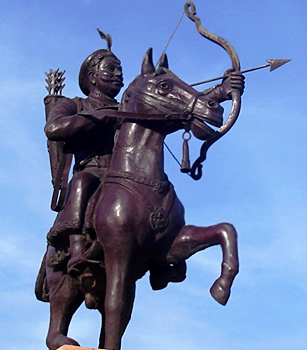
Sunday, August 12, 2012

Chand Bardai


Chand Bardai
Chand Bardai (September 30, 1149 – 1200) was a Hindu Brahmin and the court poet of the Indian king Prithviraj III Chauhan, who ruled Ajmer and Delhi from 1165 to 1192. A native of Lahore, Chand Bardai composed the Prithviraj Raso, an epic poem in Hindi about the life of Prithviraj. A Bhatt Brahman of Jagati gotra, he was a worshiper of the goddess Saraswati, who gifted him with the boon of Bardai
.
The Prithviraj Raso was embellished with time and quite a few authors added to it. Only parts of the original manuscript are still intact. There are many versions of Raso but scholars agree that a 1400 stanza poem is the real "Prithivraj Raso". In its longest form the poem comprises upwords of 10,000 stanzas.
The Prithviraj Raso is a source of information on the social and clan structure of the Kshatriya communities of northern India. The historicity of Prithviraj Raso was proved unreliable by historical writers like Buhler, Morrison, GH Ojha and Munshi Devi Prasad.

Family

Chand Bardai was married twice. His wives Kamla and Gauran gave birth to 10 sons, namely Sur, Sunder, Sujan, Jalhan, Vallah, Balbhadra, Kehari, Vir Chand, Avdut and Gunraj, and one daughter, Rajabai.

Career and work

The royal poet had mastery of grammar, literature, astrology, prosody and the Puranas. He was conversant with the Abhiri, Autkali, Chandali, Dravirhini, Shkari, Swali and Vijaitia dialects. One of his most famous work was Prithviraj Raso. He compiled it in the archaic form of Brajbhasa. It is a long poem consisting of nearly 100,000 stanzas elucidating a chronicle of his master’s achievements and the historical accounts. According to Colonel Tod, the poems of Chand Bardai have frequent indistinct references to fire arms, especially the malgola. Impressed by the classic elegance of the work, Colonel Tod translated about 30,000 stanzas into English. French scholar Garsa-de-Tasse certified and testified the authority of this compilation

Chand Bardai was not only a court poet but was a member of the inner circle of the king. The poet accompanied the king during wars. In the second battle of Tarain (now Taraori, near Karnal in Haryana state — then Punjab) in 1192 A.D.,Prithviraj lost and captured by Mohammad Ghori and Chand Bardai accompanied him.After the king was blinded at Ghori's court it was only with the help of Chand Bardai that Prithiviraj could kill Mohammad Ghori. This event is described by Chand Bardai in the couplet,"Chaar baas, chaubees gaj, angul ashta pramaan, yete pe sultaan hai, mat chuko chauhan". Although there are many other forms of this recital, this is the one mentioned in Prithviraj Raso. These events, as written by Bardai and later completed by his son are described in the article on Prithviraj Raso.

Tuesday, December 6, 2011

House of Tulsipur


The Royal House of Tulsipur or Tulsipur-Dang was one of 22 principalities in the Baise Rajya confederation of the western Rapti region before the unification of Nepal, c. 1760. The Rajas of Tulsipur-Dang belonged to the Chauhan clan. From Chaughera (near Ghorahi, Dang) they ruled the Dang and Deukhuri Valleys as well as territories around Tulsipur State south of the Siwaliks, now in India.
Tulsipur kingdom was about 150 by 150 miles. It bordered Salyan Rajya (Nepal) and Pyuthan (Nepal) in the north, Balarampur Principality (India) in the south, Madi Khola (Nepal) and Arnala River (Basti, India) in the east and Bahraich (India) in the west.
During the unification of Nepal, the part in the Siwaliks and the valleys to the north were ceded to Nepal. Remaining lands became known as Tulsipur State, one of the largest Taluqs of Awadh in India. After the Indian War of Independence of 1857 the Tulsipur State was absorbed by the British East India Company.

Key Information

Dynasty

Suryabanshi

Surname

Singh

Gotra

Kashyap

Kul Devata - Dynasty God

Sun God

Shakti-Mata of the Kingdom

Mata Patan Devi or Pataneshwori Mata. Her Temple is in Tulsipur, near Balarampur (present day India). The temple is less than One kilometre from Tulsipur Railway Station and Two kilometer from Tulsipur Bus Station. It is 29 kilometer from Balrampur, 65 kilometer from the Gonda and 150 kilometer from Gorakhpur. A major celebration and puja takes place during "Chaite Dashain" and "Navaratri" at the Goddess Patan Devi's Temple.

Jagat-Guru of the Kingdom

Baba Ratan Nath (Grandson of Gorakhnath). His monastery is in Chaughera Dang, Nepal. This site is situated in Ghorahi Municipality ward No. 4 Chaughera, one and half km east by Ghorahi Lamahi highway. A major celebration and puja takes place 7 days before "Chaite Dashain" at the Baba Ratan Nath's Monastery.

Kingdom, Palaces and Notes

Tulsipur State Principality in India currently lies near a town in district of Gonda, Oudh / Avadh. Connected to Utraula by road, the remains of old mud fort of the large palace still resides in the southern part of Tulsipur near Balarampur India. This was the Southern Palace.
Before 1760-1786 AD Unification War, this principality was known as Tulsipur Dang rajya which was part of 22 principalities of Nepal. Remaining walls of an old palace fort is in Tulsipur-Chaughera region (Chaughera Dang Tulsipur, Nepal). This was the Northern Palace.
House of Tulsipur Rajahs used Northern Palace during summer months and Southern Palace during winter months. Tulsipur rulers were Hill Chauhans from (Chauhan SINHRAJ Clan) and claimed King Rama and his descendants of Ayodhya as their ancestors.


Ancient History

The land, Its Rulers and Their Origin

History vs. Mythology: There have been various writers from the West and the East including Christians, Muslims, Buddhists and Hindus who have used the word "Ancient History" and "Mythology" interchangeably perhaps not to the fullest satisfaction of purists and modern historians. For the sake of brevity and for the purpose of this section "Ancient History", it is used here interchangeably.

King Vivaswata

He was the founder of Ayodhya. He is considered father of Manu and descendant of Narayana, Brahma, Marichi, Kashyap Rishi and Sun God.
Other notable Suryabanshi Kings following King Vivasata in ancient times have been:

Ikshvaku

He played a pivotal role in the transformation of the ancient Vedic religion into modern Hinduism.

Prithu

He chased Prithvi, who fled in the form of a cow and eventually agreed to yield her milk as the world's grain and vegetation.

Mandhata

He became a famous and Chakravarti (ideal universal ruler) king. He defeated most of the other kings of his time.

Harishchandra

He was renowned for his piety, justice and often told as a benchmark for an ideal life.

Sagar

King Sagara performed "Ashwamedha Yagya" to prove his supremacy.

Dilip

King Dilipa was a very pious king and performed as many as 100 Yagnas.

Bhagiratha

He is credited for bringing River Ganga to Earth.

Raghu

He was a king of Aryan History. The famous saying started after King Raghu is that " Raghukul reet sada chali aayi, praan jaaye par vachan na jayee" (means that whatever happens, even the life goes but the words given to someone must be kept at any cost).

King Rama of Ayodhya

According to Hindu Mythology and Legend Lord Rama's kingdom spanned from present day Iran including Afghanistan to end of New Zealand including Indonasia (Source: Various Hindu Legend, Mythology and History of Ancient India). This is based on how the story unfolds in Ramayana during "Ashwamedh Yagya" conducted by King Rama. Present day Iran is written here because land description such as vast western land beyond Kyber pass and Samarkand is mentioned in many stories of Ramayana. King Bali is mentioned in Ramayana and based on land description it would be currently eastern land of Indonasia, Australia and New Zealand. Until archeological evidence is found, this is all based on Mythology. Note: As early as 323 BC, Hindu King Chandragupta's kingdom spanned from the west bordering Persia - currently known as Iran to Vidhyas in the east.
The Hindu Holy Scriptures "Vayu Purana" and "Uttra khand" of the epic story Ramayana speak of the two Kosalas. It mentions Shravasti as capital of the North Kosala and Kusavati as that of the South Kosala. The two Kosalas are said to have been once under the suzerainty of one and the same king, known as Lord King Rama. The epic hero Lord King Rama had installed his son Prince Lava in North Kosala with Shravasti as its capital which lies on the foot of the Himalayas and his son Kusa in South Kosala as Kusavati as its capital which lies on the foot of the mountain Vindhyas.
On the border district of Gonda and Shravasti lies a vast area of ruins presently known as Sahet Mahet or Set Mahet. The ruins of Sahet, known as ancient Sravasti, are spread over an area of 400 acres. Towards the Rapti River, a little north of Sahet, lies the ancient city of Mahet. The fortified entrance to Mahet is made of mud, constructed in a beautiful crescent shape. The area represents ancient site of Shravasti known as the capital of Uttar Kosala.

King Brhadbala

Suryabanshi Rajah Brhadbala participated in the war of Mahabharata.

King Sumitra

He is presumed to be the last King of Ayodhya and of the entire land belonging to Lord King Rama. Legend has it that after Suryabanshi King Sumitra, his Kingdom that spanned from modern Iran to New Zealand, was divided into hundreds of different kingdoms to be ruled by various Suryabanshi Kings in broader Asia.

King Sravast

According to Mahabharata, he was King of Sravasti, Capital of Uttar Koshala. The ancient history of these districts is the history of Shravasti and regions around it. This region is about 16 km from Balrampur, 83 km north of Ayodhya and 1,152 km from Rajgir. The town was founded by Sravast - a king of Chauhan Solar race and descendant of King Rama. The first member of the twin name, Sahet Mahet, is applied to the site of the walled city of Shravasti.

Amhul Dev (600 BC)

Founder of Chauhan Kingdom in Northern and Western South-Asia.

Suryabanshi Kings and Notes

According to Holy Puranas, Holy Upanishads, Shruti Scriptures, Religious Epic Stories and Ancient History of India, there have been 350 known generations of Suryabanshi Kings (and thousands of unknown/unwritten generation of Suryabanshi rulers) from ancient period of Vivaswata to early medieval time of Chauhan SINHraj.

1st Millennium History (1 AD to 1000 AD)

King Vikramaditya

Raja Vikramaditya was King of Sravasti or Sahet-Mahet around 1st Century AD. It is said that he was the King of Ujjain as well. Legend says he re-built the temple of Devi Pataneshwori in Tulsipur, India. There is an interesting story about Raja Vikramaditya and the location of Ram Janmabhumi in Ayodhya. In the Hindu tradition in India and Nepal, the widely used ancient calendar is Vikrama Samvat or Vikrama's era. This is said to have been started by the legendary King. Raja Vikramaditya's son was AdityaVardhan and grandson was ShaliVardhan.
Other notable Chauhan Kings in 1,000 years from 1st Millenium to Medieval times have been:

Ajaypal Dev

250 AD

Dholrae Pal

600 AD

Chauhan Manikrae

650 AD

Sinhraj Chauhan

725 AD. Considered 350th Suryabanshi King and ancestor of the Hill Chauhans who ruled the foothills of the Himalayas in the north-west frontier of South-Asia.

Raja Mordhwaj Dev

Born 970 AD – Died 1020 AD.
He was King of Sravasti. His eldest son was Suhel Dev.

Raja Suhel Dev

Born 995 AD - Died 1050 AD
Suhil or Suhel Dev of Sahet Mahet was known widely for his valour. He is said to have forewarned Muslim invader Sayyed Salar Masood or Masud that if he wished to save his and his men's lives, he had better leave the land and go elsewhere. Suhel Dev asserted that the land belonged to his ancestors and they were determined to drive the outsiders from their land. Masud, thereupon sent a brief and simple reply that the country is God's and that the property of him belongs to on whom He bestows it. Whoever gave it to your father's and your ancestors, he questioned.
The council of war decided and told Masud to remain on the defensive, but the Hindus drove off his cattle and forced an attack. The loss was great on both sides and one third of Muslim army perished. During month of June 1033 continuous fighting went on. Two-thirds of what remained of the Muslim army was slain and among them was Saiyad Saif-ud-din who was the Kotwal of the Muslim army. In spite of many vicissitudes, Masud did not lose courage and while making a bid to mount his horse to repel the attack; his body-guards were attacked by Shuhel Dev and his men. An arrow pierced the main artery in Masud's arm resulting in his death and the remnants of his body-guards were cut to pieces by Suhel Deo on June 14, 1033.
Thus ended the singular invasion by the Muslims and Islam was in abeyance in Avadh for the next 160 years until the conquest of Shihab-ud-din Ghuri in 1193 AD.
It seems probable that Sultan Iltutmish effected the subjugation of lands as far as Avadh, Bahraich & the districts north of Ghaghra including Gonda. From this time onwards Gonda & Bahraich seem to have always been held singly by the Muslims owing to its isolated position due to river Ghaghra. Sultan Iltutmish appointed his eldest son Malik Nasir-ud-din Mahmud, as governor of Avadh in 1226 AD.
Muslim author Minhaj-uj-Siraj historically recorded in the document known as "Taqat-i-Nasiri", the Muslim prince Malik Nasir-ud-din overthrew and reduced to submission the Bhars under whose sword more than one hundred and twenty thousand Muslims had perished. These Bhars resisted the Muslim prince together with their local rulers of Tulsipur, Gonda, and Bahraich. Tulsipur rulers were descendants of Suhel Dev who claimed King Rama of Ayodhya as his ancestor. There are writing that indicate he re-built Mata Patan Devi's Temple in Tulsipur, India.
The location of this battle to be precise was near Chittaura Jheel, a lake about 8 KM away from modern Bahraich on Bahraich-Gond Road. Ashtwarka Muni, the Guru of Maharaja Janak used to live here in his ashram. Every year a fair is organized here on Basant Panchami.

2nd Millennium - Medieval History (1001 AD to 2000 AD)

Founding of Tulsipur Principality

Hill Chauhans ruled north-western lower Himalayan valleys as early as 700 AD. There are some oral legends that have been passed on i.e. Chauhan SINHRaj (700 AD), Suhel Dev (1000 AD). Writings available in Baba Ratan Nath's monastery indicate Megraj Singh Chauhan as Rajah of Tulsipur during early 13th Century. It is difficult to ascertain if Rajah Megraj was the founder of Tulsipur dynasty. Nevertheless, unless further evidence is uncovered, history of Tulsipur and of its rulers point to Rajah Megraj Singh Chauhan.

24th Ruler - Raja Meghraj Singh Chauhan

Born 1325 AD. Died 1385 AD.
Raja Megraj Singh Chauhan ruled vast land in the lower Himalayas including three lower valleys of Dang, Deokhuri and Rapti. He was 374th Generation of Suryavanshi King.
A deer hunting episode has been recorded in Yogi Baba Ratan Nath's Chaughera monastery which lies currently near Dang / Deokhuri in Nepal. The story narrates that King Meghraj arrow-shot a deer while hunting in his forest land (present day jungles of Nepal / India border). As the deer was struck by the arrow, it ran bleeding heavily. The King followed the trace of blood for couple of miles. At the end of the blood trail, he saw a Yogi-Baba meditating under a large tree. The blood stained arrow was in front of him and Yogi-Baba had blood mark on his ribs.
The king, realizing his mistake, immediately begged for forgiveness. The King asked the Yogi for his permission to speak. Then he humbly requested the Yogi to come to his palace so he could personally nurse the Yogi's wound and offered him 84 kind of dishes known as "Chaurasi Byanjan".
Yogi forgave the King and mentioned to him that he was Baba Ratan Nath (Grandson and/or third line from GorakhNath). He said he was given a mission by Gorakh Nath Baba to establish a Hindu peeth in the western frontier land of Lord Rama's Kingdom (present day Iran / Afghanistan).
In Hindu scriptures, Gorakhnath is considered to be incarnation of Lord Shiva. King Rama himself had worshiped Lord Shiva in many occasions during his reign and prayed to Lord Shiva as his JagatGuru. Stories of King Rama's dedication to Lord Shiva are found in holy book epic Ramayana. It is also found in the book of "Swastani" which is collection of stories and hymns to Lord Shiva.
Baba Ratan Nath blessed 84 Kosh (about 150 miles) in each dual direction (east / west and north / south) as the Kingdom to be ruled by King Meghraj and his descendants. The King built a temple for Baba Ratan Nath in the northern part of his state (currently in Chaughera/Tulsipur/Dang, Nepal).
Baba Ratan Nath re-established Patan Devi Temple in Rajah Meghraj's southern part of the state (currently in Tulsipur village near Balarampur India) per Gorakhnath's wishes. Devi Patan temple is one of the most important 51 Shakti Peeths revered by Hindus in Nepal and India border. Located 70 km from Gonda and 2 km from Tulsipur village in India, this famous shrine is surrounded amidst the beauty of Himalayan tarai. It is believed that while Lord Shiva was carrying the corpse of his wife Sati, the right shoulder of Sati had fallen here. In addition, it is believed that goddess Sita entered the earth at this place.
After blessing King Meghraj Singh Chauhan, Baba Ratan Nath is said to have moved on to his mission to the western frontier land (present day eastern Iran and Afghanistan) of Lord Ram.
Even to this day, a large fair takes place every year during Chaitra Dashain/Panchami at Baba Ratan Nath's monastery (present day Nepal) and Patenashwori Temple (present day India). For seven (7) days Baba Ratan Nath is worshiped in his monastery. The day before Chaita Dashain, deity of Baba Ratan Nath is taken from Tulsipur/Dang Nepal to Patan Devi temple in Tulsipur India. On Chaita Dashain/Panchami, both deities are worshiped side by side.

29th Ruler - Raja Udat Singh Chauhan

He ruled in the period of 1485 AD.

33rd Ruler - Raja Dev Narayan Singh Chauhan

1575 AD.

38th Ruler - Raja Ramkrishna Singh Chauhan

Oral legend says he ruled in the period of 1675 AD.

18th Century History

40th Ruler - Raja Nawal Singh Chauhan

Born 1730 AD. Died 1795 AD.
King Nawal Singh Chauhan was considered the 40th chief King and Raja of the Chauhan SINHraj clan (Source: Hamilton - British author).
King Nawal was also known as Nawab Singh by his Muslim subjects. He ruled from Caughera (present day Nepal). He has been identified by various names such as Newal / Nehal / Nawab / Nawal Sen / Singh. King Nawal's vast state borders at this time were Salyan Kingdom (Nepal) in the North, Balarampur Kingdom (India) in the South, Madi River (Maaddi Khola, Nepal) and Arnala River (Basti District, India) in the East and Bahraich (India) in the West.
In 1760-1763 AD, while King Nawal Singh Chauhan was away at the southern palace during winter months time, his northern land Tulsipur-Dang-Chilli-Phalabang was annexed by Gorkhali King Prithvi Narayan Shah. The land including Dang, Chhilli and Phalabang were given as a dowry in the marriage of King Prithvi's daughter to Ranabhim Shah in 1767 AD (Source: Tamrapatra 1804 Vikram Sambat, Nepali Itihas). King Prithvi did this as a reward to King of Salyan for helping or staying neutral during the war against Rajah of Tulsipur.
Unhappy that King Prithvi had attacked his land while he was away in the southern part of his country; he went to sporadic wars lasting over two decades against the Gorkhali King and Salyani Raja. During these years King Prithvi Narayan died in 1775 AD in Kathmandu and his son Singha Pratap died in 1777 AD in Kathmandu as well. Rajah Nawal Singh continued to wage sporadic wars which lasted for many years (about 25 years to be precise) but he was eventually defeated.
Finally in 1786 AD during Regent Bahadur Shah and King Rana Bahadur Shah's time, all of his land in the Nepali Territories were ceded to Kingdom of Nepal. Consequently, Raja Nawal Singh Chauhan was forced to move to southern part of his land near Balarampur (currently in India). He ruled from his southern palace as Rajah of Tulsipur (one of the largest Taluqs of Oudh) hence forth.
Historians have noted that Tulsipur Rajya in the Nepali Territories were known by various names such as Tulsipur-Dang Rajya or Dang-Tulsipur Rajya or simply Dang Rajya. The correct history is that the kingdom was known as Tulsipur Rajya - one of 22 Principality until the war of 1760-1763 AD. After the defeat of Rajah Nawal Singh Chauhan by Gorkhali Rajah, the land of Dang-Chilli-Phalabang were divided and ruled by various Rajahs paying tribute to Rajah of Salyan. Rajah of Tulsipur continued his claim to these lands. This all ended after the final unification to Nepal in 1786 AD.

Raja of Tulsipur State - One of the largest Taluq of Oudh

In the late 1700s, British author Hamilton noted that among the most powerful Taluqdars of Avadh/Oudh were Rajah of Tulsipur, Raja of Baiswara, Raja of Balarampur, Rajah of Momudahbad, Rajah of Nanparah and Raja of Tiloi.
Each of these Taluqdars had elaborate forts with guns. Tulsipur State had 12 guns in its fort according to author Hamilton.
Technically speaking, Raja Nawal Singh Chauhan would be the Last Rajah of Tulsipur-Dang Principality as his northern territories were ceded to Nepal in 1786 AD. One could state that, ruling from his Southern_Territories, 1786 AD onwards, it would make Rajah Nawal Singh the first Rajah of Tulsipur State, one of Oudh Taluqas in British India. To the contrary, him and his ancestors were already ruling the Southern_Territories for centuries and the Raja simply continued to rule his remaining Kingdom from his Southern-Palace.
Henceforth, he would continue be the 40th Chauhan and the 40th Rajah of then known as Tulsipur State, one of the largest Taluqs of Oudh in India.

19th Century History

41st Ruler - Raja Dalel Singh

Chauhan Raja Dalel Singh was born in 1750 AD. He died in 1820 AD.

42nd Ruler - Raja Dan Bahadur Singh

Born 1775 AD. Died 1845 AD.
Chauhan Raja Dan Bahadur Singh was a powerful King. In 1822 AD, he went to war and killed Kanslir Shah (Rajah of Salidna or Saliana). He was fiercely known for his ability to put together a force of 25,000 fighters in a day's notice. During his life, it is said that he fought over fifty-two battles. (Source: Full text of Gazette).
Lord Amherst "Governor General of India" came to visit the Chauhan King in 1828 AD. They went for hunting trips shooting Tigers, Rhinos and Elephants and bonded well with each other. Pleased, the British Governor with Nawab of Oudh, increased the Rajah's purse and recognized Tulsipur as an independent state.
According to some Nepali historians, around 1827 AD, King of Nepal ordered Raja of Phalawang and Salyan, Tej Bahadur Shah to expand Nepali territories into plains of India by negotiating with Nawab of Oudh. This did not succeed as the Chauhan Raja of Tulsipur was able to push back Raja Tej Bahadur to the original hilly territories of Tulsipur. It is also evident from the fact that the entire Southern Tarai Territories of Tulsipur was receiving purse and paying tax to British East India Company until 1857 Mutiny War.
Raja of Tulsipur fought sporadic wars over territories with Raja of Balarampur Digbijay Singh around 1839 AD which lasted for some time without any decisive results (Source: Gazeneer of the province of Oudh).
British historians have noted that there is suspicion King Dan Bahadur Singh was poisoned by his son Rajah Drigraj Singh who wanted to become King sooner.

43rd Ruler - Raja Drigraj Singh

Born 1795 AD. Died 1855 AD.
Raja Drigraj Singh was weak and old by the time he became King. It is an interesting observation from historical perspective that Chauhan Raja Drigraj himself was banished to Balarampur in 1850 AD by his son Raja Drig Narayan Singh. There is suspicion that Raja Drigraj Singh was poisoned by his son, Raja Drig Narayan in 1855 AD while imprisoned (nazarband) in Balarampur.

44th Ruler - Raja Drig Narayan Singh

394th Generation of Suryabanshi King. Born 1825 AD. Died around 1859 AD.
Raja Chauhan Drig Narayan Singh was a rebel from early on. He resisted paying tax to the British in 1855 AD. In the meantime Sepoy Mutiny - First War of Independence broke out. British East India Company considered King Drig Narayan a barrier to the British expansion plan. British force from Delhi was sent to capture the King. He was imprisoned, "nazarband" and kept in Lukhnow Fort called "The Residence". This palace was built by Nawab Asif-ud-Daula in the year 1775 AD.
At the time of Mutiny in August 1857, the political prisoners in the fort were King Wajid Ali Shah's brother Mustafa Ali Khan, Mughal Princes Mirza Mohammad Shikoh and Mohammad Humayun Khan, Nawab Rukn-ud-Daula and the "Raja of Tulsipur" Chauhan Drig Narayan Singh.
His consort, Rani of Tulsipur Ishwar Kumari Devi was Joint Leader of the War of Independence during 1857-1858 AD. The Rani was considered a heroine during the freedom fight. While Rajah Drig Narayan Singh was a prisoner in Lucknow fort, Rani of Tulsipur was siding actively with the freedom forces in Bahraich to free her husband and her country from the British. Her contributions to the cause of freedom were remarkable. She had collected a large force to assist the freedom forces and strengthen her own position. Raja Riasat Ali Khan of Utraula had also joined the freedom forces at Gorakhpur under Mohammad Hasan who once was the nazim of Gonda-Bahraich.

End of Tulsipur Principality

The Rani of Tulsipur, Ishwar Kumari Devi, the Raja of Gonda, Devi Baksh and Bala Rao never surrendered. Bala-Rao later died in the malaria-infested jungles of Nepal. British crushed the 1857 Mutiny uprising with the help of Maharaja Jung Bahadur Rana of Nepal. The freedom fighters' principalities were confiscated in April 10, 1859 AD when they refused amnesty. State of Tulsipur was bestowed to the Raja of Balrampur who sided with the British throughout the revolt.
Raja of Gonda Devi Baksh Singh, Raja of Peshwa Nana Saheb and Rani of Awadh Begam Hazrat Mahal escaped to Nepal territories.
The last Rajah of Tulsipur, Chauhan Drig Narayan Singh, a political prisoner of the British East India Company, died as a Martyr during the First War of Independence in 1859.
The bloodstained, enraged Rani of Tulsipur, who refused to give up without a fight, escaped capture by the British only to die in 1865 AD of exposure or disease in the wilds of southern Nepal, a fate she may have preferred to slavery.
Thus ended the rule of the Hill Chauhans, the sovereignty of their Tulsipur Kingdom and a dynasty that had lasted for 1100 Years.

45th Chauhan - Tirtharam Singh

Born 1845 AD. Died 1867 AD.
Tirtha Ram Singh was on the run with his mother, Rani of Tulsipur Ishwori Kumari Devi, during and after 1857 Mutiny. He had personally taken his son Har Dayal Singh when he was two years old to Banaras for his son's safety. It is likely that he died around Nepal India border not too long after his mother's death in the Jungles of Nepal and India.
The major difficulty in finding written accounts of Chauhan Tirtha Ram Singh stems from the fact that little is available since most of the people who formed the core elements of the rebels or freedom fighters were either hanged or blown off the mouths of guns or destroyed in the Terai Jungle by disease and hard-life.
Various English and Indian writers on the subject of 1857 Mutiny have stated that all those who were left after were either living in different parts British India or had run off to Nepali territories and thus rendered unable to state anything based on truth because of fear of life or forfeiture of liberty.
Some were so overwhelmed by disgust and grief that they thought it pointless to leave anything for posterity. Some who managed to save their life by escaping were so much pressed by privation and misery that they died premature deaths or forever lived in silence and were unable to leave for the future generations anything which may have been historically useful.