Google+
Showing posts with label Prithviraj Chauhan. Show all posts

Sunday, July 20, 2014

Love story of Prithviraj Chauhan and Sanyogita


Love story of King Prithviraj Chauhan
We keep hearing and reading about Bollywood stars love life. But do you know how the love life of last Hindu king began?

This is the story of Prithviraj Chauhan, the last Hindu ruler. He was not just a brave heart, but was ver romantic too. He was in love with Kannauj’s king Jaichandra’s daughter Sanyogita.

We all know that Prithviraj had kidnapped her and then had married her, but very few of us know that his love life was very interesting.

This story is of that time, when Prithviraj Chauhan became the king after the death of his maternal grandfather and the king of Delhi.

Since Prithviraj’s grandfather did not have his own kids, he had requested Prithviraj’s father to make his grandchild the next King. For this reason, he had to prove himself a lot of times.

During that time, Kannauj’s King Jaichandra, who had a daughter Sanyogita, was very jealous of Prithviraj’s achievements and brave nature.

One day a painter visited the kingdom of Kannauj. He had a lot of pictures of known people with him, which he had drawn. Among these pictures, was the picture of King Prithviraj Chauhan. When unmarried girls of Kannauj kingdom looked at Prithviraj’s picture, they all got attracted to him and started talking about him. This made Prithviraj really popular in Kannauj kingdom.


When Sanyogita heard about Prithviraj’s picture, she couldn’t wait to see it herself. When she saw Prithviraj’s picture with her friends she fell in love with his good looks and took that picture from that painter and kept it with herself.


During that time, King Jaichandra had arranged for a swayamvar for his daughter Sanyogita, where he invited prince from various kingdoms, but Prithviraj. Moreover, he even insulted Prithviraj by keeping a statue of him at the main door

When the Swayamvar began, Princesses Sanyogita didn’t like any prince. Soon her eyes fell on the statue of Prithviraj at the door. She went up to that statue and put the garland around its neck.

In reality, without anyone’s notice, Prithviraj had come there and was standing posing like a statue. Seeing her daughter putting the garland around Prithviraj’s neck, Jaichandra got angry and ran towards Sanyogita to kill her with his sword. To save his bride, Prithviraj ran away with Sanyogita on his horse.

Later Jaichandra made friends with Mohammad Gauri to take revenge on Prithviraj. But later Mohammad Gauri befooled Jaichandra and got him arrested and put him in jail.


Sunday, December 9, 2012

Conquest of Prithviraj Chauhan


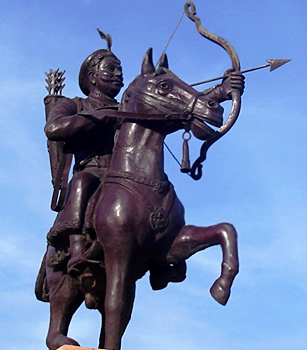
Prithviraj Chauhan

Conquest of Prithviraj Chauhan can be characterised as aggressive and implementation of shrewd tactics occasionally. Prithviraj Chauhan was a king of the Chauhan dynasty, who controlled the kingdom of Delhi and Ajmer in northern India during the second half of the twelfth century. He belonged to the Agnikula clan of Rajputs. Delhi had witnessed Prithviraj Chauhan as the last Hindu King. He ruled to a large extent current Rajasthan and Haryana, and unified the Rajputs against Muslim invasions.

Battle against Bhimdev Solanki of Gujarat
Prithviraj Chauhan had killed many of Bhimdev`s generals before getting into a war with him. Bhimdev was a ruler of the Solanki dynasty in Gujarat. A general had betrayed Prithviraj and had joined Bhimdev in this battle. He had given all the inside information to Bhimdev and had poisoned Prithviraj Chauhan`s army. Bhimdev was sending his army men accordingly. All his plans failed and on the final day of the battle, Bhimdev himself clashed with Prithviraj Chauhan and was crushed to defeat.

Battle against Mahoba
Some Chauhan dynasty soldiers from Delhi decided to stop at the Mahoba royal gardens as they were injured. The Mahoba soldiers told the Delhi soldiers that they had insulted the Mohaba king Parmar by stepping into his garden and were attacked. Prithviraj Chauhan came to know about this and declared war on Mahoba. The Mahoban army was divided into three different sections during this battle. One part was led by the Prince of Mahoba, whilst the other two were led by the brothers Alha and Udal. Prithviraj Chauhan defeated the section controlled by Udal and Prince of Mahoba. Udal had injured Pundir a friend and general of Prithviraj Chauhan in combat. Udal was then killed by Prithviraj who was injured badly. Prithviraj and his friend Sanjham Rai, who was also injured, fell down a nearby hill and were left to be eaten by crows. Sanjham Rai, in order to save his friend allowed the crows to feed on him and not on Prithviraj and died a slow death. Alha`s section was still in battle with Prithviraj`s army. He was stopped from killing Prithviraj Chauhan by his guru. When Chand Bardai, had arrived Prithviraj became unconscious. He recovered later and was grieved at his friend`s death.

Prithviraj Chauhan continued his conquests winning one territory after another.

One of Prithviraj`s small battles was in opposition to King Raichand. King Raichand and some of the other neighbouring kings took advantage of Prithviraj`s injury. They attacked at that time knowing his inability to fight .The generals and close friends of Prithviraj Chauhan guarded the king of Delhi. Some villagers also came in handy to get rid of King Raichand and he was finally killed.

Prithviraj Chauhan took over the Kukada kingdom. He continued expanding his area of control by extending his region in all four directions. His army continued a rather bloody victory march for over four years. They won the battle against King of Dariyagargh. Soon after this conquest he had to witness the destruction of a major portion of his state. This was Muhammad Ghori`s first attack on Prithviraj`s province.
Shahabuddin Ghori
First Battle of Tarain 1191
In 1191, Shahabuddin Ghori invaded India through the Khyber Pass and reached Punjab. He captured a fortress, either at Sirhind or Bathinda on the north-western frontier of Prithviraj Chauhan`s kingdom. Prithviraj`s army led by his vassal prince Govinda-Raja of Delhi rushed to defend the frontier. The two armies met at the town of Tarain, near Thanesar in present-day Haryana. Shahabuddin Ghori`s army had been divided into three flanks. The Hindu Rajput army had elephant cavalry whereas Shahabuddin Ghori`s army had no elephants. Shahabuddin Ghori`s horse cavalry was unable to hold its own against Prithviraj`s elephant cavalry, resulting in the defeat of Shahabuddin Ghori`s left and right flanks. Two regiments of the Muslim army with Shahabuddin Ghori attacked the center with a body of soldiers; where Shahabuddin Ghori met Govinda Raja in personal combat. Ghori`s army was exhausted and withdrew back and Shahabuddin Ghori himself was captured by the Rajputs.

Second Battle of Tarain, 1192
In 1192, Shahabuddin Ghori re-assembled his army and returned to challenge Prithviraj at the Second Battle of Tarain. He had sent his envoy to Prithviraj Chauhan to demand his surrender but Prithviraj Chauhan refused. He assembled a large army with the help of his fellow Rajput rulers to combat Ghori`s army. Shahabuddin Ghori issued delivered an ultimatum to him that he convert to Islam or be defeated. Either of the side could reach on an agreement. Shahabuddin Ghori divided his troops into five parts and attacked the Rajput armies in the early morning hours but retreated as the Rajput elephant group advanced. Khande Rao general of Prithviraj was killed. By the end of the day, Shahabuddin Ghori himself led a heavily-armoured force to the center of the Rajput line, which collapsed into confusion. Prithviraj abandoned the battlefield and attempted to escape but was captured. The Rajput Army also fled, thereby conceding victory to Shahabuddin Ghori.Shahabuddin Ghori took the captured Prithviraj back with him to Ghazni, where he was executed in 1192.

Although Prithviraj Chauhan could not conquer many territories like the other Indian rulers, yet he proved himself as an able soldier in the first battle of Tarain. Conquests of Prithviraj Chauhan proved him to be a great soldier but lacking political insight of a diplomatic administrator. With his victory at Tarain, Muslim rule ushered in North India and decline of Hindu supremacy begun.

Friday, August 24, 2012

Prithviraj Chauhan


Prithviraj Chauhan was born in Ajaymeru (Ajmer) in 1166 A.D. He was the son of Someshwar Chauhan and Karpuri Devi(she was a Kalachuri (Chedi) princess, daughter of Achalaraja of Tripuri).
He fought with Muhammad Ghori.Muhammad Ghori attacked India many times. First time he was defeated in Gujarat by Rajputs. Mularaja-II was not even a teen yet and his mother organized the defences of Pattan. Battle was fought at Kayadara near Mount Abu, in 1178 A.D. and Ghori was resoundingly defeated. After this defeat he never entered India through Gujarat. In first battle of tarain in 1191 Prithviraj Chauhan's cavalry charged and routed the Ghurid cavalry and captured Ghori. Ghori begged for his life. Prithviraj allowed him to go despite his generals asking him not to do so..


Prithviraj Chauhan lived at Taragarh fort which was also known as Ajaymeru after which the town of Ajmer got its name.

Following year Ghori attacked again. Prithviraj advanced with his army and sent a letter to Ghori. In this letter Ghori was asked to return as he had been defeated the previous year and was spared his life. Ghori replied that he was in India on the orders of his brother, Ghiasuddin, and that he could only retreat after he got a word from his brother. This letter was sent in the evening and after sending the letter Ghori moved his camp back a few kilometers to feign retreat. On receiving this letter and seeing Muhammad move his camp back Prithviraj assumed that Ghori was not interested in fighting. Ghori also knew that rajputs did not fight in the night and only started fighting after sun had come up. (This is an ancient Kshatriya practice e.g Mahabharata was also fought mostly in day time). Ghori treacherously attacked in the early morning hours when Prithviraj and his army were sleeping and was able to win this war

The founder of the Gahadwala line was Govindchandra Gahadwala. He was an astute ruler and ruled from Kannauj. Most of North India, including the university town of Nalanda was a part of his kingdom. He stoutly defended his kingdom from further Muslims incursions. He instituted a tax for this purpose which was called Turushka Danda (i.e. tax to fight the Turushkas or Turks). His grandson was Jaichandra Gahadwala (Rathod) who played a tragic role in Indian History.

The Story of Prithviraj Chauhan and Muhammad Ghori

In Jaichand's days, a rival Rajput clan had established itself in Delhi (Pithoragarh). The ruler there was Prithviraj Chauhan. Pritiviraj was a romantic, chivalrous and an extremely fearless person. After ceaseless military campaigns, Pritiviraj extended his original kingdom of Sambhar (Shakambara) to Rajasthan, Gujarat, and Eastern Punjab. He ruled from his twin capitals at Delhi and Ajmer. His fast rise caught the envy of the then powerful ruler Jaichandra Gahadwala and there was a lot of ill-feeling between the two.

Prithiviraj's Love for Sanyogita - Jaichandra's Daughter

The story of Prithviraj's bold exploits spread far and wide in the country and he was the center of much discussion in the circle of the nobility. Sanyogita, the daughter of Jaichandra Gahadwala fell secretly in love with Prithiviraj and she started a secret poetic correspondence with him. Her father the haughty Jaichandra got wind of this and he decided to teach his daughter and her upstart lover a lesson. So he arranged a Swayamwara (a ceremony where a bride can select her husband from the assembled princes. She had the right to garland any prince and she became his queen. This is an ancient Hindu custom among Royalty). Jaichandra invited all the big and small princes of the country to Kannauj for the royal Swayamwara. But he deliberately ignored Prithiviraj.

To add insult to injury, he even made a statue of Prithiviraj and kept him as a dwarpala (doorman).

The Elopement of Sanyogita with Prithviraj

Prithviraj got to know of this and he confided his plans to his lover.
On the said day, Sanyogita walked down the aisle where the royals had assembled and bypassed all of them only to reach the door and garland the statue of Pritiviraj as a doorman. The assemblage was stunned at this brash act of hers. But what stunned them and her father Jaichandra was the next thing that happened.

Prithiviraj who was hiding behind the statue, also in the garb of a doorman, whisked Sanyogita away and put her up on his steed to make a fast gateway to his capital at Delhi

Chauhan-Rathod Warfare Leads to Weakening of both Rajput Kingdoms

Jaichandra and his army gave earnest chase and in the resultant string of battles between the two kingdoms fought between 1189 and 1190, both of them sufferred heavily. While this drama was being enacted, another ruler also named Mahmud who was from Ghori in Afghanistan had grown powerful and had captured Ghazni and subsequently attacked the Ghaznavid Governor of Punjab and defeated him. The kingdom of Mahmud Ghori now stretched up to the domains of Prithiviraj Chauhan. A clash was inevitable
Prithivi raj Chauhan

The 1st Battle of Tarain 1191 C.E. - Victory of Prithiviraj Chouhan

Mahmud Ghori threw the gauntlet by laying siege to the fortress of Bhatinda in East Punjab which was on the frontier of Prithiviraj's domains. Prithviraj's appeal for help from his father-in-law was scornfully rejected by the haughty Jaichandra. But undaunted Prithviraj marched on to Bhatinda and met his enemy at a place called Tarain (also called Taraori) near the ancient town of Thanesar. In face of the persistent Rajput attacks, the battle was won as the Muslim army broke ranks and fled leaving their general Mahmud Ghori as a prisoner in Pritiviraj's hands.

Mahmud Ghori was brought in chains to Pithoragarh - Prithviraj's capital and he begged his victor for mercy and release. Prithviraj's ministers advised against pardoning the aggressor. But the chivalrous and valiant Prithviraj thought otherwise and respectfully released the vanquished Ghori.

The 2nd Battle of Tarain 1192 C.E. - Defeat of Prithiviraj Chauhan

The very next year Prithiviraj's gesture was repaid by Ghori who re-attacked Prithiviraj with a stronger army and willfully defeated him by attacking the Rajput army before daybreak. (The Hindus incidentally followed a hoary practice of battling only from sunrise up to sunset. Before Sunrise and after Sunset there was to be no fighting- as per a time honored battle code)The defeated Prithiviraj was pursued up to his capital and in chains he was taken as a captive to Ghor in Afghanistan.

The Blinding of Prithviraj


The story of Prithiviraj does not end here. As a prisoner in Ghor he was presented before Mahmud, where he looked Ghori straight into the eye

Prithivi raj Chauhan

Ghori ordered him to lower his eyes, whereupon a defiant Prithiviraj scornfully told him how he had treated Ghori as a prisoner and said that the eyelids of a Rajputs eyes are lowered only in death.On hearing this, Ghori flew into a rage and ordered that Prithviraj's eyes be burnt with red hot iron rods

This heinous deed being done, Prithiviraj was regularly brought to the court to be taunted by Ghori and his courtiers. In those days Prithiviraj was joined by his former biographer Chand Bardai, who had composed a ballad-biography on Pritiviraj in the name of Prithviraj Raso (Songs of Prithviraj). Chand Bardai told Prithiviraj, that he should avenge Ghori's betrayal and daily insults.

Prithivi raj Chauhan


The Blind Prithviraj avenges the Injustice done to him

The two got an opportunity when Ghori announced a game of Archery. On the advice of Chand Bardai, Prithviraj, who was then at court said he would also like to participate. On hearing his suggestion, the courtiers guffawed at him and he was taunted by Ghori as to how he could participate when he could not see. Whereupon, Prithiviraj told Mahmud Ghori to order him to shoot, and he would reach his target.

Ghori became suspicious and asked Prithviraj why he wanted Ghori himself to order and not anyone else. On behlaf of Prithiviraj, Chand Bardai told Ghori that he as a king would not accept orders from anyone other than a king. His ego satisfied, Mahmud Ghori agreed.
Prithivi raj Chauhan

On the said day, Ghori sitting in his royal enclosure had Prithiviraj brought to the ground and had him unchained for the event. On Ghori's ordering Prithviraj to shoot, we are told Prithiviraj turned in the direction from where he heard Ghori speak and struck Ghori dead with his arrow. This event is described by Chand Bardai in the couplet, "Dus kadam aggey, bees kadam daey, baitha hai Sultan. Ab mat chuko Chauhan, chala do apna baan." (Ten feet ahead of you and twenty feet to your right, is seated the Sultan, do not now miss him Chauhan, release your arrow).


Thus ended the story of the brave but unrealistic Prithviraj Chauhan - the last Hindu ruler of Delhi. Delhi was to remain under Muslim rule for the next 700 years till 1857 and under British rule till 1947. Those few Hindus who came close to liberating Delhi during the seven centuries of Muslim rule were Rana Sanga in 1527, Raja (Hemu) Vikramaditya in around 1565 (2nd battle of Panipat), and Shrimant Vishwas Rao who was the Peshwa's son and was co-commander of the Maratha forces in the 3rd battle of Panipat in 1761. Metaphorically speaking, the next Hindu ruler to actually preside over Delhi was to be Dr. Rajendra Prasad, the first President of Independent India (and Jawarharlal Nehru - who was the President's first Minister).

Sunday, August 12, 2012

prithviraj chauhan pics


prithviraj chauhan

prithviraj chauhan

prithviraj chauhan

prithviraj chauhan

prithviraj chauhan

prithviraj chauhan

Qutub Minar Legends


qutub minar
There a number of legends related to the Qutub Minar of New Delhi. Some people believe that the monument was actually built by Prithviraj Chauhan, so that his daughter could behold the sacred river Yamuna from its top as part of her daily worship. Since Qutub Minar's entire architecture seems to be of Islamic origin, these legends seem to be baseless.

However, Hindu craftsmen and sculptured stones of some Hindu temples were certainly employed for its construction, as is evident from the 'Devanagari' inscriptions on its surface. It is said that a cupola surmounted the stone tower originally, which was destroyed by an earthquake. Later, an effort was made to replace it in the 19th century, but it was brought down in 1848. It can still be seen on the lawns to the south east of Qutab Minar.

Sanyogita


sanyogita

Sanyukta, also known as Sanyogita, Sanjukta, or Samyukta, was the daughter of Raja Jaichand of Kannauj. She became the wife of Prithviraj Chauhan, the king of Delhi. Prithiviraj was a Rajput who ruled from his twin capitals of Delhi (Pithoragarh) and Ajmer. He is a popular figure of romance and chivalry from the folklore of medieval India, and also a figure of tragedy.

The love between Prithviraj and Sanyukta(Sanyogita) is one of India's most popular medieval romances. At the peak of his reign, Prithviraj had annexed vast regions of India to his kingdom, and his fame had spread all across the subcontinent and to Afghanistan. Many lesser kings were envious and wary of his power, including Raja Jaichand of Kannauj. Jaichand's daughter, Samyukta (Sanyogita), was a headstrong girl who was known for her bewitching beauty.
Sanyukta(Sanyogita) fell in love with Prithiviraj as his reputation dazzled her. She desired nobody but him. For his part, Prithviraj had heard of Sanyukta's (Sanyogita's) loveliness and fell in love with her as well.
However, Jaichand and Prithviraj belonged to rival Rajput clans.
On finding out about the affair, Raja Jaichand was outraged that a romance had been budding behind his back. Jaichand decided to insult Prithiviraj and arranged a Swayamvara for his daughter. He invited royalty from far and wide to the ceremony, every eligible prince and king - except Prithiviraj. He then commissioned a clay statue of Prithiviraj, which served as doorman (dwarpala) to Jaichand's court.
Prithviraj, on hearing about the impending swayamvara, devised a plan to elope with the bride to be.
On the day of the ceremony, Sanyukta(Sanyogita) walked through the court holding the ceremonial garland, ignoring the gazes of her ardent suitors. She passed through the door and put the garland around the neck of Prithviraj's statue, declaring him her husband. Prithiviraj, who meanwhile was hiding behind the statue, caught Sanyukta(Sanyogita) up in his arms, set her on his horse, and whisked her away to Delhi. Raja Jaichand was enraged. This led to a rift between Delhi and Kannauj, which was later taken advantage of by Mohammad Ghori of Afghanistan.
Mohammad Ghori attacked the fortress of Bhatinda in East Punjab, which was on the frontier of Prithiviraj's vast domain. Prithviraj's appeals to Kannauj for help were rejected. Undaunted, the famous warrior king of Delhi marched on to Bhatinda and met his enemy at Tarain, near the ancient temple town of Thanesar. Prithiviraj won the battle there, and Mohammad Ghori was made his prisoner. He begged for mercy and release. Prithviraj, who was renowned for his sense of honor and chivalry, respectfully released Ghori against the advice of his ministers.
Ghori rode to Afghanistan, and then returned to India with a stronger army. Kannauj again did not come to Prithviraj's aid. Ghori attacked Prithiviraj and defeated him. Prithiviraj, along with his courtier Chand Bardai, was sent to Afghanistan as a prisoner.
Maharani Sanyukta(Sanyogita), along with her ladies, committed Jauhar and ended their lives instead of surrendering to the lust of the Afghan invader.
The defeat of Prithviraj Chauhan also marked the end of Hindu rule in Delhi until the Marathas in the 1700s.

Prithviraj Raso written by Chand Bardai


The Prithviraj Raso was composed by Chand Bardai, Prithviraj's court poet, who accompanied the king in all his battles. Chand Bardai belonged to the community known as Charans,whose traditional occupation is to compose poems and ballads in praise of their patrons, based loosely on historical incident; they were poets and scribes who accompanied the armies of their patrons and encouraged and exhorted the warriors to bravery in battle by reciting the great deeds of their illustrious clan forebears.

Overtime, the Prithviraj Raso has been embellished with the interpolations and additions of many other authors. Only a small portion of the existing texts is likely to have been part of the original text. Several versions of the Prithivraj Raso are available, but scholars agree that a small 1300 stanza manuscript in Bikaner is closest to the original text. The longest available version is the Udaipur manuscript, which is an epic comprising of 16,306 stanzas. The language of the texts available today largely appears to be post-15th century.

The Prithviraj Raso is a source of information on the social and clan structure of the Kshattriya communities of northern India.

The story related in the epic


According to the ballad, Prithviraj was a romantic, chivalrous and an extremely fearless king who, after ceaseless military campaigns, extended his original kingdom of Sambhar
(Shakambara) in present-day Rajasthan, to cover Rajasthan, Gujaratand eastern Punjab. He ruled from his twin capitals of Delhi and Ajmer. His fast rise aroused the envy of the then powerful ruler of Kannauj, Jaichand Gahadwala, and caused ill-feeling between the two.

Elopement with Samyogita


The story of Prithviraj's exploits spread far and wide and became the subject of much discussion among the nobility. Samyogita, daughter of Jaichand, fell secretly in love with Prithviraj and began a secret correspondence with him. Her father got wind of this and resolved to have her safely wed at an early date. He arranged a Swayamwara, a ceremony where a maiden selects her husband from a number of suitors who assemble at the invitation of her guardian. Jaichand invited many princes of acceptable rank and heritage, but deliberately failed to invite Prithiviraj. To add insult to injury, Jaichand had a statue of Prithviraj made and placed at the door of the venue, thus parodying Prithviraj as a doorman. Prithviraj came to hear of this. He made his plans and confided the same to his lover, Samyogita.

On the day of the ceremony, Samyogita emerged from an inner chamber, entered the venue of the swayamwara, walked straight down the hall past the assembled suitors, bypassing them all. She reached the door and garlanded the statue of Pritiviraj. The assemblage were stunned at this brash act, but more was to follow: Prithviraj, who had been hiding behind the statue in the garb of a doorman, emerged, put Samyogita upon his steed, and made a fast getaway. Jaichandra and his army gave earnest chase, to no avail. This incident resulted in a string of battles between the two kingdoms and both of them suffered heavily. The Chauhan-Gahadvalafeud led to the weakening of both Rajput kingdoms.

Mahmud of Ghor


While this drama was being enacted, an obscure warlord named Mahmud, hailing from Ghor
in present-day Afghanistan, grew increasingly powerful. He captured Ghazniand subsequently defeated the Ghaznavid governor of Punjab. Mahmud Ghori's domain now touched upon that of PrithvirajChauhan. A clash was inevitable. 


First battle of Tarain (1191 CE):

Mahmud Ghori invaded Prithviraj's domains and laid siege to the fortress of Bhatinda in Punjab, which was at the frontier between the two kingdoms. Prithviraj's appeal for help from his father-in-law was scornfully rejected by the haughty Jaichandra. Undaunted, Prithviraj marched on Bhatinda and gave battle to the invaders at a place called Tarain (also called Taraori) near the town of Thanesar.

In face of the Rajput onslaught, the invading Muslim army broke ranks and fled, leaving their leader, Mahmud Ghori, a prisoner in Prithviraj's hands. Mahmud Ghori was brought in chains to Pithoragarh, Prithviraj's capital. He begged his captor for mercy and release. Prithviraj's ministers advised against pardoning the aggressor. However, the chivalrous and valiant Prithviraj thought otherwise and respectfully released the vanquished Ghori. 

Second battle of Tarain (1192 CE):

The very next year, Ghori repaid Prithviraj's gesture by again invading Prithviraj's kingdom with a stronger army. Again, the two armies met at Tarain. The Hindus incidentally followed a hoary practice of battling only between sunrise and sunset. Ghori attacked the Rajput army before daybreak and thus emerged victorious. The defeated Prithviraj was pursued upto his capital. At the point when annihilation became certain, Samyukta committed suicide by self-immolation rather than face the prospect of personal dishonour at the hands of a barbaric invader. Prithviraj was taken in chains to Ghor in present-day Afghanistan.

Captivity, revenge and death


As a prisoner in Ghor, Prithviraj was brought in chains before Mahmud. He haughtily looked Ghori straight into the eye. Ghori ordered him to lower his eyes, whereupon a defiant Prithviraj scornfully reminded him of how he had treated Ghori when the latter was a prisoner. He declared that the eyelids of a Rajput are lowered only in death. On hearing this, Ghori flew into a rage and ordered that Prithviraj's eyes be burnt with red hot iron rods. This heinous deed was committed. The blind Prithviraj was then regularly brought to the presence of the barbaric warlord to be taunted by Ghori and his courtiers.

Prithviraj's former courtier Chand Bardai, who was later to compose the Prithviraj Raso, a ballad-biography of Pritiviraj, came to Ghor to be near Prithviraj in his misery. Chand Bardai came in disguise and secured himself a place in Mahmud's court by purveying his skills as a composer of paens. On the one hand, he earned Mahmud's regard; on the other, he took every opportunity to meet with Prithviraj and urge him to avenge Ghori's betrayal and daily insults.


Killing of Mahmud:

The two got an opportunity when Ghori announced an archery competition. Chand Bardai told Ghori that Prithviraj was so skilled an archer, that he could take aim based only on sound, and did not even need to look at his target. Ghori disdained to believe this; the courtiers guffawed and taunted Chand Bardai, asking how a blind man could possibly shoot arrows. In the spirit of their usual barbaric mockery, they brought the blind and hapless Prithviraj out to the field. Pressing a bow and arrows into his hand, they taunted him to take aim.

Chand Bardai told Ghori that this taunting would avail nothing, for Prithviraj would never do as some sundry courtiers bade him do. He said that Prithviraj, as an anointed king, would not accept orders from anyone other than another king. His ego thus massaged, and in the spirit of the occasion, Mahmud Ghori agreed to personally give Prithviraj the order to shoot.

Thus, Chand Bardai provided Prithviraj with an aural indication of where Ghori was seated. He gave Prithviraj one further indication of the same, by composing a couplet on the spot and reciting the same in Prithviraj's hearing. The couplet, composed in a language understood only by Prithviraj went thus:


"Char bans, chaubis gaj, angul ashta praman,
Ete pai hai Sultan, (Taa Upar hai Sultan),
ab mat chuko hey Chauhan."


(Ten measures ahead of you and twenty four feet away, is seated the Sultan. Do not miss him now, Chauhan). 


Ghori then ordered Prithviraj to shoot. Prithviraj turned in the direction from where he heard Ghori speak, and, taking aim based only on the voice and on Chand Bardai's couplet, he sent an arrow racing to Ghori's throat. Ghori was thus stuck dead by Prithviraj.

Naturally, after this deed, Prithviraj was killed by Mahmud's courtiers. But the brave Rajput had avenged the betrayals and humiliations suffered by him. Thus ended the story of the brave and chivalrous Prithviraj Chauhan, the last Hindu ruler of Delhi. 


Muhammad of Ghor
(Persian:ãÍãÏ ÔÀÇÈ ÇáÏیä ÛæÑی) also Muhammad Ghori,Mohammad Ghauri, etc., originally named Mu'izz-ad-din, b.1162 - d.1206, was a Ghurid emperor and the governor of Ghazni from 1173 to 1206.
Muhammad was the brother of the Sultan Ghiyas-ud-din Muhammad of Ghor , a region of what is now a province in Afghanistan. Ghor lay on the western boundary of the Ghaznevidempire. Before 1160, the Ghaznevid empire covered an area running from central Afghanistanto the Punjab, with capitals at Ghazniand Lahore.

In 1160, the Ghorids conquered Ghazni from the Ghaznevids, and in 1173 Muhammad was made governor of Ghazni. In 1186-87 he conquered Lahore, ending the Ghaznevid empire and bringing the last of Ghaznevid territory under his control.

Muhammad attacked the north-western regions of the Indian subcontinent many times. The first time he was routed in present-day Gujaratby Rajputs.A battle was fought at Kayadara near Mount Abu, where Ghauri'sadvance was defeated. Gujarat later fell to Muhammad Ghori's armies in 1197.

In the First Battle of Taraori in 1191 PrithviRaj Chauhandefeated Muhammad Ghouri. Prithviraj met Ghori in a personal combat and injured him. Later both armies attacked each other and Ghori's army was defetaed. Ghori took his army back to North India and started preparing for another battle. Prithviraj, following the rules of engagement of Rajputwarfare, allowed his foe to escape as he was forbidden by Kshatriya rules to attack an enemy wishing to retreat. It is said that he vowed not to sleep on a bed or take a bath until he had defetaed Prithviraj. Next year, he again reached Taroro and challenged Prithviraj, defeated him and seized control of his kingdom.

One account recounts that after taking him prisoner, Ghori ordered the eyes of Prithviraj to be gouged out and made the blind Prithviraj a subject of ridicule in his court.

After some time, an archery competition was held in Ghori's kingdom. Prithviraj, being a skilled archer of repute was also brought for this competition and asked to compete to ridicule him further. Prithviraj refused to shoot his arrow on the orders of Ghori's generals, being a king himself. As such, Ghori himself asked Prithviraj to shoot at the target. Prithviraj, instead, turned around and locating the source of the voice, shot his arrow straight into Ghori's throat, killing him instantly. The valorous Prithviraj was thus able to avenge his defeat at the hands of Ghori. It was as a result of this that Qutb-ud-din-Aybak, one of Ghori's generals, was able to succeed him and control his empire.

A different version, propogated by Muslim historians, says that after defeating Prithviraj Ghori killed him and gained control of his kingdom and went on to control northern Rajasthan
and the northern part of the Ganges-Yamuna Doab. Allegedly, Muhammad Ghori returned east to Ghazni to deal with the threat to his western frontiers from the Turksand Mongols, but his armies, mostly under Turkish generals, continued to advance through northern India, raiding as far east as Bengal.

Muhammad returned to Lahore after 1200to deal with a revolt of the Gakhartribe in the Punjab. He suppressed the revolt, but was killed during a Gakharraid on his camp on the Jhelum Riverin 1206.

Legacy

Upon his death, Qutb-ud-din Aybak, Muhammad Ghori's most capable general, took control of Muhammad's Indian conquests and declared himself the first Sultan of Delhi. Muhammad's former territory in Afghanistan was conquered by the Mongols.

Muhammad, like his predecessors, routinely killed non-Muslim priests and destroyed non-Muslim temples and towns while his armies pillaged and raped their way across the Indus. In Bihari folklore, it is said that his invading armies often destroyed entire towns only to find valuable scrolls and manuscripts in town libraries useless as all inhabitants who could read and write in the language were slaughtered.

The tomb of Pir Sultan Muhammad Ghori is located at Punjab, Pakistan. Pakistan considers Sultan Muhammad Ghori as a hero, and has named its intermediate-range ballistic missile
the Ghauri missile in his honor.

History of kannauj


Formerly known as Kanyakubja (called Kanogiza by Ptolemy), the town is known to have been an important center during the Gupta empire. It reached the pinnacle of its glory in the 7th century under Harsha as the capital and cultural center of the empire he built. Harsha however was greatly weakened after being defeated by the Chalukya emperor Pulakesin II; his empire fell apart soon after his death. By the end of the 8th century, Kannauj became the focus of a three-way contest by the three dominant dynasties of the time, the Pratiharas of Malwa, the Rashtrakutas of the Deccan, and the Palas of Bengal. The Pala king Dharmapala installed a proxy king at the end of the 8th century; however, the Pratihara king Nagabhatta II conquered Kannauj in the 9th century. Kannauj became the Pratihara capital for nearly 200 years. During this period, it became known as a center for poetry. The Pratiharas ruled much of northern India in the latter half of the 8th century, but they had weakened by the early 10th century. The Rashtrakuta king Indra III captured Kannauj in 916, and by the end of that century, the Pratihara domains had been reduced to a small kingdom around the town of Kannauj. In 1019, the town was sacked by Mahmud of Ghazni, who ushered in a chaotic period for the city. After this sacking of Kannauj, the area came to be dominated by the Chandela Rajput clan of Bundelkhand. The Gahadvala dynasty, descended from former vassals of the Pratiharas, established themselves as rulers of Kannauj at the end of the 11th century. Kannauj recovered some of its former prosperity under the Gahadvalas, but the respite was brief, for the city was sacked again in 1194 by Mohammed of Ghori, and by the early years of the 13th century it was incorporated into the Delhi Sultanate. Kannauj has never since recovered its importance. On the face of it, the story of Sanyogta and Prithviraj may seem to have nothing to with the latter’s wars and campaigns. But if it is true that Sanyogita’s father Jaichand, already a rival of Prithviraj, was angry that she eloped with the Chauhan king, then the bad blood between Chauhan and Rathore is a definite backdrop to the geopolitics of the time. Also, if – as it is said – Prithviraj was so besotted with Sanyogta that he neglected his kingdom to the extent he was oblivious to the danger Mahmud of Gaur presented, then again we can legitimately discuss Sanyogita. After all, this is no ordinary king we are discussing, but the man who was the last Hindu emperor of Delhi, a man of immense contradictions, and who appears to have lost his empire to the Muslims despite his magnificent warrior qualities because of a lack of diligence and a preference for the good and soft life. So from this angle, too, Sanyogta is important. The problem is, according to R.C. Majumdar, there is no evidence to back the story. It originates from the Prithviraso, which was written much after the events it narrates. It’s also worth noting that Prithviraj and Sanyogita are supposed to have eloped in 1175. Even given that she was his youngest queen, if 17 years later the man is still so infatuated with her that he cannot think straight, we can legitimately ask if the story is as told. Kings had their favorite wives, but they had many wives. It would be a bit unusual for a wife to have such a hold for so many years that she is the cause of the king’s neglecting his duties. Our difficulty originates with the part concerning Prithviraj’s antecedents. The popular story has it that two daughters of Anangpal, King of Delhi, married rival kings: Someshwar Chauhan of Ajmer, and Vijaypal Rathore of Kannauj. Prithviraj was born to Someshwar and his wife Kamladevi, Jaichand was born to Vijaypal and his wife Roopsundari. This would make Prithviraj and Jaichand first cousins, though Jaichand was much older to Prithviraj. Furthur, Anangpal of Delhi, having no son, decided to leave his kingdom to Prithviraj, because young as Prithviraj was, he was clearly a better soldier than Jaichand. This discrimination by the grandfather in favor of the junior grandson further exacerbated the hostility Jaichand bore Prithviraj. The problem with this story is several-fold. First, Prithviraj’s mother was not the daughter of the King of Delhi, but of Achalaraja, the Kalachuri king of Tripuri, which is today’s Jabbalpore in Madhya Pradesh. Her name was Karpuradevi and not Kamladevi. Second, Prithviraj inherited the kingdom of Delhi from his father, Someshwar of Ajmer, not from any king of Delhi. Delhi was a vassal of Ajmer, so when Someshwar died, Prithviraj got Delhi as well as Ajmer. Third, there was no Anangpal ruling Delhi during Prithviraj’s time. The closest Anangpal we have been able to locate is the jagirdar of Bhatnar [modern Bhatinda?]. He was a decendent of Bhimpal, last Shahi king of the Punjab – who was disposed of his kingdom by Mahmud Ghaznavi in the 11th century. Anangpal, according to the story, was an Aruyvaid herbalist doctor who became close friends with Prithviraj. The later liked him so much he added to Anangpal’s jagir at Bhatnar, and this inspired Anangpal to attack and recover his lost inheritance of Lahore 1179. However, he could not hold on to Lahore, was pushed out by the Muslims and died. His son Gorakrai was brought back to Bahtnar, and later became a luminary at Prithviraj’s court. Be that as it may, in so far national psyches are shaped by legends, the story of Prithviraj and Sanyogita is one of the most powerful of Indian legends. For Indians, the romance is on par with the most famous of all Western civilization romances, Paris and Helen of Troy. So while as historians we must remain skeptical, as Indians we should remain free to enjoy the story.

prithviraj n jaichand quarrel


Raja Jai Chand convened his famous Rajsu Yajna at Kannauj in 1191 with the object of expelling the Muslims from India. Prithviraj was a special invitee to this function, which was attended by many ruling chiefs of the period. Its seven eminent men represented the Mohyal community, one from each caste of its constellation. They were: Gorakh Rai Vaid, Rai Tirlok Nath Bali, Rai Midder Dev Datt, Rai Narsing Dev Chhibber, Rai Takhan Dev Mohan, Rai Inder Sain Lau and Rai Kailash Dev Bhimwal.

However, the ill-fated convention failed to achieve its goal due to the clash of Prithviraj and Jai Chand whose old rivalries came to the surface over-riding national interests. Prithviraj had abducted Sanyogta, Jai Chand's daughter, from a crowded Swyambar. When he ascended to the throne of Delhi, Jai Chand refused to recognize him as a sovereign and made a rival claim. This breach occurred at a crucial time when a series of invasions of Mohammed Ghori were looming in he horizon. Ghori had captured the empire of Mahmud Ghazni after his death and was now poised with the same devilish designs to conquer India.

PrithviRaj Chauhan


Born : 1168
Died:1192
Father: Someshwar Chauhan
Mother: Kamladevi
Maternal Grand Father: Anangpal
Made King : 1179
Ruled : Ajmer Delhi
Wife: Samyukta


Historical Preface
Bottom of Form
Around 1300 A.D. there was a King called Anangpal, a Tunvar Rajput who ruled over Delhi. He had two daughters Kamladevi and Roopsundari. Kamladevi was married to the King of Ajmer called Someshwar Chauhan. King Someshwar had a son called Prithviraj Chauhan. Roopsundari was married to King Vijaypal of Kanoj. He also had a son named Jaychand. Since King Anangpal had no sons, he adopted Prithviraj Chauhan and declared him to be the successor to the throne of Delhi. King Anangpal gave to his other relations the towns under his jurisdiction. He also gave away Pokran and Phaloji and the surrounding four Jojan land to Dheersinh Tunvar who was a close relation to King Anangpal.
Prithviraj Chauhan(1168-1192) was a king of the Rajput Chauhan ruler who ruled a large area of northern india.
He was born in 1168 to king Someshwara Chauhan and his wife Kamladevi.
He was made king in 1179 at the age of just 11
He ruled in Ajmer and Delhi.
His elopement with Samyukta, the daughter of Jai Chandra, the Gahadvala king of Kannauj, is a popular romantic tale in India, and is one of the subjects of the PrithvirajRaso, an epic poem composed by Prithviraj's court poet, ChandBardai. The Chauhan succession had been rather confused since the death of Vigraha-raja in 1165; Prithviraj reconsolidated control of the Chauhan kingdom and conquered several neighboring kingdoms, which made his state the leading Hindu kingdom in northern India. Delhi was captured from the Tomara Rajputs during the early years of his reign, and was renamed Qila Rai Pithora. He campaigned against the Chandela Rajputs of Bundelkhand. His kingdom included much of the present-day Indian states of Rajasthan and Haryana, and parts of Uttar Pradesh and Punjab. To this day, Prithviraj is considered to be a legendary hero and martyr by Hindus, and his lineage appears quite spread out covering vast tracts of Uttar Pradesh, Harayana, Rajasthan, Madhya Pradesh, Gujarat, Uttaranchal, Punjab and Himanchal Pradesh.

Battles of gadha

The Muslim Ghaznavid Empire, which bordered Prithviraj's kingdom to the north, was conquered by the Afghan Muhammad of Ghor towards the end of the 12th century. A dispute over a fortre on the border of 3 kingdoms (thought to be either Sirhind or Bathinda in the Punjab) brought the armies of the 3 kingdoms into conlict at the First Battle of Tarain in 1191. In the First Battle of Taraori in 1191 Prithvi Raj Chauhan defeated Muhammad Ghouri, when he met Ghauri in a personal combat and injured Ghauri. Later both armies attacked each other and Ghauri's army was defeated. Ghauri retreated to Afghanistan. Prithviraj, following the tenets of Rajput warfare of forgiveness, allowed his foe to escape as he was forbidden by Kshatriya rules to attack a retreating enemy. Ghori is said to have vowed not to sleep on a bed or take a bath until he had defetaed Prithviraj. Due to internecine quarrels, Ghori was encouraged and abetted to wage another war on Prithvi Raj Chauhan by petty kingdoms, in which Prithviraj was defeated.
Captivity, revenge and death
As a prisoner in Ghor (Afghanistan), Prithviraj was brought in chains before Mahmud Ghori. He haughtily looked Ghori straight into the eye. Ghori ordered him to lower his eyes, whereupon a defiant Prithviraj scornfully reminded him of how he had treated Ghori when the latter was his prisoner. He declared that the eyelids of a Rajput are lowered only in death. On hearing this, Ghori flew into a rage and ordered that Prithviraj's eyes be burnt with red hot iron rods. The blind Prithviraj was then regularly brought to the presence of the barbaric warlord to be taunted by Ghori and his courtiers.
Prithviraj's former courtier and friend Chand Bardai, who was later to compose the Prithviraj Raso, a ballad-biography of Pritiviraj, came to Ghor to be near Prithviraj in his misery. Chand Bardai came in disguise and secured himself a place in Mahmud's court as a composer of ballads and poems and thus could get access to his friend - Prithvi Raj Chauhan and planned with him on how to seek the revenge.
Killing of Mahmud:
The two got an opportunity when Ghori announced an archery competition. Chand Bardai told Ghori that Prithviraj was so skilled an archer, that he could take aim based only on sound, and did not even need to look at his target. Ghori refused to to believe this; the courtiers taunted Chand Bardai, asking how a blind man could possibly shoot arrows and hit a target. In the spirit of their usual barbaric mockery, they brought the blind and hapless Prithviraj out to the field. Pressing a bow and arrows into his hand, they taunted him to take aim.
Chand Bardai told Ghori that these orders and requests coming from courtiers would be of no avail, for Prithviraj would never follow orders of lowly courtiers. He said that Prithviraj, as an anointed king, would not accept orders from anyone other than Ghori, the king. His ego thus massaged, and in the spirit of the occasion, Mahmud Ghori agreed to personally give Prithviraj the order to shoot. Thus, Chand Bardai ensured Prithviraj of a signal in the form of the voice of Ghori as he was to give the orders to shoot an arrow. To reconfirm the site and distance of the target (Ghori), ChandBardai gave Prithviraj one further and final clue by composing a couplet on the spot and reciting the same to Prithviraj. This couplet, composed in a language understood only by Prithviraj went thus:
"Char bans, chaubis gaj, angul ashta praman, Taa ke upar sultaan hai, mut chooke Chauhan."
(Ten measures ahead of you and twenty four feet away, is seated the Sultan. Do not miss him now, Chauhan).
As Ghori himself ordered Prithviraj to shoot, Prithviraj aimed directly at Ghori having located the origin of the voice and was helped immensely by the Chand Bardai's couplet. His arrow was so well aimed that it went through Ghori's throat killing him on the spot. The friends, Prithvi Raj Chauhan and Chand Bardai, had planned to end their lives themselves rather being subjugated to toture by the enemy, once their king was killed. Thus having avenged the defeat and humiliation, the friends took out their 'Kataars' (hunting knife), and as per the plan, inflicted fatal blow to one another simultaneously. Thus ended the story of the brave and chivalrous PrithvirajChauhan, the last Hindu ruler of Delhi. Since the Indian history was never documented in writing, but was passed down by the word of mouth, this folklore is still prevalent and instils great amount of pride as well as a sense of bereavement.
It is also said that Kayam Singh, a brother of Prithvi Raj Chauhan, was forcibly converted to Islam after Prithvi Raj was defeated and taken a prisoner. The progeny of Kayam Singh are said to be the followers of Islam and are called 'Kayamkhani Muslims'.
A different version, propogated by Muslim historians, says that after defeating Prithviraj, Ghauri killed him and gained control of his kingdom and went on to control northern Rajasthan and the northern part of the Ganges-Yamuna Doab.

Sunday, November 27, 2011

Prithviraj Chauhan


Prithviraj Chauhan, the last ruler of Chauhan dynasty to sit on the throne of Delhi, was born in 1168 as the son of Someshwar Chauhan, the king of Ajmer. He was a brilliant child and very sharp at learning the military skills. He had the skill of hitting the target only on the basis of its sound. He succeeded to the throne of Ajmer at the age of thirteen, in 1179,when his father died in a battle.
His grandfather Angam, ruler of Delhi, declared him heir to the throne of Delhi after hearing about his courage and bravery. He once killed a lion on his own without any weapon. He was known as the warrior king.

When he ascended to the throne of Delhi, he built Qila Rai Pithora here. His whole life was a continuous chain of bravery, courage, chivalrous deeds and glorious exploits. He defeated the mighty Bheemdev, ruler of Gujarat, at the mere age of thirteen.

His love story with his enemy, Jaichand's daughter, Samyukta is very famous. He rode off with her on the day of her 'Swayamwara'.

He expanded his empire, during this time Mahmud Ghori attacked India in 1191 and he was defeated at the first battle of Tarain. After defeating the army of Mahmud Ghori he was asked to attack the retreating army but in true Rajput tradition he refused to do so as it did not conform to the fair war rules. As a result Mahmud ghori again attacked India and in the second battle of Tarain Prithviraj Chauhan was defeated and captured. He was treated very badly, his eyes were burnt with red-hot irons and he was made blind. But Prithviraj did not lose courage. Helped by his court poet and friend Chand Bardai, he is believed to kill Mahmud ghori with his "shabdabhedi baan". His skill of hitting the target just on the basis of sound made by it come handy. and during the archery competition organized by Mahmud ghori, he displayed his skill. When Mahmud ghori praised him he heard his voice and attacked him. Mahmud ghori was killed. In order to escape death at the hands of enemies he and his friend Chand Bardai stabbed each other.

Chand Bardai compiled the story of the life of Prithviraj Chauhan in his epic poem Prithviraj Raso. Prithviraj Chauhan died in 1192, with his death a period of bravery, courage, patriotism and principles came to an end. Prithviraj Raso of Chand Bardai and Prithviraj Vijay of Jayanak have immortalized deeds of Prithviraj Chauhan.

Bring Back Prithviraj Chauhan's remains from Afghanistan


Background:
The Great Prithviraj Chauhan, the last ruler of Chauhan dynasty to sit on the throne of Delhi, was born in 1168 as the son of Someshwar Chauhan, the king of Ajmer.

The brave emperor was buried near the tomb of Mohammad Ghori.

According to reports, it is now a part of the tradition in Afghanistan that those who pay visit to the tomb Mohammad Ghori first disrespect the place where the Indian emperor’s mortal remains are buried.

The inscription on the tomb reads: “Here lies the Kafer king of Delhi.”

There must now be an urgency of bringing back the remains of Prithviraj Chauhan to India for a worthy memorial at Delhi as well as Ajmer.

Indian PM visited grave of Babur, but not Prithviraj Chauhan

Indian PM Dr. Manmohan Singh, Natwar Singh and Rahul Gandhi’s recent visit to Afghanistan was one of the historic visit after along time, during that visit they have visited to Babur’s Grave.

Needless to say Babur is an Invader, not a Indian King. Indian Media and Indians might have forgotten to recollect history, there is another grave in afghanistan, grave of legendary Rajput king Prithviraj Chauhan, a hero in India, lying in a dilapidated condition in the outskirts of Ghazni. This passive callousness shown by these leaders has brought utter disgrace to India, these leaders should be questioned by public and parliamentarians in the parliament.


Mr. S.C Sharma who has seen the dilapidated grave, of the Emperor of India Prithviraj Chauhan in Afghanistan, which is been subject to regular indignity till today. He is an eyewitness to this and has penned down what he has seen 

Many years ago, while travelling by jeep from Kandahar to Kabul, I had to make a night halt en route at Ghazni. At the hotel, I learned that there was a grand mausoleum over the tomb of Sultan Mahmud Ghaznavi near the town, and I determined to see it. A few extra Afghanis (the local currency) helped my driver to comprehend the necessity of making a small detour the next morning.

The mausoleum was indeed grand - judging by local standards - with a high, arched doorway like the Buland Darwaza. lie tomb proper was in a cellar about four or five feet be low ground-level. It intrigued me considerably to note that there were no steps leading down into the tomb. Instead, a metal chain hung from the ceiling of the cellar. I was told that I would have to hold the chain and jump down.

I asked for the reason for this peculiar method of entry. The caretaker was evasive at first. But after much persuasion, he disclosed that there was another tomb at the exact spot where you jumped down. There, the infidel king of Delhi, Prithviraj Chauhan, lay buried.

Prithviraj Chauhan and Sanyogita of Kannauj


On the face of it, the story of Sanyogita and Prithviraj may seem to have nothing to with the later’s wars and campaigns. But if it is true that Sanyogita’s father Jaichand, already a rival of Prithviraj, was angry that she eloped with the Chauhan king, then the bad blood between Chauhan and Rathore is a definite backdrop to the geopolitics of the time. Also, if – as it is said – Prithviraj was so besotted with Sanyogita that he neglected his kingdom to the extent he was oblivious to the danger Mahmud Ghori presented, then again we can legitimately discuss Sanyogita.

After all, this is no ordinary king we are discussing, but the man who was the last Hindu emperor of Delhi, a man of immense contradictions, and who appears to have lost his empire to the Muslims despite his magnificent warrior qualities because of a lack of diligence and a preference for the good and soft life. So from this angle, too, Sanyogita is important.

The problem is, according to R.C. Majumdar, there is no evidence to back the story. It originates from the Prithviraj raso, which was written much after the events it narrates.

It’s also worth noting that Prithviraj and Sanyogita are supposed to have eloped in 1175. Even given that she was his youngest queen, if 17 years later the man is still so infatuated with her that he cannot think straight, we can legitimately ask if the story is as told. Kings had their favorite wives, but they had many wives. It would be a bit unusual for a wife to have such a hold for so many years that she is the cause of the king’s neglecting his duties.

Our difficulty originates with the part concerning Prithviraj’s antecedents. The popular story has it that two daughters of Anangpal, King of Delhi, married rival kings: Someshwar Chauhan of Ajmer, and Vijaypal Rathore of Kannauj. Prithviraj was born to Someshwar and his wife Kamladevi, Jaichand was born to Vijaypal and his wife Roopsundari. This would make Prithviraj and Jaichand first cousins, though Jaichand was much older to Prithviraj.

Furthur, Anangpal of Delhi, having no son, decided to leave his kingdom to Prithviraj, because young as Prithviraj was, he was clearly a better soldier than Jaichand. This discrimination by the grandfather in favor of the junior grandson further exacerbated the hostility Jaichand bore Prithviraj.

The problem with this story is several-fold.

First, Prithviraj’s mother was not the daughter of the King of Delhi, but of Achalaraja, the Kalachuri king of Tripuri, which is today’s Jabbalpore in Madhya Pradesh. Her name was Karpuradevi and not Kamladevi.

Second, Prithviraj inherited the kingdom of Delhi from his father, Someshwar of Ajmer, not from any king of Delhi. Delhi was a vassal of Ajmer, so when Someshwar died, Prithviraj got Delhi as well as Ajmer.

Third, there was no Anangpal ruling Delhi during Prithviraj’s time. The closest Anangpal we have been able to locate is the jagirdar of Bhatnar [modern Bhatinda?]. He was a decendent of Bhimpal, last Shahi king of the Punjab – who was disposed of his kingdom by Mahmud Ghaznavi in the 11th century.

Anangpal, according to the story, was an Aruyvaid herbalist doctor who became close friends with Prithviraj. The later liked him so much he added to Anangpal’s jagir at Bhatnar, and this inspired Anangpal to attack and recover his lost inheritance of Lahore 1179. However, he could not hold on to Lahore, was pushed out by the Muslims and died. His son Gorakrai was brought back to Bahtnar, and later became a luminary at Prithviraj’s court.

Be that as it may, insofar national psyches are shaped by legends, the story of Prithviraj and Sanyogita is one of the most powerful of Indian legends. For Indians, the romance is on par with the most famous of all Western civilization romances, Paris and Helen of Troy.  So while as historians we must remain skeptical, as Indians we should remain free to enjoy the story.

Monday, July 25, 2011

History


According to the Rajput bards the Chauhan is one of the four Agnikula or 'fire sprung' tribes who were created by the gods in the Agni kund or 'fountain of fire' on Mount Abu to fight against the Asuras or demons.There was a Asur Named Dhunda at Mount Abu.All Rajputs of the world were unable to kill him.Then Guru Vashistha make a Yagya at Mount Abu.In the agni of that Yagya 4 Rajputs took Birth Ist was Parihar 2nd was Pammar 3rd was Solanki but those 3 were also unable to kill asur Dhundha.Then 4th birth from that Kund Was Anhil,his name was Anhil,Guru Vashishtha take the 4 Swear from Anhil those were Satya,Dharm,Karm & Daya, those were 4 Aans for Anhil So he named as The follower of charaans ie.Chauhan.The Anhil killed that Asur Dhundha & free the Earth from Asurs.Chauhan is also one of the 36 ruling races of the Rajputs. Chauhans were mainly used as foot soldiers in many battles due to their huge population.

The Chauhan dynasty flourished from the 8th to 12th centuries AD. It was one of the four main Rajput dynasties of that era, the others being Pratiharas, Paramaras and Chalukyas. Chauhan dynasties established themselves in several places in North India and in the state of Gujarat in Western India. They were also prominent at Sirohi in the southwest of Rajputana, and at Bundi and Kota in the east. Inscriptions also associate them with Sambhar, the salt lake area in the Amber (later Jaipur) district (the Sakhambari branch remained near lake Sambhar and married into the ruling Gurjara-Pratihara, who then ruled an empire in Northern India). Chauhans adopted a political policy that saw them indulge largely in campaigns against the Chalukyas and the invading Muslim hordes. In the 11th century they founded the city of Ajayameru (Ajmer) in the southern part of their kingdom, and in the 12th century captured Dhilika (the ancient name of Delhi) from the Tomaras and annexed some of their territory along the Yamuna River. Prithvi Raj Chauhan has become famous in folk tales and historical literature as the Chauhan king of Delhi who resisted the Muslim attack in the First Battle of Tarain (1191). Armies from other Rajput kingdoms, including Mewar assisted him. However, Prithviraj was defeated in the Second Battle of Tarain the following year. This failure ushered in Muslim rule in North India in the form of the Slave Dynasty, the first of the Delhi Sultanates.

The Chauhans later asserted their independence from the Pratiharas, and in the early eleventh century, the Sakhambari king Ajaya-Raja founded the city of Ajayameru (Ajmer) in the southern part of their kingdom, and in the mid twelfth century, his successor Vigraharaja enlarged the state, captured Dhilika (the ancient name of Delhi) from the Tomaras and annexed some of their territory along the Yamuna River, including Haryana and Delhi. In 12th century the Chauhans dominated Delhi, Ajmer and Ranthambhor. They were also prominent at Godwar in the southwest of Rajputana, and at Hadoti (Bundi and Kota) in the east. Chauhans adopted a political policy that saw them indulge largely in campaigns against the Chalukyas and the invading Muslim hordes.

The Chauhan kingdom became the leading state and a powerful kingdom in Northern India under King Prithvi Raj Chauhan (1165-1192), also known as Rai Pithora. Prithvi Raj Chauhan has become famous in folk tales and historical literature as the Chauhan king of Delhi who resisted and repelled the invasion by Mohammed of Ghor at the first Battle of Tarain in 1191. Armies from other Rajput kingdoms, including Mewar, assisted him. The Chauhan kingdom collapsed after Prithvi Raj Chauhan was defeated by the use of deception by Mohammed of Ghor in 1192 at the Second Battle of Tarain.